
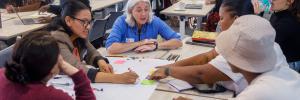
Dr. Gill Black explaining the details of context mapping to attendees during a workshop at the Creative Research Methods session
Public Squares sessions put creative methods at the heart of participatory research
- At a recent lecture and workshop series, the Public Squares Initiative invited researchers, academics, students, and community members to explore creative methods in participatory research.
- The series featured two sessions, each combining a lecture and practical workshop. Both sessions were presented and facilitated by Dr. Gill Black, a Research Fellow at CERI and an engaged research specialist.
At a recent lecture and workshop series, the Public Squares Initiative invited researchers, academics, students, and community members to explore creative methods in participatory research.
The series featured two sessions, each combining a lecture and practical workshop. Both sessions were presented and facilitated by Dr. Gill Black, a Research Fellow at CERI and an engaged research specialist.
Creative Research Methods in Participatory Research
Participatory research is a collaborative approach where stakeholders, especially those directly affected by an issue, partner as co-researchers throughout the research process. This approach creates an equitable partnership between community members and researchers regarding methodology, data collection, and analysis. But how does one bring communities into the research process? This is where creative research methods step in.
Central to the first session, titled Creative Research Methods, was the argument that creative research methods allow for more nuanced forms of expression and knowledge. “The creative arts such as drama, puppetry and music build upon emotions, gestures, and the senses to express the multifaceted nature of social and environmental challenges,” explained Dr. Black. She added that these approaches enable participants from affected communities to share knowledge “in ways that can’t always be reached by traditional qualitative research methods.”
Creative methods as a data collection process are especially relevant in healthcare and wellbeing studies where the lived experiences of affected people cannot be measured through questionnaires and surveys. Visual and creative methods such as body mapping, digital storytelling and photovoice are often less intimidating and more engaging for participants when addressing sensitive topics. These kinds of creative methods are also effective in crossing barriers of literacy and language. An example of this is hand-drawn pictures used in digital storytelling. These images are visual forms of data that can communicate a story to a wide audience regardless of the language they speak or their level of literacy.
The session concluded with a discussion on ethical considerations, underscoring the importance of informed consent and inclusivity. Careful attention must be paid to power dynamics, anonymity, and the potential for distress when working with sensitive topics, highlighting the responsibility researchers carry when engaging with participants.
Participatory Analysis of Creative Data
The second session shifted focus from data collection to interpretation. Titled Creative Methods Analysis, it explored how participants can be involved in analysing the data they produced from creative research methods.
Traditional research often positions analysis as the role of experts, whereas participatory approaches recognise it as something researchers, participants and stakeholders can do together. Dr. Black explained that creative methods generate “rich, contextualised data that can be interpreted not only by researchers, but also by participants themselves”.
At the core of the session was the idea that analysis is not only about identifying themes, but also about translating lived experience into action. “Through participatory processes, communities can convert lived experience and knowledge into research concepts and action plans that inform interventions”, said Dr. Black.
One of the case studies presented was the Water and Fire project, which worked with communities in Cape Town to address environmental risks such as flooding, fires and water shortages. The project used an iterative process, combining digital storytelling, community mapping and photovoice to build layered insights into everyday experiences of environmental risk and resilience.
Community-based co-researchers were directly involved in analysing the data they had created. They were asked to identify “one big problem” and “two best solutions” from stories, maps and photographs, before collectively grouping these into shared themes. This collaborative process allowed communities to prioritise key issues and co-develop practical, relevant responses for improving resilience.
Participatory analysis allows for unique research insights and impactful solutions. However, the process can also be emotionally and ethically demanding as it often involves revisiting trauma and loss. Concluding the session, Dr. Black stressed the importance of creating safe, supportive spaces and recognising that analysis is not only a technical process but also a deeply human one.
Reflections from the sessions
“This was a very insightful workshop. I learnt about the various kinds of creative research methods, and it was quite interesting to see how we can share perspectives and research findings in a way that is visually provoking and socially relevant” – Virginia Digomo
“It was wonderful to work in groups as it enables you to see that diversity of input and other perspectives. It also exposes how your own biases can influence your approach to research and finding answers. Creative methods show just how much richer data can be when we have the perspectives of other people” – Felicity Hartley
View the full gallery of images here.
Related stories
Events
Shaping research culture one event at a time: Reflections from the International Consortium for Research Culture (ICRC) Symposium 2026
Last week, I had the privilege of attending the International Consortium for Research Culture Symposium at Stellenbosch University in collaboration with the...
Events
Critical Health Issues of Young Women in South Africa: Engaging Experts f
On Thursday, the 17th of October, members of the public, health promoters, post-grad students, and scholars gathered for a participatory workshop at...