

Strijdom to lead biomedical sciences with focus on excellence, compassion and innovation
- Prof Hans Strijdom has been appointed Executive Head of Biomedical Sciences, aiming to build on the department’s strong foundation through three core pillars: excellence, compassion and self-accountability.
- He plans closer alignment with the Biomedical Research Institute (BMRI) and a stronger focus on diversifying research funding in response to recent global funding cuts.
- Despite his new role, Strijdom remains deeply committed to teaching, driven by his passion for students, while continuing his work as an award-winning educator and leading researcher in medical physiology.
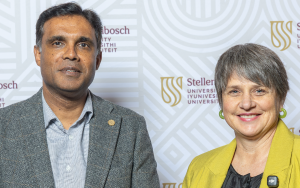
Prof Hans Strijdom, the Head of the Division of Medical Physiology at Stellenbosch University’s Faculty of Medicine and Health Sciences (FMHS), was appointed Executive Head of the Department of Biomedical Sciences last month.
“It is a very big Department, but I look forward to the challenge,” says Strijdom, who has been part of the Department since he became a lecturer in the Division of Medical Physiology in 1998.
There are currently about 200 staff members and 250 postgraduate students in the Department. “That’s a lot of people that one has to make sure are at ease and are able to do their work,” says Strijdom.
But he is quick to add that there is no need to reinvent the wheel: “My vision is to continue building on where we are. The quality of the research and teaching within the Department is already at a very high level. We need to continue the excellence.”
Three pillars: excellence, compassion and accountability
At the same time, Strijdom includes compassion as a key part of his vision. “One usually thinks of excellence as cut-throat and chasing for achievement – to be the best,” he says. “However, we should always aim for compassion, too.
“We should never forget that it is ultimately about people – whether it’s the students, the researchers or the patients that our research is trying to help one day. Because ultimately that is what biomedical research is about: the whole premise of our research is to find treatment for disease or to prevent disease.”
In addition, Strijdom points out, he is a strong proponent of self-accountability for both staff and students: “We do not micromanage, but that then requires a very high level of responsibility from all individuals for what they do.”
He refers to excellence, compassion and self-accountability as the three pillars of his vision. In addition, he says, that vision is informed by Stellenbosch University’s values and by the FMHS’s mission statement (which is currently being revised for 2027-2030).
Aligning with the BMRI and diversifying funding
Strijdom’s appointment came just weeks after his election in April as Deputy Director and Chair of the Executive Leadership Team at Stellenbosch University’s Biomedical Research Institute (BMRI).
It is therefore natural that the new institute features prominently in his plans. “The Department will soon start aligning itself with the BMRI,” he explains. “It will be very much an integrated system.”
For instance, the BMRI aims to assist in fundraising in future – firstly, to help sustain existing research but, secondly, also to look for new avenues of research. “It’s an ongoing enterprise,” says Strijdom.
However, fundraising became even more of a priority when the United States (US) announced significant federal research funding cuts last year. It was a huge setback for many South African universities.
“Our Department was affected very badly because so many of our top researchers were funded through the US’s National Institutes of Health,” says Strijdom. “The impact of that was devastating.”
For this reason, he stated in the vision statement he submitted before he was appointed that it was important to make a concerted effort to start looking for alternative research funding opportunities.
“Lessons were learnt about receiving grants from a particular source and sometimes forgetting that the allocation of those funds is often subject to changes in government priorities,” says Strijdom.
“That is why we expedited the launch of the BMRI this year so that we can start looking for alternative funding and don’t become over-reliant on a source that might end. This is one of our challenges in the next five or 10 years.”
Students at the heart of a passion for teaching
Despite the enormity of such challenges in his new position, Strijdom is determined to continue teaching as well. “Even given my new leadership responsibilities, I promised myself that I would never allow my teaching to become a victim of that,” he says. “I ring-fenced my calendar very clearly so that I can continue teaching.
“I always tell people that the one thing that makes me get up every morning is my students. I’m a passionate educator. I love interacting with young health sciences students and postgraduate students. It doesn’t mean I don’t get up for my staff, but the driving force for me through all the years has been my students.”
Strijdom’s many awards bear testimony to his passion for teaching. He has received the First Year Academy Prestige Evening award several times since 2008 for being selected as outstanding lecturer by top first-year achievers. In addition, he was nominated for the South African Association of Health Educationalists Distinguished Educator and Research Award in 2014 and 2015, and received the University’s Chancellor’s Award for outstanding merit and sustained excellence in 2025.
It is no surprise, then, that Strijdom includes teaching in his vision statement. “I would love to see the Department support the founding of a biomedical education research entity or group,” he says. “We have a lot of colleagues who have a passion for pedagogy and the scholarship of teaching but have not really had an opportunity to get together.”
Distinguished scientists and research leader
Besides being an accomplished educator, Strijdom is a highly distinguished scientist. In recognition of his work in medical physiology, he received the Physiological Society of Southern Africa Lifetime Career Achievement Award in 2024.
“My passion for medical physiology is still very strong,” says Strijdom, who followed up his MBChB with a PhD in Medical Physiology at Stellenbosch University in 2006. “My own research focuses on people with HIV and looks specifically at why people with HIV have a greater risk of developing heart disease and metabolic disease. We are trying to figure out what the underlying causes might be.”
In addition to his work as a researcher and educator, Strijdom serves as Deputy Director of the FMHS’s Centre for Cardio-metabolic Research in Africa (CARMA), which he helped to establish in 2019.
On top of that, he retains his position at the Division of Medical Physiology where he has been Head since November 2020. “The Division is up and running and my staff are supportive,” he says. “There will be times when I will have to squeeze in certain things, but my new appointment will not have a negative impact on my work in the Division.”
Department poised for success
For Strijdom, his appointment came at an opportune time. “Despite all the problems in the world and the funding crisis and the geopolitical instability, we are very well-positioned in this Faculty and this Department to take things to the next level in terms of our research and academic mandate,” he says.
“We have a wonderfully diverse campus of students and staff. We have experts in so many subject fields. We have everything in our favour right now – the current leadership, the current management and the staff and students – to really go for it.”
Related stories
Awards and milestones
Top lecturers take centre stage at TLA celebration
An accomplished audience recently gathered at the Stellenbosch Institute for Advanced Study (STIAS) for Stellenbosch University’s (SU) annual “Celebrating...
Media release
President Ramaphosa honours SU academics for global contributions to healing and science
Two of Stellenbosch University’s (SU) leading academics have been recognised with some of South Africa’s highest national honours. President Cyril Ramaphosa...
Arts, languages and social sciences
Dazzling gala commemorates Afrikaans dictionary’s centenary and ties with SU
A century of work to document the Afrikaans vocabulary in all its rich diversity was recently celebrated on the campus of Stellenbosch University (SU)...