
Two of Stellenbosch University’s (SU) leading academics have been recognised with some of South Africa’s highest national honours.
President Ramaphosa honours SU academics for global contributions to healing and science
- SU academics Prof Pumla Gobodo-Madikizela and Prof Tulio de Oliveira received national honours from Pres Cyril Ramaphosa today (19 May 2026).
- Gobodo-Madikizela received the Order of the Baobab (Bronze) for her internationally recognised work on trauma, forgiveness and reconciliation.
- De Oliveira received the Order of Mapungubwe (Gold) for his groundbreaking scientific leadership during the Covid-19 pandemic.
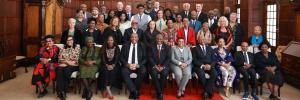
Two of Stellenbosch University’s (SU) leading academics have been recognised with some of South Africa’s highest national honours. President Cyril Ramaphosa handed over the 2026 National Orders today (19 May 2026).
Prof Pumla Gobodo-Madikizela received the Order of the Baobab in Bronze for her contribution to social cohesion and her pioneering scholarship on forgiveness, trauma and reconciliation. Prof Tulio de Oliveira has been awarded the Order of Mapungubwe in Gold for his contribution to scientific research, including the groundbreaking discovery of the Omicron variant of Covid-19.
The National Orders are the country’s highest civilian honours and recognise individuals who have made an exceptional contribution to democracy, society, science and humanity.
A scholar of the “reparative quest” and moral imagination
Gobodo-Madikizela, the 2024 Templeton Prize laureate, is the South African Research Chair in Violent Histories and Transgenerational Trauma and Director of the Centre for the Study of the Afterlife of Violence and the Reparative Quest (AVReQ) at SU.
The Presidency said she was being honoured “for her powerful work on conflict resolution and the concept of unsolicited forgiveness. Her corpus of work on the psychology of forgiveness has been recognised internationally.”
Her work has shaped international understanding of trauma, memory and reconciliation in societies emerging from violence. A former member of the Truth and Reconciliation Commission’s Human Rights Violations Committee, Gobodo-Madikizela became globally known for her landmark book, A Human Being Died that Night, based on her conversations with apartheid assassin Eugene de Kock.
Over decades, her scholarship has explored how societies reckon with historical trauma and how empathy, accountability and moral imagination might interrupt cycles of violence passed between generations.
In 2024 she received the prestigious Templeton Prize, one of the world’s most respected awards recognising contributions to humanity’s deepest questions. At the time, the John Templeton Foundation praised her efforts to “repair ruptures created by past violence and to build a path toward healing and restoration”.
Prof Deresh Ramjugernath, SU’s Rector and Vice-Chancellor, congratulated Gobodo-Madikizela and noted that her work at AVReQ has given South Africa and the world vital insights into how individuals and communities heal after conflict.
“Her work speaks directly to Stellenbosch University’s commitment to advancing knowledge in service of society and reflects the University’s broader focus on societal impact, meaningful engagement and research that contributes to human dignity, social justice and transformation,” Ramjugernath said.
Gobodo-Madikizela said her work has been about articulating the deeply human moments that are possible when societies dare to face violent histories in all their messiness. “In many ways, this honour recognises not only my scholarship on forgiveness, but also the moments in which South Africa showed its human face to the world – the moral imagination to honour humanity and to choose truth over denial. To receive this acknowledgement from my own country fills me with a deep sense of gratitude and thanksgiving. It is an honour far beyond anything I could adequately express,” Gobodo-Madikizela said.
A scientist who helped change the course of the pandemic
De Oliveira, Director of the Centre for Epidemic Response and Innovation (CERI) and the KwaZulu-Natal Research Innovation and Sequencing Platform (KRISP), has become one of the world’s most recognised scientific voices in genomic surveillance and epidemic response.
The Presidency said he would receive the Order of Mapungubwe in Gold “for his contribution in the field of scientific research with a groundbreaking discovery of the Omicron variant of Covid-19”.
Working with South African and international collaborators, De Oliveira played a leading role in identifying both the Beta and Omicron variants of SARS-CoV-2, placing South Africa at the centre of global scientific efforts to understand and respond to the pandemic.
His work earned worldwide recognition and helped establish African genomic science as a major force in international public health. In 2021, the journal Nature named him among the ten most influential scientists in the world. TIME magazine later included him among the world’s most influential people.
At SU, De Oliveira has continued building large-scale scientific collaborations focused on epidemic preparedness, genomics, artificial intelligence, and precision medicine. His research teams have supported genomic surveillance across Africa while helping train a new generation of African scientists.
He has repeatedly argued that scientific collaboration across borders is essential in combating global disease threats.
Ramjugernath noted the high calibre of expertise, innovation and societal impact reflected in De Oliveira’s work. “We warmly congratulate Prof De Oliveira on this exceptional and richly deserved recognition. This award not only honours a remarkable scientific contribution to global public health but also affirms the growing impact and leadership of African science on the world stage.”
De Oliveira gave recognition to fellow researchers as he expressed his gratitude. “I must stress that this was a team effort, and I would like to recognise some of the main contributors, including Dr Richard Lessells, Dr Jennifer Giandhari and Dr Sureshnee Pillay from KRISP at the University of KwaZulu-Natal, and Prof Houryiiah Tegally, Dr Eduan Wilkinson and Prof Cheryl Baxter from CERI, who worked day and night throughout the pandemic to advance science that saves lives,” De Oliveira said. “I would also like to recognise the dozens of scientists and colleagues from the Network for Genomics Surveillance in South Africa, a network fully funded by the Department of Science, Technology and Innovation and the South African Medical Research Council.”
Recognition for SU scholarship
The dual recognition marks a significant moment for SU, with two of its academics receiving national honours for work that has shaped both public life and global scientific knowledge.
One has spent decades examining the human consequences of violence and the possibilities of healing. The other helped the world detect and respond to one of the most dangerous public health threats in modern history.
Together, their work reflects the breadth of scholarship emerging from South African universities – scholarship rooted both in local realities and global impact.
Ramjugernath said that the institution is proud to celebrate the recognition of two of its academics’ service to the nation. “As one of Africa’s leading research-intensive universities, Stellenbosch University is proud to support scholarship that not only advances academic excellence but also helps address some of the most complex human and societal challenges of our time.”
- The National Orders investiture ceremony took place on Tuesday 19 May 2026. Watch the full ceremony here.
- Among the recipients were two honorary doctorates of the University: Mr Jonathan Kenneth Butler: For his contribution to the arts and music in particular, as a jazz, R&B and gospel singer, songwriter and producer; and, Prof Salim Abdool Karim for his contribution to medical science and public health, particularly in respect of HIV/Aids and tuberculosis research, and health policy development which is placing South Africa on the international stage.
- Read more about the National Orders here.
Related stories

Media release
Seven days of gambling could wipe out a year of national student funding
At the current rate at which South Africans gamble, it would take just seven days to spend the equivalent of the country’s entire national student funding...

Media release
Cape Winelands Airport and SU forge strategic partnership for smart and sustainable development
Cape Winelands Airport and Stellenbosch University (SU) have entered into a cooperation agreement aimed at advancing innovation under the shared themes of...

Media release
SU Policy Innovation Lab helps equip Parliament for AI
The growing influence of artificial intelligence (AI) across society is creating opportunities and new responsibilities for lawmakers.
Recognising the need for...