
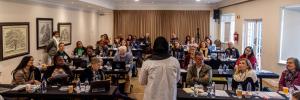
Participants at the launch of a special issue of the journal Development Southern Africa devoted to “Prioritising the Fight Against Stunting in South Africa” on 21 April 2026.
SU researchers contribute to major stunting study
- Researchers, policymakers and practitioners have come together to confront one of the country’s most persistent and complex public health challenges – child stunting.
- Stunting is not a single-sector problem. It is systemic and requires a systemic response.
- Success depends on treating stunting as a national development priority, backed by strong coordination and accountability.
A new special issue of the journal Development Southern Africa brings together leading South African researchers, policymakers and practitioners to confront one of the country’s most persistent and complex public health challenges – child stunting.
Titled “Prioritising the Fight Against Stunting in South Africa”, the publication synthesises evidence from ten peer-reviewed articles, offering what is arguably the most comprehensive, interdisciplinary assessment to date of why child stunting remains so prevalent in South Africa – and what it will take to change that trajectory.
The project was funded by the DG Murray Trust (DGMT) and draws on contributors from six universities – Stellenbosch University (SU), the University of Cape Town (UCT), the University of the Western Cape (UWC), the University of the Witwatersrand, North-West University and Nelson Mandela University – alongside the South African Medical Research Council (SAMRC), as well as policymakers and civil society organisations.
In total, 12 SU researchers played a significant role in the special issue – as authors or co-authors of five of the articles: Romeo Bhebhe, Ronelle Burger, Angela Coetzee, Scott Drimie, Lisanne du Plessis, Trust Gangaidzo, JH Nel, Benjamin Oamen, Jessica Ronaasen, Marna Smuts, Dieter von Fintel and Gabrielle Wills (she was also one of the guest editors).
The publication has its origins in a 2024 convening at SU, supported by the University’s Public Squares initiative – a programme designed to foster transdisciplinary, solutions-oriented research on complex societal challenges. A participating group, “Break Free, Grow Tall, Reach Far”, focuses specifically on child growth and development.
‘Move the needle’
The special issue was formally launched at the Devon Valley Hotel outside Stellenbosch on 21 April 2026.
Opening the event, Prof Ronelle Burger of SU’s Department of Economics, emphasised the collaborative nature of the project, with the participants united by a common goal: to “move the needle” on stunting, a crisis that has shown little meaningful improvement over time.
What is stunting?
Stunting means that a child is too short for their age, a condition caused by chronic undernutrition and other early-life deprivations.
It is not simply about physical growth. Stunting is associated with impaired brain development, poorer school performance and reduced earning potential later in life.
Crucially, stunting develops during the first 1,000 days – from conception to age two. The effects are long-lasting and often irreversible.
As the editorial notes, stunting is not just a health issue – it is a marker of structural inequality and unrealised human potential.
Bigger picture
Prof Julian May of UWC, speaking in his capacity as a member of South Africa’s National Planning Commission, painted the bigger picture.
“Children are not placed at the centre of planning across government,” he said, describing the special issue as a “call to action” – offering both a diagnosis of the problem and a roadmap for change.
From evidence to synthesis
Presenting the research findings, the lead guest editor, Prof Wiedaad Slemming of UCT, stressed that the special issue represents more than a collection of individual studies.
“We often say we lack evidence – but that’s not entirely true,” she said. “We actually know quite a lot. The problem has been fragmented evidence.”
Until now. The new publication paints a comprehensive picture of why South Africa’s stunting rate has remained stubbornly high, and what it will take to shift the trajectory.
“Stunting is not a single-sector problem,” Slemming said. “It is systemic and requires a systemic response.”
What the research shows
Across the publication, several key insights emerge.
First, the scale of the problem is difficult to measure precisely, which limits the ability to track progress and hold programmes and officials accountable. Estimates range from 20% to 30% – reflecting inconsistencies in data collection and measurement.
Second, stunting reflects cumulative deprivation, shaped by poverty, food insecurity, inadequate care and weak service delivery systems.
Third, the determinants are multifactorial, spanning health, food systems, social conditions and caregiving environments.
Fourth, while effective interventions exist, they are difficult to scale.
Policy frameworks – and their limits
South Africa has no shortage of policy frameworks, but implementation remains uneven.
Reflecting on the 2017 National Food and Nutrition Security Plan, Thulani Masilela of the Department of Planning, Monitoring and Evaluation in the Presidency said an independent evaluation found the framework to be “highly relevant”, but with “no meaningful progress in coordination and oversight structures”.
He pointed to the 2024 National Strategy for Accelerated Action for Children which places greater emphasis on stunting. It positions South Africa at a “crossroads”, where accelerated progress will depend on a multi-sectoral, whole-of-government and whole-of-society response.
Lessons from elsewhere
International experience suggests that progress is possible, if the right approach is followed.
World Bank economist Zelalem Yilma Debebe noted that stunting has declined significantly in countries that have prioritised the issue at the highest levels.
“In Peru, stunting fell by 15 percentage points over a decade,” he said, while “in Indonesia it declined by 11 percentage points in six years.”
The key lesson, he argued, is that success depends on treating stunting as a national development priority, backed by strong coordination and accountability.
From policy to implementation
Across both the research and the discussions, a consistent message emerged: South Africa’s challenge is not primarily one of resource scarcity.
The country has a relatively stable food supply, an extensive social protection system, a network of community health workers, and a strong research base.
The problem lies in how these are aligned and coordinated.
Cautious optimism
The special issue comes at a moment of renewed political attention. In his 2026 State of the Nation Address, President Cyril Ramaphosa committed the country to ending stunting by 2030.
Researchers describe this as an important signal – but caution that success will depend on whether this commitment is matched by sustained leadership, adequate financing, and coordinated implementation.
Dr Lesley Bamford of the National Department of Health said: “We need to shift from ensuring children survive to ensuring they thrive.”
In closing the launch event, Liezel Engelbrecht of DGMT framed the challenge in human terms, calling for a future in which every child is born with: “enough love, enough food, enough safety, and enough opportunity to develop.”
Burger stressed: “The ideal outcome is that it is not just another publication, but something that is read, trusted, and acted upon.”
* Development Southern Africa is a peer-reviewed journal focusing on development policy, practice and research across the region, published by Taylor & Francis. The special issue (Volume 42, Issue 6, 2025) is open access and available for free download.
* Desmond Thompson is a freelance journalist.
Related stories
Media release
New internship programme at SU clinics opens doors for aspiring medical receptionists
For many young South Africans, earning a qualification is only the beginning of a difficult journey. The next hurdle is finding the work experience employers...
Events
70 years of healing, science and humanity celebrated at FMHS gala
Every day, somewhere in South Africa, someone’s life is changed by the work of Stellenbosch University’s (SU) Faculty of Medicine and Health Sciences (FMHS)...

Awards and milestones
A quiet childhood dream propelled Dr Kevin Naude to success
For as long as he can remember, Dr Kevin Naude fostered an unspoken dream: the idea that he might one day become a doctor. Now, nearly a decade after first...