
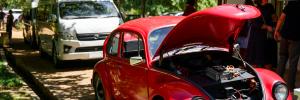
A retrofitted electric 1978 Volkswagen Beetle affectionately known as Pata-pata, as well as a converted Suzuki Carry were on display at the premiere of Recharging Hope.
SU documentary showcases ‘crazy idea’ that powered an electric bike through Africa
- Recharging Hope is a seven-part documentary series about an SU-led team's epic journey through Africa on a solar-powered bike.
- The premiere event provided an opportunity to see first-hand how electric transport solutions can be adapted for African realities.
- The documentary can be viewed on YouTube.
It travelled 6 200 km across six African countries powered only by the sun. And last week, at the premiere of a new documentary series about the epic journey, the Roam Air electric bike shared the spotlight with the team that turned a “crazy idea” into a life-changing reality.
Also on display at the premiere of Recharging Hope, hosted at the Stellenbosch Institute for Advanced Study (STIAS), was a retrofitted electric 1978 Volkswagen Beetle affectionately known as Pata-pata, as well as a converted Suzuki Carry.
Guests attending the screening of the first episode of the seven-part series, produced by videographer and expedition team member Lewis Seymour, were able to see first-hand how electric transport solutions can be adapted for African realities. There was also a demonstration of the training bench, developed by SU students in partnership with the Transport Education Training Authority (TETA), which forms part of the faculty’s practical skills development.
Two years ago, the SU-led team set off for Kenya to collect an electric motorcycle developed by Kenyan electric mobility company Roam. The company supplied two test bikes, and the initial plan was to courier the vehicles and batteries to Stellenbosch. When this proved impossible, the team designed an off-grid solution and charging operational plan, which included sizing the solar plant, inverter and battery bank, and drove the bikes home instead.
The team would not only cover 6 200 km across the continent but would do so using solar power alone. As Prof Thinus Booysen, founder of SU’s Electric Mobility Lab, admits in the documentary, his first thought was: “Don’t try this at home.”
A tale of grit
Recharging Hope offers an honest, behind-the-scenes look at the resilience, innovation and problem-solving required to turn that daring concept into reality, Booysen said. Set against the backdrop of Africa’s varied landscapes, the series documents both the technical challenges of the solar-powered journey and the fortitude demanded of every team member. It also celebrates the connections and interactions between the team and the communities they encountered. “We’re looking at the experience and the inspirational stories,” said Booysen.
In his documentary, which demanded more than 500 hours of editing, Seymour captures the harsh realities of the expedition. Battling searing heat, wind and hail, and navigating unfamiliar and at times unsafe terrain, the team overcame numerous obstacles over 17 days to reach their final destination. In a final test of endurance, they chose on the penultimate day to cover 1 000 km in 24 hours to reach the southern tip of the continent.
“As we finished the expedition in Stellenbosch with great fanfare, we realised our journey was creating momentum,” Booysen said. That momentum translated into broader institutional and industry support, enabling the team to scale the project into a documentary series for a global audience.
The team initially tried, unsuccessfully, to pitch the series to streaming platforms. Instead, they have opted to release it on YouTube, thereby ensuring accessibility far beyond traditional distribution channels. Seymour told guests at the premiere that by screening the documentary online, a child in a village in Malawi would be able to watch it. “The success of this documentary will not be measured in terms of viewership but by the significance it has and the people that it has touched.”
Partnerships and workable solutions
Speaking ahead of the screening, Prof Wikus van Niekerk, Dean of the Faculty of Engineering, emphasised the power of applied research and industry collaboration.
“Engineering is wonderful because it allows you to build and do stuff that you can touch and play with,” he said. “It’s fortunate that we work in a field where we can make these things tangible.” He added that partnerships are essential to turning ambitious ideas into workable solutions. “As a faculty, we cannot do these things without industry partners.”
The solar panels used during the expedition were supplied by Scatec, while battery energy storage was provided by Balancell. The project also received support from the South African National Energy Development Institute (SANEDI) through the LEAP-RE project.
The Suzuki Carry conversion was completed with support from corporate partners HYDAC and Balancell, illustrating how collaboration between academia and industry can translate research into real-world, African-led clean-energy innovation.
Recharging Hope chronicles the challenges and achievements of crossing six countries using nothing but solar power. It highlights the ingenuity, creativity and determination of Africa’s young engineers, while showcasing the region’s natural beauty, reflected Booysen. “Through this documentary, we are also able to show how renewable energy can change lives, especially for the most vulnerable and isolated.”
Watch: Recharging Hope YouTube channel – https://www.youtube.com/@RechargingHope
Related stories
Media release
Universities key to SA’s energy transition, Ramokgopa tells SU
Minister of Electricity and Energy Dr Kgosientsho Ramokgopa says South Africa’s energy ambitions will depend on rapidly expanding the country’s engineering and...

Media release
SU student takes African prosthetics innovation to global stage
At just 23, Stellenbosch University (SU) master’s student and NAVU Mobility founder Amohetsoe Shale is preparing for the biggest sprint of her life: access to a...

Engineering and technology
Prof Arnold Rix advances renewable energy technologies for a low-carbon future
Prof Arnold Rix from the Department of Electrical and Electronic Engineering in the Faculty of Engineering at Stellenbosch University delivered his inaugural...