
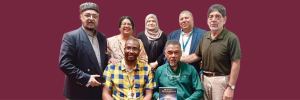
Probing discussion explores prophetic ethics in a fractured world
- A new book on the ethical legacy of the Prophet Muhammad sparked a wide-ranging interfaith discussion at the Faculty of Theology.
- Scholars reflected on how prophetic traditions across religions can guide responses to contemporary challenges such as inequality, conflict and artificial intelligence.
- The conversation emphasised dialogue, ethical living and the need for deeper human encounters across differences.
A recent book launch at Stellenbosch University (SU) evolved into a searching and wide-ranging conversation about ethics, faith and the future of humanity in an increasingly complex world.
Hosted by the Beyers Naudé Centre for Public Theology at SU’s Faculty of Theology, the event centred on the release of Prophet Muhammad at 1 500: His Prophetic Legacy, Ethical Vision and Contemporary Resonance, under the editorship of Prof Aslam Fataar, research professor in Higher Education Transformation in the Department of Education Policy Studies at SU. Rather than a conventional launch, the gathering became a reflective dialogue on what “prophetic ethics” might mean in a time shaped by global crises, deepening divisions and rapid technological change.
Dr Sipho Mahokoto, Director of the Beyers Naudé Centre, framed the session as an invitation to engage the ethical significance of the Prophet Muhammad’s legacy beyond historical commemoration. That theme was taken up by contributors who emphasised that the book seeks to re-activate prophetic ethics as a living resource for contemporary life.
Fataar described the volume as a “summoning towards a broader conversation”, bringing together 22 contributors from across disciplines to explore how the prophetic tradition might inform ethical life today. Central to the book, he argued, is the idea of a “prophetic grammar of ethical presence” – a framework for thinking about how to live justly and meaningfully in the present.
Framework for ethical leadership
Rather than simply imitating historical practices, the contributors to the book seek to emulate the ethical spirit of the Prophet in ways that respond to contemporary realities. This involves what Fataar described as a critical engagement from within the prophetic tradition, allowing for both fidelity and reinterpretation.
Dr Elias Parker, one of the coordinators of the broader Prophetic Legacy project, which published the book in partnership with AWQAFSA, placed it within a global context marked by “profound moral mismanagement” and social fragmentation. In this context, he argued, the prophetic tradition offers not only spiritual guidance but also a framework for ethical leadership, social justice and human flourishing.
If Fataar and Parker provided the conceptual scaffolding, Prof Nuraan Davids of SU’s Faculty of Education brought a deeply human and philosophical dimension to the discussion. Drawing on her own chapter, she challenged narrow understandings of religious identity and highlighted the universality of ethical responsibility.
“The word ummah (community) is not only reserved for Muslims,” she noted, arguing that it encompasses all of humanity. In a world increasingly marked by Islamophobia and polarisation, she warned that such divisions ultimately threaten everyone: Where extremist views flourish, “we are all at risk”.
Davids placed particular emphasis on education as a space for ethical formation and mutual understanding. Human diversity, she argued, is not accidental but “by divine design”, intended to enable people “to get to know each other”. This process of knowing, she suggested, is central not only to social cohesion but to spiritual understanding itself: By encountering others, individuals come to know both the Creator and themselves more deeply.
Across the discussion, participants repeatedly returned to the idea that ethics must be lived rather than merely theorised. The most profound form of religious practice, Davids argued, lies in how people treat one another in everyday life.
A call for deeper dialogue and cooperation
This emphasis on lived ethics was echoed in reflections from Prof Nico Koopman, SU’s Deputy Vice-Chancellor for Social Impact, Transformation and Personnel, who described the event as one of those rare moments that would endure in memory. He highlighted the importance of recognising religious diversity as “divinely mandated” and called for deeper dialogue and cooperation across traditions.
Yet the conversation did not shy away from complexity. Prof Simon Bekker, a sociologist, raised questions about the place of religion in an increasingly secular and technologically driven world. Drawing on sociologist Max Weber’s notion of “disenchantment”, he suggested that modernity and the rise of artificial intelligence pose significant challenges to traditional ethical frameworks, asking how prophetic ethics might “re-enchant” contemporary life.
Responding to this, Fataar cautioned against accepting narratives of loss too readily. While modernity may marginalise ethical meaning, he argued, prophetic traditions continue to travel, adapt and re-emerge in lived practice. Even in a world shaped by data and automation, ethical life remains embodied and relational, something that cannot be outsourced to machines.
The discussion also moved beyond the idea of dialogue itself. Several participants argued that what is needed is not only conversation, but encounter – forms of engagement in which people meet one another fully, beyond stereotypes and preconceptions. As Davids put it, it is “not enough to only have a conversation”; what matters is how people come into each other’s presence with openness and compassion.
This shift from dialogue to lived engagement was perhaps the most resonant theme of the discussion. Participants reflected on South Africa’s own history of interfaith solidarity, particularly during the struggle against apartheid, as a reminder that ethical cooperation across difference is both possible and necessary.
Closing the discussion, Mahokoto emphasised that the conversation does not end with the book. Instead, it marks the beginning of further engagement – through workshops, dialogue and collaboration – aimed at addressing the ethical challenges of the present.
In a world marked by division and uncertainty, the discussion suggested that prophetic ethics across traditions may offer not a set of fixed answers, but a shared language for reimagining how to live together, with dignity, responsibility and care.