
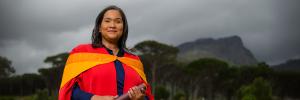
Knowledge as a meadow of wildflowers: Florence de Vries’ doctorate blossoms in tribute and triumph
- Some achievements in life require the observer to pause, reflect, and then express profound appreciation.
- Florence de Vries’ PhD in Philosophy (Journalism), that interrogates how journalism shapes mental health narratives in South Africa, falls in this category.
- Congratulations, Florence. What you have accomplished is remarkable—not only because you completed a doctorate, but because of how you did it, and what you carried with you along the way.
Some achievements in life require the observer to pause, reflect, and then express profound appreciation. Florence de Vries’ PhD in Philosophy (Journalism), that interrogates how journalism shapes mental health narratives in South Africa, falls in this category.
I want to begin by saying simply: Congratulations, Florence. What you have accomplished is remarkable—not only because you completed a doctorate, but because of how you did it, and what you carried with you along the way.
As the reader might know, Florence completed her PhD while working full-time as Manager: Marketing and Communication in the Faculty of Medicine and Health Sciences, in a complex academic environment. Anyone who understands the demands of that role will know that this alone is no small feat.
But what makes her achievement extraordinary is the perseverance and resilience she showed in the face of grief. Over the course of her doctoral journey, Florence endured profound personal loss, losing both her parents within a span of a few years—her father, Wesley, to cancer during the lonely Covid years, and her mom, Marilyn, not long thereafter. To persist under those circumstances speaks to a remarkable depth of courage and determination.
This PhD was not required for her job. There was no box to tick, no institutional expectation. It was, in her own words, “a labour of love”. And that love shines through in the care, thoughtfulness and ethical seriousness of her research.
In short, her research centred on news coverage of tennis player Naomi Osaka and gymnast Simone Biles, athletes who disrupted global expectations in 2021 when they chose mental health over competition. Florence’s work offers vital insights into how journalism portrays mental health, interrogating the frames, language and images that can either reinforce stigma or foster understanding. At a time when mental illness remains misunderstood and stigmatised, this contribution matters not only academically, but also socially and on a human level.
I cannot write this without speaking about Marilyn de Vries. Marilyn worked at the FHMS for some 13 years, and I knew her well. She was respected, admired and loved. I have no doubt that she would be immensely proud of her daughter’s achievement. In many ways, this PhD feels like a continuation of Marilyn’s own legacy of service, care and quiet excellence.
Florence’s PhD is dedicated to the memory of both her parents, “the quiet architects of who I became”. She describes her mom as someone who refused to teach her girls how to cook and subscribed them to reading clubs and pen-pal networks instead, widening their worlds deliberately. “She chose what futures to make possible.” Marilyn would also have been immensely proud that Florence is carrying this legacy forward to the next generation as portrayed by the other poignant dedication in her PhD: “To my daughter, Amelia: Knowledge is a meadow of wildflowers, fierce and wondrous. Flourishing where no one dreams life can take root.”
Her doctorate is a testament to resilience in the face of grief, to the belief that words matter—that how we tell stories can either wound or heal.
Florence, you have earned every accolade that comes your way. My wish for you is continued purpose, curiosity and fulfilment in the years ahead. May this achievement open new doors and spark new conversations.
Congratulations, Dr De Vries!
Related stories
Awards and milestones
Strijdom to lead biomedical sciences with focus on excellence, compassion and innovation
Prof Hans Strijdom, the Head of the Division of Medical Physiology at Stellenbosch University’s Faculty of Medicine and Health Sciences (FMHS), was appointed...

Awards and milestones
New SAMRC/SUN Preeclampsia Research Unit to tackle life-threatening pregnancy condition
The South African Medical Research Council (SAMRC) has established a new Extramural Research Unit (EMU) focused on preeclampsia at Stellenbosch University’s (SU...

Awards and milestones
70 years of remarkable milestones: FMHS celebrates its legacy of impact
Throughout 2026, the Faculty of Medicine and Health Sciences (FMHS) at Stellenbosch University will be celebrating a remarkable milestone: 70 years of advancing...