
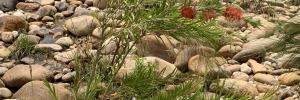
A weeping bottlebrush (Melaleuca viminalis) along the Eerste River - this species has invaded a substantial stretch of the river and is spreading rapidly downstream from Stellenbosch. Image: Dave Richardson
Eerste River study needs your help – students, hikers, landowners and other stakeholders
- The last benchmark survey was done over two decades ago.
- The invasive weeping bottlebrush has already established in a substantial stretch of the river and is spreading rapidly.
- Key data on native species that persist adjacent to invasives will offer insights on options for management.
Stellenbosch University’s Centre for Invasion Biology is embarking on a comprehensive benchmarking exercise to establish the status of plant invasions along the entire length of the Eerste River.
To achieve this ambitious goal, the public is called upon to contribute records of native and alien plants within the river and in a strip of 20 metres on both sides along the entire length of the river. A project in the citizen science platform iNaturalist, called “Eerste River plant communities”, has been created and already has more than 8700 records of over 660 plant species. This will serve as the foundation for the inventory.
The source of the Eerste River lies in the Jonkershoek Mountains at an altitude of 530 metres. From Jonkershoek, the river flows through the town of Stellenbosch before it turns south and ultimately discharges into the Atlantic Ocean in False Bay at Macassar. On its 42-kilometer journey, it flows through a variety of different landscapes – including agricultural lands (vineyards, orchards and crops), commercial forest plantations, communal grazing, industrial and urban residential areas.
According to Prof. Dave Richardson of the Department of Botany and Zoology, the first benchmark survey was done nearly two decades ago: “We need to understand how plant communities have changed over time, whether there are new invaders, and the extent to which management interventions have been successful,” he explains.
For example, his own observations recorded on the iNaturalist app over the past few years, show that the invasive weeping bottlebrush (Melaleuca viminalis) has already established in a substantial stretch of the river and is spreading rapidly.
“The Eerste River provides a classical example of river systems in Mediterranean-climate regions which often have relatively pristine upper catchments but have been heavily transformed by human activities in their lower reaches,” Richardson explains.
While it may be unrealistic to restore heavily disturbed areas to their historical states, it remains important for riparian ecosystems to remain useful in providing valuable ecosystem services, such as corridors for the movement of wildlife and preventing erosion.
“Key data on those native species that persist within and adjacent to alien-dominated communities along the Eerste River will offer insights on options for restoration”, he adds.
All interest parties are invited to help in achieving comprehensive sampling of the distribution of native and alien plants along the entire length of the river. As a large proportion of the records are from riverside vegetation within urban Stellenbosch, the team needs help to get more records from other parts of the river, both upstream and downstream of Stellenbosch.
Owners of land adjoining the Eerste River (and its tributaries) are urged to assist either by submitting records themselves or by allowing members of the project team controlled access to their land.
People who are interested in contributing are requested to contact Raphaelle Moors at [email protected] to register their interest. Several briefing/training sessions will be held along the river to ensure that records are collected in a way that will ensure their usefulness for the project.
Contact
Ms Raphaelle Moors
Email: [email protected]
Related stories
Media release
South African fynbos soil delivers a new species of soil bacterium
Microbiologists from Stellenbosch University have discovered a previously unknown bacterial genus within the phylum Acidobacteriota. It is the first genus from...
Media release
New study led by South African scientists reveals how sea-ice microbes survive the Southern Ocean’s harsh winter, with implications for climate change
A study led by scientists from Stellenbosch University reveal that during winter the sea-ice around Antarctica harbors a reservoir of microbes of which most...
Media release
Gut health: why food alone won’t fix childhood stunting
Prof. Thulani Makhalanyane, holder of the NRF-SU research chair in African Microbiome Innovation in the Department of Microbiology, and Prof. Ronelle Burger...