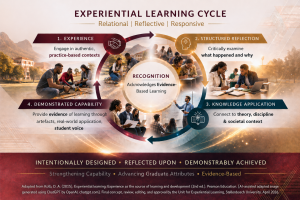
Experiential learning at Stellenbosch University follows a structured pedagogical cycle. It moves beyond participation toward intentional learning design, guided reflection, and measurable capability.
The Experiential Learning Cycle
Experiential learning is structured around four interdependent stages utilising Kolb’s (1984) experiential learning theory
Experience
Students engage in authentic, practice-based contexts that extend learning beyond traditional classroom settings.
Structured Reflection
Students critically examine their experience through guided prompts, dialogue, or written reflection, making sense of what occurred and why it matters.
Knowledge Application
Experience is explicitly connected to disciplinary knowledge, theory, professional frameworks, or broader societal contexts.
Demonstrated Capability
Students provide credible evidence of learning through artefacts, real-world application, student-voice (feedback), and assessments. Recognition evaluates the integrity of this cycle and affirms learning that is intentionally designed, reflected upon, and demonstrably achieved.