
DeLTA Framework

DeLTA
DeLTA is a framework that illustrates the iterative nature (cycle) and the steps of the teaching-learning-assessment (TLA) process. The acronym DeLTA is the title of the framework, but 'Delta' is also the mathematical symbol (∆) for change. This framework aims to achieve change in TLA at SU.
Purpose:
The DeLTA framework guides academics through the iterative and cyclical process of designing, facilitating and reflecting on TLA at SU to promote a transformative student learning experience in service of society.
To download this diagram:
Definition of each component:
 | The facilitation of learning—this includes all aspects of the DeLTA framework. |
 | Ensure that your TLA practice is responsive to context. This is about you as a teacher and your understanding of your students and their diversity, the SU environment (including your department, faculty, and discipline), the national higher education context, and the South African context and beyond. |
 | 'Intended learning outcomes' are the goals of the learning process. They describe the result of student learning after the learning activities and opportunities, i.e., what your students should be able to do by the end of the learning process. This is not about content but rather about the key concepts and underlying principles of the field of study and ways of knowing. |
 | Assessment is concerned with how well your students have achieved the intended learning outcomes. This is not about students reporting back to you what you have taught them, but rather about how well they demonstrate their understanding of the key concepts and underlying principles of their field of study. Assessment for learning focuses on learning from feedback on an assessment, while assessment of learning is planned before the learning activities but executed as part of or after those activities. Assessment as learning refers to students judging their own performance. |
 | Learning is about what the students do. The lecturer's role is to design and facilitate learning activities and opportunities that engage students and enable them to access disciplinary knowledge and succeed in the assessment. The learning activities and opportunities should also encourage lifelong learning among students. |
 | The core of good teaching is to continuously, deliberately, and deeply think about your TLA to determine whether you and your students are achieving the intended learning outcomes. Ask yourself what your TLA comprises and why, what you have learned about it, and how you could improve it. |
 | Evaluation is judging what worked or not at the end of the entire TLA process. This will show the sustainability of any initiatives made and enable you to revise the module, if necessary. |
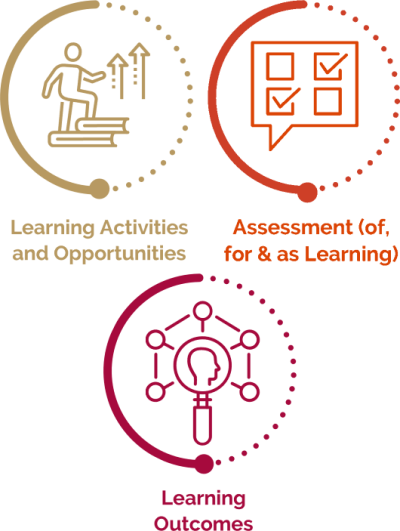 |
When designing a module, you (1) first have to be clear about what you want your students to learn by formulating intended learning outcomes, and (2) then you need to conceptualise and plan the assessment in alignment with the outcomes, whereafter (3) you design and facilitate appropriate learning activities and opportunities to prepare students to complete the assessment to demonstrate that they have achieved the outcomes or are progressing towards achieving them (Biggs, 1996).
|