
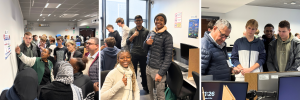
First-year engineering students present their poster projects during the ICC113 Intercultural Communication assessment
A competitive assessment approach to communication in ICC 113 for first-year engineering students
- First-year engineering students concluded their ICC113 Intercultural Communication module with a conference-style poster presentation and simulated investment activity, creating an authentic and engaging learning experience.
For the first time, first-year engineering students at Stellenbosch University concluded their Intercultural Communication course (ICC113) with a poster presentation session modelled on a conference walk-around format. What distinguished it from a conventional assessment was the addition of a simulated investment activity, in which invited guests distributed fake money to the student projects they found most convincing.
The task
Over the course of the semester, student groups investigated a real engineering problem linked to one of the United Nations Sustainable Development Goals (SDGs) - seventeen global targets addressing issues such as clean water, affordable energy and climate action. Their task was to understand the problem in both technical and human terms: who is affected, why it matters and what engineering responses have been proposed or implemented.
The poster served as the primary communication output. Rather than reproducing their written report, students distilled their findings into a single A3 design, clear enough to be understood by someone unfamiliar with the topic within sixty to ninety seconds. The brief specified five components: a problem statement, an account of the problem's impact, one or two key insights, one or two proposed innovations or solutions and a reflection on relevant social, ethical and environmental considerations.
Students were also explicitly warned against FONCE - the Fear Of Not Covering Everything - making deliberate choices about what to include and what to leave out.
The investment incentive
Lecturers from the Engineering Faculty attending the session took on the role of potential investors. Each received a pack of fake currency and a roll of stickers. They moved through the room, engaging with student groups and asking questions about the problem, its impacts and the proposed solutions. After visiting a group, they placed a sticker on that group's label and allocated their funds to whichever projects they found most compelling. The groups attracting the most investment received prizes.
The investment incentive served a clear pedagogical purpose: it required students to explain their work persuasively to an unfamiliar audience and to respond to questions in real time - the kind of communication engineering professionals encounter regularly in stakeholder briefings and community consultations.
Assessment and reflections
A consistent emphasis across the rubric is the link between global SDG issues and local South African context, with students expected to demonstrate a specific, well-justified understanding of how a problem manifests locally.
Reflecting on the module, ICC113 coordinator Prof Karin Wolff said: “As a team, we are delighted to see the reflective feedback from students describing how significantly their perception of what ‘intercultural communication’ means has shifted through their active participation in the module this semester. I am inspired by these young students and really see a great future for them all.”
By requiring students to engage with real-world problems, consider their social and ethical dimensions, and present findings to a non-specialist audience, the ICC113 poster session offers a model for how communication courses can move beyond writing exercises toward more applied learning. The initial run suggests that structured content requirements, an authentic audience and a light competitive element together create meaningful engagement for first-year students.
ICC113 Intercultural Communication forms part of the first-year engineering curriculum at Stellenbosch University.
Related stories

Awards and milestones
Two SU lecturers combine academic accountability and financial freedom in unique stokvel
A stokvel that funds education, fights procrastination and invests in community upliftment has earned two Stellenbosch University (SU) lecturers top honours at...
Media release
SU opens unique immersive technology lab
Imagine standing beneath a star-filled night sky rendered in real time or watching a lecturer guide students through the inner workings of the human brain at...

Innovation and entrepreneurship
Local, lekker and affordable – SU students develop innovative food delivery app
Two Stellenbosch University (SU) students have found a way to tackle food insecurity, support local food vendors, and improve access to affordable meals — all...