
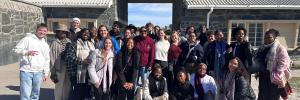
Head Mentors reflect on leadership and transformation during Robben Island visit
- A group of Stellenbosch University (SU) Head Mentors recently visited Robben Island as part of the SU Mentor programme’s experiential learning curriculum focused on intellectual and spiritual wellness.
- The visit created an opportunity for student leaders to engage critically with South Africa’s history while reflecting on leadership, social justice, and their own role in shaping inclusive student communities.
- A total of 34 Head Mentors participated in guided tours of the island, visited historical prison sites and exhibitions, and listened to stories shared by former political prisoners.
A group of Stellenbosch University (SU) Head Mentors recently visited Robben Island as part of the SU Mentor programme’s experiential learning curriculum focused on intellectual and spiritual wellness. The visit created an opportunity for student leaders to engage critically with South Africa’s history while reflecting on leadership, social justice, and their own role in shaping inclusive student communities.
The Mentor programme, housed within the Centre for Student Life and Learning (CSLL) in the Responsibility Centre: Dean of Students, focuses on supporting first-year students through peer mentorship, leadership development, and holistic student support. Over the years, the programme has increasingly incorporated experiential learning opportunities aimed at helping student leaders engage with identity, belonging, transformation, and ethical leadership beyond the classroom.
According to Dr Joy Petersen, First-Year Student Experience Coordinator within CSLL and co-founder of the SOAR programme for first-generation students, the Robben Island visit formed part of the programme’s broader developmental approach to leadership training.
“The visit to Robben Island formed part of the mentor programme’s experiential learning approach, which encourages student leaders to engage critically with South Africa’s history, identity, and social realities beyond the classroom. The purpose of the visit was not only educational, but also developmental – to create space for reflection on leadership, social justice issues, reconciliation and restitution.”
Petersen explained that the experience also aligned closely with the programme’s intellectual and spiritual wellness focus.
“The visit linked directly to the programme’s intellectual and spiritual wellness focus by encouraging students to reflect on values, purpose, empathy, ethical leadership, and human dignity.”
A total of 34 Head Mentors participated in the fieldtrip as part of their leadership development journey. During the visit, students engaged in guided tours of the island, visited historical prison sites and exhibitions, and listened to stories shared by former political prisoners.
Petersen said the experience challenged students to think more deeply about leadership and their responsibilities within diverse student communities.
“Themes such as privilege, inequality, identity, resilience, and the responsibilities of leadership were subliminally woven into the discussions – challenging students’ understanding, perceptions and conditioning – an exercise in confrontation, disturbance, and enrichment.”
Many students were particularly impacted by the personal stories shared during the tour and the resilience demonstrated by prisoners under apartheid.
“Many students found the prison cells and personal stories shared during the tour especially moving. Hearing firsthand or deeply personal accounts of life under apartheid made the history feel immediate and human rather than distant or abstract.”
Petersen added that several moments during the visit left a lasting impression on the group.
“The stories of the intellectual and well-educated prisoners teaching their not so literate compatriots, and the number of university degrees attained during incarceration, were deeply inspiring and encouraging.”
She noted that Robert Sobukwe’s prison cell and the reality of his solitary confinement particularly affected many of the Head Mentors.
“Of particular significance was Robert Sobukwe’s prison cell and the solitary confinement he had to endure – this was a bitter pill to swallow.”
Reflecting on the broader significance of the experience, Petersen emphasised that student leadership in South Africa cannot be disconnected from the country’s historical context.
“It is important for student leaders to engage with spaces like Robben Island because leadership in South Africa cannot be separated from history, inequality, and the ongoing work of transformation. Understanding the past helps student leaders approach their roles with greater empathy, awareness, and responsibility.”
She also highlighted the importance of engaging critically with Stellenbosch University’s own institutional history.
“Given Stellenbosch University’s historical association with apartheid-era structures and ideologies, the experience encouraged Head Mentors to think deeply about institutional memory, accountability, transformation, and the responsibility of current student leaders in fostering inclusion and healing on campus.”
One Head Mentor who attended the trip described the experience as both emotional and deeply meaningful.
“The trip to Robben Island was a sobering experience which allowed us to learn more about our country's painful past. Hearing the stories of past prisoners and the history of the island highlighted the gravity of the price people paid for our freedom. It was an honour to walk the same path and be reminded of who is to thank for the life that we live today.”
Related stories

Institutional news
Four SU finalists in running for SA’s prestigious ‘Science Oscars’
Four finalists from Stellenbosch University (SU) will represent the institution at the 2025/2026 National Science and Technology Forum (NSTF)/South32 Awards whe...
Education
SU’s TLA Day confronts the future of learning and teaching in the age of AI
Artificial intelligence (AI) dominated many of the conversations at Stellenbosch University’s (SU) first Teaching-Learning-Assessment (TLA) Day. The event...

Institutional news
Fadzai sets her sights on a global career
Growing up in Harare, Zimbabwe, Fadzai Priscilla Zonke never imagined she would one day pursue a career in Animal Science. At school, mathematics was her...