
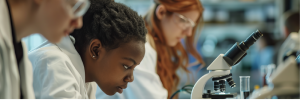
Women scientists are making significant contributions in both academia and industry.
Women in STEM are solving real-world problems
- Women scientists contribute to solutions to real-world problems and flexible ways of thinking.
- Women advance science in the academia and through entrepreneurship and product development.
- Mentorship, broader exposure, and more inclusive recognition can attract more women and girls to science.
Women in science are solving real-world problems not only by discovering new materials or refining experiments, but by redefining what counts as a problem and what counts as a solution. They are turning pollution into possibility, risk into responsibility, and waste into worth, while opening doors for the next generation to walk through. This is the view of Dr Bambesiwe May (African Rainbow Minerals Chair in Geometallurgy in the Department of Earth Sciences) in an opinion for the Mail & Guardian in celebration of the International Day of Women and Girls in Science on 11 February.
Read the original article below or click here for the piece as published.
The International Day of Women and Girls in Science is celebrated every year on 11 February to recognise the outstanding contributions of women in science, technology, engineering, and mathematics (STEM), and to help close the gender gap in these fields. Women in STEM contribute not only to solutions to real-world problems, but also to flexible ways of thinking that can be applied across sectors and contexts. As a woman scientist, this day matters because it highlights the successes of women in STEM while also drawing attention to the obstacles that prevent us from achieving parity.
My journey into science did not begin with a grand plan. It began with curiosity. I excelled in chemistry at school, and the most obvious path seemed to be laboratory work, analysing samples, following protocols, and producing results. At the time, I imagined a quiet career inside a laboratory rather than one that engaged with policy or society.
What transformed this narrow vision was mentorship. During my undergraduate studies, a lecturer saw potential in me that I did not yet recognise in myself. He did more than teach me experiments; he taught me how to think critically, how to write clearly, how to present confidently, and how to claim my voice in scientific spaces. Through him, I learned that scientists do not only analyse, but also create knowledge, influence decisions, and shape society. He encouraged me to pursue a master’s degree even when I believed my undergraduate studies were enough.
Equally important was exposure. With his support, I travelled outside South Africa for the first time to present my work in Japan. That experience changed my mindset from asking “can I do this?” to believing “I belong here.” Exposure to different cultures, research environments, and professional networks expanded my imagination of what a STEM career could look like.
These experiences gradually converged into purpose. During my PhD, I encountered a persistent real-world environmental problem: large volumes of mine waste that threatened ecosystems and communities while still containing valuable materials. Instead of accepting waste as an inevitable liability, I became fascinated by whether it could be transformed into an asset. That curiosity has guided my work ever since.
Today, I help South Africa rethink waste. I developed a framework that evaluates environmental risk, explores the potential of waste being turned into valuable resources (valorisation), and reassesses risk after beneficiation. The aim is not reckless recycling, but responsible transformation. The framework provides a credible evidence base that can support waste declassification and inform policy decisions.
This work sits at the intersection of science and governance. Policymakers need robust data to decide whether a material should remain regulated as hazardous waste or be reclassified as a resource. Industry needs clear pathways to innovate sustainably. Communities need assurance that environmental protection is not being compromised. My framework helps align these interests by showing when valorisation can reduce pollution, conserve resources, and create economic value simultaneously.
The framework is now being actively piloted internationally in other waste streams. For example, in Tanzania, collaborators are applying it to textile waste, exploring how industrial residues can be transformed into safer, useful materials. In Ethiopia, our partners are adapting it to agricultural biomass and invasive water hyacinth, testing pathways that convert environmental problems into productive resources. These are not conceptual interests; they are real, ongoing projects beyond South Africa.
However, individual success stories are not enough. If we want more women and girls to thrive in STEM, we must move from luck to structure.
First, we need intentional mentorship. I was fortunate to have mentors who invested in my growth and advocated for me. Institutions should formalise mentorship programmes that nurture both competence and confidence.
Second, we need earlier and deeper exposure to science. Inspiration cannot wait until university. Through the Kwande Education Foundation, I am working towards environmental education bootcamps that bring high-school learners, especially girls, into laboratories, field sites, and research spaces during school holidays so they can experience science as practical, creative, and socially meaningful. We have also piloted the idea of structured exposure in practice through a multi-stakeholder Geochemistry Graduate Internship Programme supported by funding from the Human Sciences Research Council. The programme rotates one graduate across three environments over two years: Stellenbosch University’s Central Analytical Facilities Laboratory, the African Rainbow Minerals Research Chair in Geometallurgy Chair, and Digby Wells Environmental. Rather than placing a graduate in a single organisation, this model intentionally broadens their horizon, allowing them to experience laboratory science, applied research, and environmental consulting. This exposure is designed to expand imagination, build competence, and open doors so that young scientists can make more informed career choices about their future in STEM.
Third, we must build networks that multiply opportunity. Growth in science rarely remains individual; it becomes collective through relationships. Schools, universities, and industry should create platforms where young women can meet researchers, engineers, entrepreneurs, and policymakers so that networks become part of the system rather than a privilege.
Fourth, mentorship must include advocacy. Early in my postdoctoral career, I refused to supervise a master’s student without funding because I know how financial insecurity can derail academic potential. I actively sought institutional seed funding for her, and we succeeded. True mentorship means fighting for resources, not only giving advice.
Finally, we must broaden how we recognise women in science. Accolades such as the L’Oréal–UNESCO For Women in Science and the South African Women in Science Awards are powerful because they signal belonging and excellence. Yet science is not practiced only in universities or measured only by master’s and PhD degrees. Many women advance science through entrepreneurship and product development.
Women who design sustainable skincare products, develop cleaning formulations, create biotechnology-based wines, or build science-driven businesses are also doing science through experimentation, testing, iteration, and evidence-based decision-making. Recognition systems should make room for these contributions, while still valuing formal research pathways.
If a 16-year-old girl were to read this article, I would want her to feel inspired above all else. I would want her to know that curiosity is enough to begin, that uncertainty is normal, and that science is wide enough to welcome her, whether she becomes a researcher, engineer, entrepreneur, or policymaker.
Women in science are solving real-world problems not only by discovering new materials or refining experiments, but by redefining what counts as a problem and what counts as a solution. We are turning pollution into possibility, risk into responsibility, and waste into worth, while opening doors for the next generation to walk through.
The work is far from finished. But with stronger mentorship, broader exposure, deeper networks, and more inclusive recognition, more women and girls will not only enter science — they will reshape it.
*Dr Bambesiwe May is a postdoctoral researcher at the African Rainbow Minerals Chair in Geometallurgy in the Department of Earth Sciences at Stellenbosch University.
Related stories
Opinion and features
Mandela Day: Madiba’s life a reminder that liberation, journey to freedom continue
Nelson Mandela’s life reminds us that liberation is never a completed matter but an ongoing responsibility, and that the road to freedom is never truly finished...

Opinion and features
How emergency procurement fuels corruption – and how to prevent it
Bribery, the embezzlement of public funds, conflicts of interest, the unethical exchange of confidential information, and the steering of contracts and...
Opinion and features
Entrepreneurship hubs, right skills can help reduce youth unemployment
During Youth Month, one of the key issues highlighted was the difficulty many young people face in finding work. In opinion pieces for the media, Luluto Mgweba...