
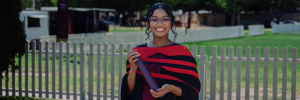
SU mentors shaped Handré Muller’s path to mastering science
- Handré Muller graduated with a master’s degree in physiological sciences from Stellenbosch University.
- A school outreach visit by SU academics sparked her passion for science and set her on a path into research.
- Her achievements show the power of mentorship, perseverance and the long-term impact of investing in young minds.
In 2019, a group of Stellenbosch University (SU) academics walked into a classroom at Lückhoff High School in Stellenbosch to demonstrate life sciences practicals. For Handré Muller, a matric learner at the time, it was the moment everything changed.
Until then, science had existed only in textbooks – diagrams, definitions and exam papers. That day, it came alive and left a lasting impression.
“I witnessed experiments unfold in real time,” Muller recalls. “I remember that Dr Balindiwe Sishi demonstrated a DNA extraction from strawberries. During another visit to our school, the Stellenbosch University academics showed us how you would test for different blood groups. I was fascinated by these experiments,” she marvels.
“I saw scientists who were not only knowledgeable but approachable and invested in young minds. In that moment, science shifted from something abstract to something tangible, something I could belong to.”
A family connection to Stellenbosch
Muller was born in Ceres and her family moved to Cloetesville in Stellenbosch, where she attended primary school, later completing her high school education in Ida’s Valley.
Education has long been a cornerstone of her family’s story. Her grandfather, Hendrik Damonse, worked for 36 years as technical support staff in SU’s Department of Physics, while her mother, Lisette, obtained a BA in Social Work from the University in 1989. Her sister, Francé, also studied at SU, completing a BA in Humanities and an honours degree in Afrikaans and Dutch in 2019.
“Education has always been a big priority in our family,” Muller remarks.
Inspired by this legacy, she entered SU as a first-year student determined to pursue a career in science.
Muller enrolled for a BSc in Human Life Sciences with psychology, eager to immerse herself in campus life. Yet within a month, the Covid-19 pandemic reshaped her university experience.
“Lecture halls were replaced with screens and laboratories with simulations,” she says.
For more than two years, her studies unfolded largely online – a far cry from the hands-on scientific training she had imagined. But rather than dampening her enthusiasm, the disruption deepened her interest.
“My fascination with human physiology and disease mechanisms grew even stronger,” she reflects.
In 2023, when she began her honours in physiological sciences, Muller finally stepped into the laboratory spaces she had envisioned years earlier. It was here that her journey came full circle.
She reconnected with the very academics who had visited her school in 2019 and, without hesitation, chose Dr Sishi and Dr Danzil Joseph as her supervisors.
“What had once been a high school outreach demonstration had now become my reality,” she says.
From observation to contribution
Under their guidance, Muller completed her master’s degree in human physiological sciences, focusing on the effects of chemotherapy on vital organs such as the heart and liver.
Her research examined the molecular mechanisms underlying doxorubicin-induced organ toxicity, with particular attention to oxidative stress and the pathways involved in cellular injury.
In simple terms, her work explored a critical tension in modern medicine. “It shows how a life-saving chemotherapeutic agent can simultaneously cause harm to healthy tissues,” she explains.
The findings highlight the importance of a more integrated approach to cancer treatment. “When someone is diagnosed with cancer, it is not only the oncologist who should be involved,” she says. “Specialists such as cardiologists and endocrinologists should ideally also form part of the treatment process.”
Over time, Muller’s role evolved from observer to contributor.
“I moved from watching experiments to designing them, from learning established knowledge to contributing new insights,” she says.
Creating space for others
As she prepared to graduate, Muller sees her achievement as part of a much larger story. “This represents perseverance through uncertainty, growth through challenge, and the power of mentorship,” she reflects.
She is particularly conscious of what her journey represents for others. “I stand here today as the product of people who believed in me,” she says. “What may seem like a small gesture – a school outreach or a word of encouragement – can quietly alter the trajectory of someone’s life.”
Looking ahead, Muller hopes to build a career in academia, combining research with teaching.
“I’ve always wanted to work in academia and perhaps become a lecturer. I want to share my knowledge and educate people in our communities about lifestyle diseases.”
As a young coloured woman in STEM (science, technology, engineering and mathematics), she is also committed to creating opportunities for others.
“I hope to contribute meaningfully to the scientific field, but also to create space and representation for those who may one day see themselves reflected in this journey.”
Her message to young people is simple but hard-won. “Your voice matters, and your presence in science is powerful,” she stresses. “Never underestimate the value of your perspective – what makes you different is exactly what the world needs. Stay curious, stay resilient, and remember that your journey is uniquely your own. Never compare yourself to others. Make the most of the opportunities you are given.”
What began as a single classroom demonstration has grown into a scientific career rooted in curiosity, resilience and purpose. “The seed that was planted in 2019 did not remain small,” Muller says. “It took root, it was nurtured, and today it has grown into something far greater than I could have imagined.” And for this young scientist, that growth is only just beginning.
Related stories
Media release
New internship programme at SU clinics opens doors for aspiring medical receptionists
For many young South Africans, earning a qualification is only the beginning of a difficult journey. The next hurdle is finding the work experience employers...
Media release
Stellenbosch University researchers and international partners develop global ‘Declaration on Multilingual Healthcare’
Patients who do not speak the same language as their healthcare providers are disadvantaged worldwide when it comes to accessing healthcare services and...

Media release
Seven days of gambling could wipe out a year of national student funding
At the current rate at which South Africans gamble, it would take just seven days to spend the equivalent of the country’s entire national student funding...