

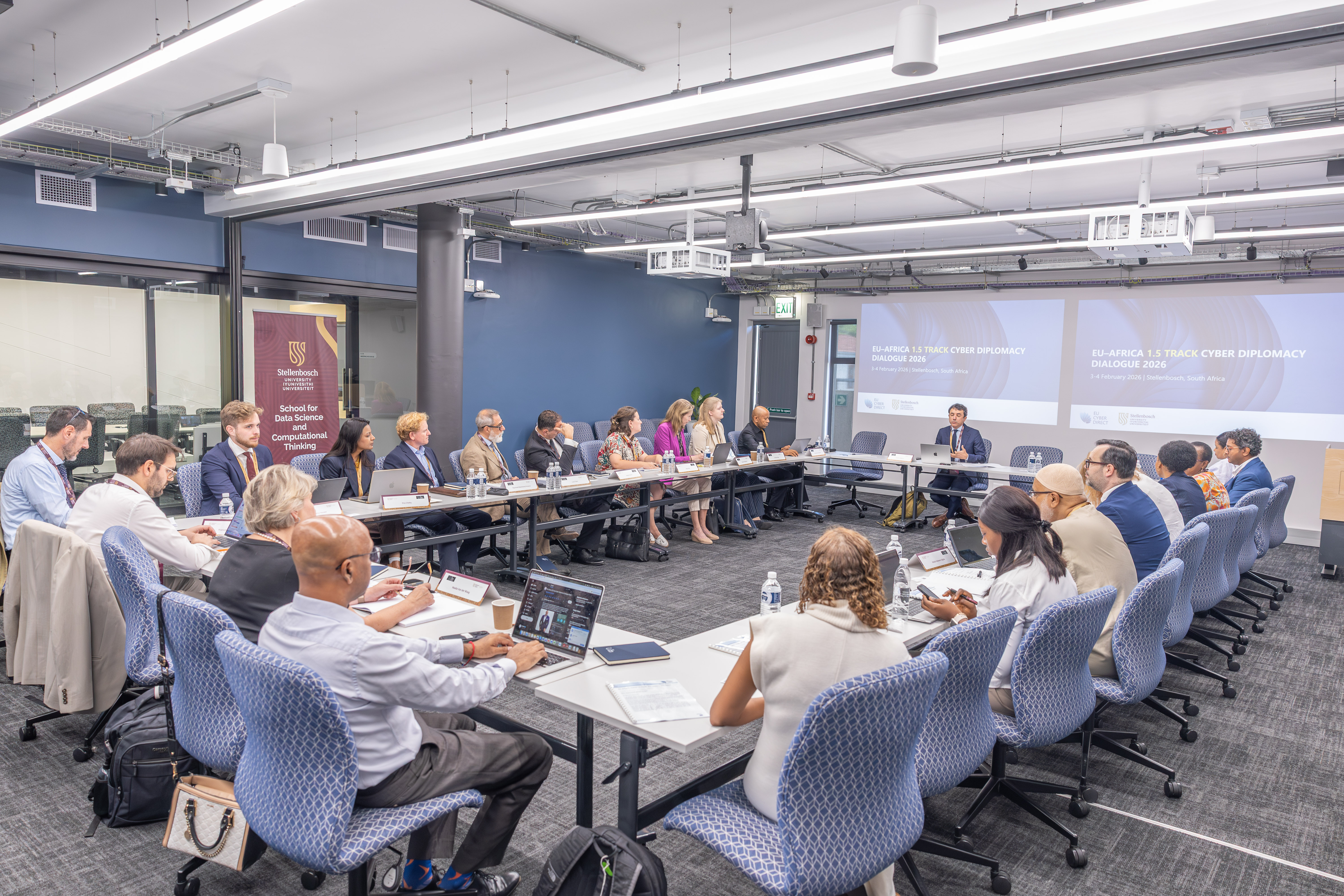
Stellenbosch University’s (SU) School for Data Science and Computational Thinking recently hosted the EU–Africa Track 1.5 Cyber Diplomacy Dialogue, bringing together leaders from government, industry, academia and civil society to tackle pressing cybersecurity challenges.
SU hosts landmark EU–Africa Cyber Diplomacy Dialogue
- The EU–Africa Track 1.5 Cyber Diplomacy Dialogue brought together leaders from government, industry, academia and civil society to tackle pressing cybersecurity challenges.
- The diplomatic corps in South Africa, led by the Ambassadors of Austria and Italy, also participated.
- It has established a historic platform for future EU–Africa cybersecurity cooperation.
Stellenbosch University’s (SU) School for Data Science and Computational Thinking recently hosted the EU–Africa Track 1.5 Cyber Diplomacy Dialogue, bringing together leaders from government, industry, academia and civil society to tackle pressing cybersecurity challenges.
Held on 3 and 4 February, the Dialogue convened representatives from the European Union, African Union, EU Cyber Direct, the South African Development Community (SADC) and countries such as South Africa, Ghana and Mauritius. The diplomatic corps in South Africa, led by the Ambassadors of Austria and Italy, also participated. Track 1.5 Dialogues are designed to foster open discussions across sectors and borders, combining official perspectives with expert insights.
Prof Kanshu Rajaratnam and Noëlle van der Waag-Cowling of the School for Data Science and Computational Thinking welcomed delegates on the first day, setting the tone for a dynamic exchange of ideas. Over the two days, discussions focused on digital transformation, responsible state behaviour in cyberspace, and opportunities for joint capacity building.
Manon le Blanc, Coordinator for Cyber Issues at the EU External Action Service, described the event as “a milestone moment for EU–Africa cyber cooperation”. Delegates engaged in frank dialogue about cyber policy, best practices and collaboration during systemic cyber events, reflecting shared challenges and the importance of geographical and strategic proximity between the continents.
The second day included a cross-continental cybersecurity response scenario exercise, which offered valuable insights into crisis response architectures and highlighted potential areas for future capability development. The Dialogue concluded with a visit to a submarine cable landing station on the West Coast, where delegates were briefed on the infrastructure and technologies that underpin global marine cable networks – an essential component of international connectivity.
The Track 1.5 Cyber Diplomacy Dialogue has established a historic platform for future EU–Africa cybersecurity cooperation, notes Van der Waag-Cowling. “For African nations, it presents a unique opportunity to leverage initiatives such as the EU’s Global Gateway Project to strengthen cybersecurity capabilities amid a rapidly digitising continent.”

Related stories

Events
Prof Mesias Alfeus’s vision brings global finance congress to Africa
The announcement that Stellenbosch University (SU) will host the 14th World Congress of the Bachelier Finance Society (BFS) in 2028 – the first time the...

Arts, languages and social sciences
Building community through multilingualism at SU Teaching-Learning-Assessment Day
Multilingualism should be seen not merely as a policy requirement, but as a powerful tool for learning, participation and belonging in higher education.
This was...

Media release
Seven days of gambling could wipe out a year of national student funding
At the current rate at which South Africans gamble, it would take just seven days to spend the equivalent of the country’s entire national student funding...