

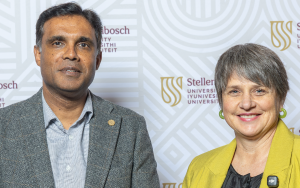
From left to right: Prof. Tulio de Oliveira, Director of CERI; Brandon Paschal, Deputy-Director for Spin-out Companies and Funds at SU LaunchLab; Dominique Rocher, co-founder of Urobo Biotech; Dr Richard Gordon, Director of Special Programmes at the South African Medical Research Council and Maambele Khosa, Head of Communications and Marketing at CERI.
SU biotech spin-out bags SWEAT Africa 2026 pitch prize
- Urobo Biotech claimed the R100 000 grand prize at the high-profile two-day SWEAT Africa 2026 event.
- Fellow SU spin-out companies ReSurfify and Nanosene also showcased their innovations, underlining the University’s growing footprint in Africa’s startup landscape.
- The event aligned with SU’s Vision 2040 strategy’s strategic focus on purposeful partnerships and inclusive networks.
A Stellenbosch University biotech spin-out competed against some of the best startups in Africa to clinch the top prize at the 2026 SWEAT Africa pitch competition.
Urobo Biotech claimed the R100 000 grand prize at the high-profile two-day event held this month at the Bertha Retreat in Stellenbosch, where more than 100 innovators and 50 investors gathered to scout breakthrough technologies. Fellow SU spin-out companies ReSurfify and Nanosene also showcased their innovations, underlining the University’s growing footprint in Africa’s startup landscape.
Urobo Biotech co-founder, Dominique Rocher, said winning SWEAT Africa affords the company both visibility and critical resources at a pivotal stage. “The prize funding allows us to convert current pilots into commercial sales by expanding local technical capacity and strengthening South Africa’s growing biotech ecosystem. This accelerates our ability to deploy our technology that uses enzymes to convert bioplastic waste into circular chemicals, reducing costs and environmental impact for waste operators.”
She emphasised that SU, LaunchLab and the Innovus Technology Transfer Office (TTO) have been instrumental in providing mentorship, lab access, and business guidance.
“Their ecosystem enabled us to refine our business strategy, validate our technology, and connect with investors, giving us the confidence and preparation needed to compete, and win, at a platform like SWEAT Africa. It is also due to their efforts in creating and hosting the biotech and hardtech (advanced manufacturing devices) SWEAT Africa Pitching contest that we could compete on a stage in front of investors and other key ecosystem players,” she said.
SWEAT Africa is an initiative that reflects the energy, creativity, and collaborative spirit needed to grow Africa's innovation ecosystem, bringing together venture capitalists, founders, researchers and ecosystem builders to shape the future of African entrepreneurship.
“The idea behind SWEAT was simple; to create a space where founders, investors, scientists and students can have real conversations; not just pitch decks, but honest discussions about building, failing, scaling and collaborating across Africa,” said Prof. Tulio de Oliveira, Director of the Centre for Epidemic Response and Innovation (CERI),co-founder and host of SWEAT Africa.
The event aligned with SU’s Vision 2040 strategy’s strategic focus on purposeful partnerships and inclusive networks. With the main organisation done by CERI, SU in collaboration with LaunchLab, the Stellenbosch Network and other universities and ecosystem builders, hosted the event with the aim of strengthening collaborations that extend beyond campus boundaries. In this way, SWEAT Africa nurtures relationships that promote knowledge exchange, entrepreneurship and innovation that contribute to social impact.
“Innovation does not happen in isolation. It requires strong ecosystems — spaces where researchers, entrepreneurs, investors, industry partners and students come together to co-create solutions that are relevant, sustainable and scalable,” said Prof. Deresh Ramjugernath, SU Rector and Vice-Chancellor.
“Universities have a particularly important role to play. At SU, we believe deeply in innovation-driven entrepreneurship and in building partnerships that extend beyond institutional boundaries. SWEAT Africa represents exactly this kind of collaborative platform, one that connects talent, ideas and opportunities across Africa.”
Panel discussions during the event explored how investment in higher education institutions and their spin-out companies can accelerate the translation of research into investable ventures. SU spinouts, ReSurfify made it to the Top 10 of the SWEAT Africa biotech and hardtech pitch competition, while Nanosene was among the deep-tech companies presenting breakthrough technologies during a session hosted by the BRAIN (Bridging Research and Innovation) Accelerator. Another programme highlight was the SWEAT Equity Programme which introduced young innovators to entrepreneurship and ecosystem building.
“Beyond generating knowledge, we must actively help to translate research into real-world impact, supporting entrepreneurship, enabling collaboration, and ensuring that innovation contributes meaningfully to society and the economy. We are proud to support this initiative and to work alongside partners to share a commitment to strengthening Africa's innovation future,” said Ramjugernath.
Related stories
Awards and milestones
Top lecturers take centre stage at TLA celebration
An accomplished audience recently gathered at the Stellenbosch Institute for Advanced Study (STIAS) for Stellenbosch University’s (SU) annual “Celebrating...
Media release
President Ramaphosa honours SU academics for global contributions to healing and science
Two of Stellenbosch University’s (SU) leading academics have been recognised with some of South Africa’s highest national honours. President Cyril Ramaphosa...
Arts, languages and social sciences
Dazzling gala commemorates Afrikaans dictionary’s centenary and ties with SU
A century of work to document the Afrikaans vocabulary in all its rich diversity was recently celebrated on the campus of Stellenbosch University (SU)...