
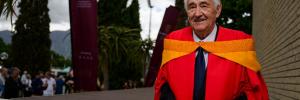
Renowned radiologist Emeritus Professor Jan Lotz obtained his PhD in Applied Ethics from Stellenbosch University at the age of 78.
Purpose amid the pain – renowned radiologist Prof Jan Lotz graduates with a PhD at 78
- Renowned radiologist Emeritus Professor Jan Lotz obtained his PhD in Applied Ethics from Stellenbosch University at the age of 78.
- The murder of his only daughter, Inge, in 2005 profoundly shaped his life. Teaching and mentoring young registrars became his source of purpose and healing, and his PhD thesis is dedicated to her.
- After suffering a traumatic brain injury and months of recovery, Lotz overcame significant physical and cognitive hurdles to complete his PhD.
At 78, an age when many of his peers are enjoying a quiet retirement, Emeritus Professor Jan Lotz has crossed the podium to receive his PhD in Applied Ethics from Stellenbosch University (SU) during the December graduation ceremony.
The septuagenarian retired from SU’s Division of Radiodiagnosis after occupying a funded academic associate professorship sponsored by a consortium of private radiological practices between 2005 and 2017. During these years, he assumed responsibility for the modular postgraduate teaching programme in the Division of Radiodiagnosis. Since retirement, he has been serving as Emeritus Professor of Radiology (Academic) in the Division of Radiodiagnosis for the past eight years.
The position allowed for a new chapter of learning and contribution, says Lotz. “It gave me the opportunity to work alongside brilliant young people keen to study.”
It also provided a lifeline during the dark days following the murder in 2005 of his only daughter.
He describes the tragic death of Inge, who was a 22-year-old SU student at the time, as “one of the worst tragedies any human can suffer” and admits that there were many days when he asked himself if it was worth “going on”. Being able to teach and mentor young registrars gave him “something to live for”, he says.
The memory of Inge, two decades after her death, remains a quiet source of strength and motivation for Lotz.
Under “Acknowledgements” in his PhD thesis, after thanking his supervisors, it says simply: “For Inge”.
Exploring new fields
After decades in clinical medicine and teaching, the well-known radiologist also immersed himself in the field of applied ethics, completing a Postgraduate Diploma and an MPhil (in 2020) before beginning his doctoral research. Lotz’s PhD evaluates the ethical foundations of South Africa’s proposed National Health Insurance (NHI), engaging critically with some of the most pressing moral questions shaping the country’s future health-care landscape.
Highly accomplished and respected in his field, Lotz is no stranger to career milestones. He also distinguished himself in the medicolegal field, providing expert opinion on concluded and ongoing civil actions relating to newborns with brain damage from not receiving enough oxygen or blood. He estimates he was involved in around 250 cases, adding: “I can’t remember ever losing a case.”
But this particular academic recognition resonates more deeply, he says, speaking from his sun-dappled office surrounded by books collected over a lifetime of learning and study.
Overcoming challenges
A serious fall shortly after he submitted his dissertation ahead of the March graduation earlier this year resulted in a traumatic brain injury. He was in a coma for three weeks and spent months in hospital and rehabilitation, at times with no certainty that he would recover fully, let alone return to the demanding intellectual work of finalising his PhD.
What followed was a slow, determined recovery marked by resilience, discipline and steadfast hope. Against formidable odds, he regained his strength and completed his oral examination, clearing the final hurdle to graduation. He now experiences a balance deficit and short-term memory loss.
Closure and celebration
This PhD also marks the “end of the road” for a medical practitioner who has committed much of his life to helping others. “I have given my medical books away,” he says with finality. There will be no more lectures, no more consultations about hypoxic-ischaemic injury in infants. It is a moment of closure as much as celebration. “This is not the life we (Lotz and his wife, Juanita) wanted – to be all alone. But we managed to live through this huge tragedy. The only way to survive it was by giving back, especially to young people.”
It is therefore particularly poignant for Lotz to graduate alongside Gaenor Michel, who received a scholarship to complete her PhD, funded partially by the R1 million donation that the Inge Lotz Foundation made to the University’s Unit for Bioethics in 2021. The Foundation was established in Inge’s memory.
“It has been a privilege to assist her,” says Lotz, whose first meeting with Michel was delayed by his fall. He described the opportunity to graduate during the same ceremony as “something special for both of us”.
Related stories
Media release
Career Day inspires future lawyers to carry Mandela’s legacy forward
Three decades after South Africa adopted one of the world’s most progressive constitutions, more than 150 aspiring lawyers gathered at Stellenbosch University...
Media release
New internship programme at SU clinics opens doors for aspiring medical receptionists
For many young South Africans, earning a qualification is only the beginning of a difficult journey. The next hurdle is finding the work experience employers...
Media release
Stellenbosch University researchers and international partners develop global ‘Declaration on Multilingual Healthcare’
Patients who do not speak the same language as their healthcare providers are disadvantaged worldwide when it comes to accessing healthcare services and...