
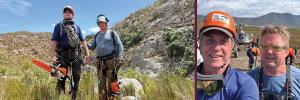
Leon Visser (64) was among 21 volunteers who were dropped on the mountain peaks of Boosmansbos, where they proceeded to clear 16 276 invasive pine trees from the slopes over three days.
Matie part of record-breaking ‘helihack’ to clear invasive pines
- A Matie alumnus is helping to take the fight against invasive vegetation to new heights.
- Leon Visser (64) took part in an initiative in which volunteers were airlifted by helicopter into the nearly inaccessible Boosmansbos wilderness area near Barrydale in the Western Cape to clear invasive pine trees.
- Helihack’s work is aimed at maintaining vital ecosystem services and securing future water survival in the face of climate change.
A Matie alumnus is helping to take the fight against invasive vegetation to new heights. In November 2025, Leon Visser (64) took part in an initiative in which volunteers were airlifted by helicopter into the nearly inaccessible Boosmansbos wilderness area near Barrydale in the Western Cape to clear invasive pine trees.
The operation, executed by non-profit Helihack, was the most successful to date, setting a record for both pine removal numbers and area cleared. Thanks to a memorandum of agreement with CapeNature, Helihack is expanding the reach of its work.
Visser was among 21 volunteers who were dropped on the mountain peaks of Boosmansbos, where they proceeded to clear 16 276 invasive pine trees from the slopes over three days. The area covers some 2 500 ha.
An arborist from Stellenbosch, Visser lives for adventure. A graduate of Stellenbosch University, he completed a BSc in Forestry in 1984 and a BScHons in Forestry in 1988. As a keen tree climber, he has not only scaled most of the tallest trees in Stellenbosch – including the tallest tree in the Boland – but has also climbed and measured the world’s tallest planted tree, which is growing in Magoebaskloof.
“Dangling three-three on a rope hundreds of metres in the air is an exhilarating experience to say the least, but you also get to see nature from above,” Visser says. “If you like using a chainsaw, enjoy the mountains, are not afraid of hard work, and on top of that, get the opportunity to be choppered into the deep mountains, why not?” He adds: “But, more importantly, it is great to be part of an initiative where we are making a significant difference in slowing down the spread of unwanted trees in our catchment areas and on our mountain tops.”
Preparation and the right equipment are key, he cautions, particularly as they also overnighted in the mountains. Although he uses most of his own equipment, funding sources such as CapeNature, the driving force behind the project, are available to ensure that volunteers have the right gear. “Up in the mountain, weather conditions can change in the blink of an eye, and you need to be prepared to overnight right there and then in a ‘bivi’ [bivouac shelter]. Good, sturdy shoes or boots, a suitable backpack, a climbing helmet, harness, eye protection and food and water for 12 to 24 hours are all non-negotiable,” Visser explains. “Volunteers also have sun protection, bright clothing for visibility from the air, headlamps, a first-aid kit, gloves, a multitool, a GPS or compass, and slings and karabiners for clipping on chainsaws and fuel bottles, among others.”
Why clearing invasives is crucial
The Boosmansbos wilderness area, a protected world heritage site and key strategic water source, is fundamental to regional water security. Its catchment area feeds the Duivenhoks dam and supplies approximately 15 000 residents across the region with water.
The primary threat in the area is the presence of aggressively water-guzzling invasive alien plants, particularly pine trees, which consume significantly more water than the native fynbos vegetation. The invasive plants are ‘water thieves’ in what is essentially a water-scarce region, draining the critical water catchment that protects the ecosystems we all rely on.
Helihack’s work is aimed at maintaining these vital ecosystem services and securing future water survival in the face of climate change. According to CapeNature, this latest operation “builds on three years of work at Boosmansbos, where Helihack has cleared a total of 43 189 pines and restored 6 380 ha, equating to 40% of Boosmansbos cleared”. The current three-year partnership between CapeNature and Helihack was formalised in 2024 following successful pilot missions in April 2023 and April 2024 respectively.
The partnership ensures that the Helihack strategy continues at Boosmansbos, while also expanding to another four CapeNature reserves as part of a firm commitment to conserving the Western Cape’s biodiversity and securing vital water resources for communities and nature alike.
Volunteering not for the faint-hearted
Taking part is not for everyone, says Visser. “It can, in fact, be very dangerous, and safety always comes first. Apart from the physical challenges of moving about in steep, rugged and exposed mountain terrain, you must demonstrate ropework competence, including safe movement on fixed lines and simple rigging,” he says. “You also need to understand fundamental chainsaw safety principles and operate responsibly around active cutting zones. After all, we are there to chop down trees, so you need to know the basics of tree felling, including assessing tree lean, escape routes and safe cutting positions.” Participants also need to understand basic helicopter drills, dos and don’ts.
Sources:
CapeNature and the Mapula Trust
Related stories
Media release
SU’s ‘mountain goats’ run toward the flames
While many students glance at their phones during lectures to check messages or social plans, a small group of Stellenbosch University (SU) volunteers monitor...