
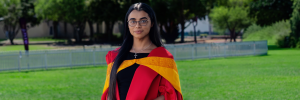
Dr Elana Ryklief turns lived trans experience into groundbreaking scholarship
- Dr Elana Ryklief, an NRF scholarship holder, graduated with a PhD in English Studies from SU, completing the degree in just three years.
- Her research draws on her lived experience as a transgender woman to challenge dominant narratives about gender transition and representation.
- Growing up in Steenberg, she is the first coloured trans woman from the community to earn a PhD from the University’s Department of English.
Growing up in Steenberg on the Cape Flats, Elana Ryklief learned early that resilience and determination were essential tools for navigating life. Years later, those same qualities would carry her to an extraordinary milestone: earning a PhD in English Studies from Stellenbosch University (SU) in just three years.
The newly capped Dr Ryklief is keenly aware that her academic achievements are deeply meaningful. “Coming from a disadvantaged community and being the first in my family to obtain a higher education, I knew that I was breaking a generational cycle by pursuing a career in academia,” she remarks. “The legacy of apartheid hindered the generations before me. Yet I counted on this legacy to inform my research, my own value systems and goals.”
Female role models
Ryklief credits the women in her life for shaping her sense of self and her womanhood from early on. “Steenberg is a lively community filled with people from diverse backgrounds and lived experiences,” she says. “Coloured women are formidable, strong and exceptionally independent. Growing up, these women supported my goals and dreams and celebrated all my achievements.”
Her childhood memories, however, reflect the complexity of growing up in a community marked by both warmth and hardship. “The good memories are based on community and celebrations,” she recalls. “But there were also difficult realities. The neighbourhood is affected by gang violence, drug abuse, police raids and the deaths of ordinary people.”
These early experiences would later inform the critical perspective she brings to her research.
In school, teachers quickly recognised Ryklief’s academic potential, encouraging her curiosity and dedication. Initially planning to study science at university, she eventually found her intellectual home in the humanities.
Finding a voice through scholarship
At SU, she met the supervisors who would play a pivotal role in shaping her doctoral work: Prof Sally-Ann Murray and Prof Mathilda Slabbert in the Department of English. Murray says that supervising Ryklief’s project was both intellectually challenging and deeply rewarding. “Elana was key to everything,” Murray says. “She was eager to share her ideas and experiences but also took guidance seriously and did the hard work of conceptualising, drafting and refining her thinking. Her study is innovative and moving, and we are incredibly proud of the contribution she has made to transgender scholarship.”
Ryklief’s research explores transgender life writing and representation, drawing on both emerging trans scholarship and her own autoethnographic experiences. She argues that popular assumptions often frame gender transition as a simple linear journey from “before” to “after” – a narrative she believes fails to reflect the complexity of lived realities.
Slabbert says Ryklief’s research opens up new ways of thinking about transgender experiences in South Africa. “Her pioneering work offers crucial insights into how societies and institutions respond to transgender individuals,” Slabbert says. “Elana’s passion, energy and commitment kept us on our toes as supervisors. It has been an exceptionally rewarding experience.”
Breaking barriers in academia
Completing a doctoral degree in three years is a demanding achievement in any field. For Ryklief, the motivation to persevere came from a sense of purpose. “I draw on the strength, hopes and dreams of all the cis and trans women who came before me,” she says. “Refusing to quit, I wanted to make myself, my supervisors and all the women who supported me proud.”
Her accomplishment carries particular significance for the community she comes from. “To my knowledge, I am among the first coloured trans women from the Cape Flats to receive a PhD from the Department of English at Stellenbosch University.”
Ryklief says she’s encouraged by the changes in attitudes towards the trans community that she’s witnessed over the past decade. “When I started in 2014, the University did not have many support systems that worked towards including and improving the lives of trans people. “Facing challenges forced me to rely on my agency and independence – fighting for recognition and inclusion in spaces that previously excluded or tolerated me.”
Over time, she has witnessed important changes and hopes her own presence and activism contributed in some small way to that progress.
Compassion through stories
Ryklief’s research is already gaining recognition. She has co-authored an article with Murray titled ‘Transgender narratives and online dating: Reframing trans-cis relations (in Cape Town)’, which appears in the Journal of Multidisciplinary International Studies. She has also secured a six-month Consolidoc postdoctoral fellowship at SU and additional research funding to continue developing her work.
Looking ahead, she hopes to build a career in academia and continue documenting transgender experiences in South Africa. “I am excited to continue producing research for and by my community,” she says. “My goal is to share these stories and bring them into spaces where they have not always been heard.”
For Ryklief, scholarship is ultimately about expanding understanding and ensuring that the everyday experiences of transgender people are recognised as part of the broader archive of human knowledge. “Our stories, identities and how we represent ourselves are always evolving,” she reflects. “Recognising that allows us to create space for compassion, understanding and grace.”
Related stories
Media release
New internship programme at SU clinics opens doors for aspiring medical receptionists
For many young South Africans, earning a qualification is only the beginning of a difficult journey. The next hurdle is finding the work experience employers...
Media release
Stellenbosch University researchers and international partners develop global ‘Declaration on Multilingual Healthcare’
Patients who do not speak the same language as their healthcare providers are disadvantaged worldwide when it comes to accessing healthcare services and...

Arts, languages and social sciences
Building community through multilingualism at SU Teaching-Learning-Assessment Day
Multilingualism should be seen not merely as a policy requirement, but as a powerful tool for learning, participation and belonging in higher education.
This was...