

Alumni series: Engineering change – The inspirational journey of Bovinille Anye Cho
- Bovinille Anye Cho overcame early adversity in Cameroon to become a world-class chemical engineer and Royal Society Fellow, dedicated to pioneering sustainable bioenergy and circular economy innovations for global impact.
Bovinille’s journey into the world of chemical engineering began in a small rural town in the Southwest Region of Cameroon. Raised by his widowed mother after the early death of his father – and the subsequent loss of the family’s assets – he grew up balancing school with helping run his mother’s small business to fund his education. These early challenges forged in him a powerful sense of resilience, purpose, and discipline. “From a young age, I learned the value of hard work,” he recalls.
That hard work paid off. As a high school student, Bovinille distinguished himself as the top-ranked learner at his examination centre (Centre No. 1122) during the national Cameroon GCE Advanced Level exams. His academic talent naturally steered him toward engineering, and his childhood fascination with the towering distillation columns at Cameroon’s national oil refinery in Limbe further nudged him in the direction of chemical engineering. “I was fascinated by the towering vertical columns and industrial structures I saw there – curious about how crude oil was transformed into petrol, diesel, and kerosene. I would later learn that those massive columns were part of a chemical process known as distillation,” he recalls. That curiosity evolved into a clear academic path when he enrolled in the Chemical Engineering programme at the Catholic University Institute of Buea (CUIB), the only Cameroonian university offering a full programme in the discipline at the time.
Graduating with a BSc in Chemical Engineering in 2015, Bovinille’s journey could have taken a purely entrepreneurial turn. His final-year project matured into a viable business model, earning him selection for the prestigious Tony Elumelu Entrepreneurship Programme in 2016, from a pool of over 45,000 applicants across Africa. That same year, he joined the Young African Leaders Initiative (YALI) West Africa cohort, a leadership programme launched by former U.S. President Barack Obama. These recognitions confirmed that his work had significance beyond his local context. Still, he felt a deeper pull toward scientific research and technological innovation. “I longed to understand systems more deeply, to develop technologies that could drive sustainable development, and to contribute meaningfully to the advancement of engineering in Africa and beyond.”
That pull led him to pursue postgraduate studies. Yet with no Master’s programme in Chemical Engineering offered in Cameroon at the time – and limited financial means – studying abroad seemed out of reach. Then came a turning point: Bovinille discovered the Mandela Rhodes Scholarship. “I was immediately drawn to the scholarship’s mission and values – leadership, reconciliation, entrepreneurship, and education – all of which resonated deeply with my personal and professional goals,” he explains.
In 2017, he became one of only 14 Cameroonians ever to receive the Mandela Rhodes Scholarship since its inception, which enabled him to enrol in the MEng (Research) programme in Chemical Engineering at Stellenbosch University. The professionalism and responsiveness of the department impressed him immediately. “Within minutes of my initial inquiry, they sent me a list of potential supervisors and research projects. That level of enthusiasm and support made me feel seen, valued, and academically at home.”
Culturally, the transition was eye-opening. Cameroon and South Africa, though both diverse, express identity in very different ways. “As a Black African, I was often greeted in isiXhosa or isiZulu,” he notes. “People were surprised when I could only respond in English – our official languages in Cameroon are English and French.” Yet he found connection and community through the Mandela Rhodes Foundation, which offered spaces for academic exchange and meaningful relationships during his time in South Africa.
His master’s research focused on the development of a thermosiphon photobioreactor for cultivating photosynthetic bacteria to generate renewable bioenergy. The project’s real-world implications, especially in waste valorisation and energy sustainability, resonated deeply with him. “It felt like a contribution to the long-term development goals of my home country,” he says, referring to Cameroon’s Vision 2035. A major milestone came when he published his research as first author in the high-impact Chemical Engineering Journal, a recognition that validated his scientific contributions and inspired him to pursue a PhD.
That next chapter took him to the United Kingdom, where he became one of only two Cameroonians awarded the prestigious Commonwealth PhD Scholarship in 2019. His doctoral research at the University of Manchester expanded on his master’s work, focusing on sustainable biofuel production and carbon capture technologies.
Following the completion of his PhD in 2023, Bovinille continued at the University of Manchester as a Postdoctoral Research Associate. There, he broadened his research into cellular agriculture in collaboration with the biotech company Cellcraft Ltd, focusing on cultivated meat production as a sustainable alternative to traditional protein sources. Drawing on both mechanistic modelling and machine learning, his work addressed the complex challenges of designing and scaling advanced bioreactor systems. His contributions during this period led to over 20 peer-reviewed publications and earned him the 2021 Commonwealth Research Impact Award for outstanding PhD research tackling global climate challenges.
Today, Bovinille is a Royal Society Career Development Fellow at the University of Manchester, where he leads independent research using data intelligence and digital twin technologies to optimise bioenergy processes. His current work focuses on integrating anaerobic digestion with algae photoproduction to produce biomethane more efficiently while recovering valuable resources. The goal is clear: to unlock a circular bioeconomy that is sustainable, efficient, and aligned with climate action goals. “My lifelong ambition is to pioneer innovations that contribute to the UN Sustainable Development Goals, particularly SDG 6 (Clean Water and Sanitation), SDG 7 (Affordable and Clean Energy), and SDG 13 (Climate Action),” he says.
To aspiring engineers from Africa and other developing regions, his advice is clear and purposeful. “Apply broadly to competitive scholarships and leadership programmes like the Mandela Rhodes Foundation or the Commonwealth Scholarship – they are more than just financial support; they can open global networks and life-changing opportunities.”
He also encourages students to be intentional and strategic in their academic journeys. “My choices to study at Stellenbosch University and the University of Manchester were strongly influenced by how quickly and positively their departments responded to my initial inquiries,” he explains. That early academic receptiveness made a lasting impression and helped him feel immediately welcomed and supported.
He advises students to begin building a strong research and leadership portfolio early. “A strong publication record and demonstrated commitment to sustainable development go a long way when applying for research grants or fellowships,” he says. But just as important, he adds, is embracing the experience of studying and working in new cultural environments. “Cultural immersion builds resilience, widens your worldview, and helps you form a global professional network that will serve you for years to come.”
Beyond advice, Bovinille is passionate about the broader role African chemical engineers can and must play in addressing both local and global challenges. “Chemical engineers sit at the intersection of mathematics, physics, biology, and chemistry – designing processes that transform raw materials into valuable products that fuel our economies and improve quality of life,” he says.
He notes that Africa, as one of the world’s youngest and fastest-growing continents, faces rising demand for energy, clean water, sustainable materials, and resilient infrastructure. These realities, he believes, create a unique opportunity, and responsibility, for African chemical engineers to lead transformative solutions in renewable energy, waste management, water purification, and sustainable manufacturing. “Ultimately, African chemical engineers have a critical role to play in shaping both local and global futures, and the time to rise to that challenge is now.”
Looking back, Bovinille credits each phase of his international academic journey with shaping him not just as an engineer, but as a person. In Cameroon, he learned to be resourceful. In South Africa, he encountered new paradigms of identity and leadership. And in the UK, he gained the skills to lead in high-stakes global science. “These international experiences have shaped me into an engineer who is both globally minded and locally grounded,” he reflects. “I design with empathy, lead with cultural awareness, and innovate with a clear purpose: to contribute to a more equitable and sustainable world.”
His journey is a testament to the power of persistence, scholarship, and vision – and a reminder that with the right opportunities, engineers from even the most modest beginnings can lead globally and give back meaningfully.
Related stories
Engineering and technology
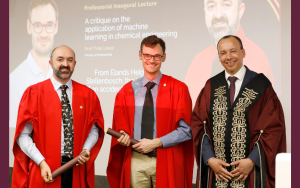
Two professors deliver inaugural lectures in chemical engineering
Prof Tobi Louw – A critique on the application of machine learning in chemical engineering
In his lecture, A critique on the application of machine learning in...
Engineering and technology
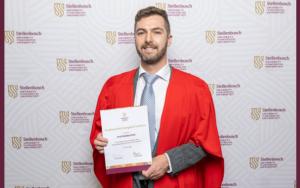
Prof Robbie Pott delivers inaugural lecture: From laboratory to lecture hall – growing bioprocesses and graduates
The Department of Chemical Engineering at Stellenbosch University recently celebrated a major milestone in the academic career of Prof Robbie Pott, who...
Engineering and technology
Alumni series with Natali van Zijl: From process plants to the human brain — Unlocking the potential of a Chemical Engineering degree
When Natali van Zijl began her journey at Stellenbosch University (SU) in 2015, she couldn’t have predicted that her path in chemical engineering would...