
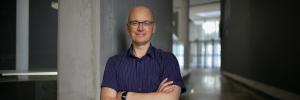
Dr Scarpa Schoeman returns to shape SU’s next generation of doctors
- In 1995, Dr Scarpa Schoeman was an excited first-year medical student at Stellenbosch University.
- Now, three decades later, he has returned to head the medical undergraduate programme at his alma mater.
- Schoeman’s academic career provides him with a solid background for his current role and is the logical outcome of a decision he made quite early on to focus on Medical Education.
In 1995, Dr Scarpa Schoeman was an excited first-year medical student at Stellenbosch University. Now, three decades later, he has returned to head the medical undergraduate programme at his alma mater.
“It’s a very big job,” says the newly appointed MBChB Programme Lead in the Faculty of Medicine and Health Sciences (FMHS). “I’m trying to find my feet and hope to make a positive impact over time working together with students and colleagues.”
Schoeman’s academic career after he graduated at Stellenbosch University in 2000 provides him with a solid background for his current role and is the logical outcome of a decision he made quite early on to focus on Medical Education.
“I always wanted to be a pediatrician or a surgeon,” he recalls. “But when I became a born-again Christian, I changed my focus and decided to be in a space where you can really engage with developing people.”
After he completed his community service in Paarl in 2002, he looked around for opportunities to specialise in Medical Education. He settled on the University of Dundee in Scotland, which is renowned for its MMed programme.
Initially Schoeman worked as a resident doctor in the United Kingdom (UK) for six months in 2003 to pay off his student loans. Later that same year, he became an Anatomy Demonstrator at the University of Dundee.
The following year he joined St George’s Hospital (now City St George’s) medical school in London, one of the largest teaching hospitals in the UK, where he was a lecturer in Clinical Skills for five years. While there, he worked part-time on his MMed over five years and completed it in 2010.
When he was offered a position as a senior lecturer in Medical Education at the University of the Free State in Bloemfontein, he accepted it. “During that time, I developed a real affinity for assessment in Medical Education,” says Schoeman.
He completed a PhD in assessment in Medical Education at the University of the Free State in 2015, doing his research on standard setting and developing his skill set in assessment in Medical Education specifically.
Schoeman was subsequently recruited by Wits University in Johannesburg to set up and head its Unit for Undergraduate Medical Education as Director. He stayed there for three years until June 2019. “It was a very turbulent time,” he recalls. “#FeesMustFall protests were very intense for me and I realised that I needed a break.”
He returned to the UK in July 2019. “I got the opportunity to help establish a brand-new medical school, Kent and Medway Medical School (KMMS), in Canterbury, Kent, in the southeast corner of England,” he explains. “I was recruited and appointed as head of the assessment programme.”
KMMS opened in September 2020, in the midst of the Covid-19 pandemic: “It was very hectic, but it was an amazing time to set up and develop a strategy for a new medical school. That was a wonderful job. But, all along, my wife Marlene and I felt the call to come back to South Africa with our three children.”
Schoeman was appointed as MBChB Programme Lead in August 2025. He started in January 2026 and welcomes the many new challenges ahead. “We are implementing a renewed curriculum process in the Faculty,” he says. “The renewed curriculum is in the fifth year (of six years), so we are in the last year of the outgoing curriculum.”
He explains: “Starting as an intern is always quite challenging. It’s a big jump, so I think the new curriculum – with its six clinical years, compared to three and a half years in the previous curriculum – should set students up stronger in their preparation to become a Stellenbosch doctor and intern.
“I think the exposure of our new sixth year in particular – the distributed clinical apprenticeship (DCA) – is going to offer students that powerful opportunity to mature significantly as a clinician before they hit the first day of their internship.
“It’s very exciting, but there’s also challenges. Logistically, it’s expensive to run a decentralised programme and manage the quality assurance at all our sites. It’s a big undertaking, so my focus is on working with colleagues to make sure the first rollout of the DCA is a success.”
Schoeman points out that his own unit is still very small: “We are trying to grow it to become the engine room to carry this integrated curriculum for 1 800 students. I plan to work closely with the wider Faculty to develop a vision and structure on the ground that will enhance and deliver the integrated curriculum that we now have.”
Even the fact that he was recently diagnosed with non-Hodgkin’s lymphoma in October 2025 will not deter him from giving his full commitment to his new position. Instead, he intends to use this as an asset: “When colleagues are able to share some vulnerabilities, it enables and encourages students and other colleagues to also be real about the struggles they face and to ask for support.”
After all, Schoeman regards providing support to students as a key part of his new role and his work in Medical Education more generally. “I’m very big on student support,” he emphasises. “Hence I want to role-model openness as far as I can.”
Related stories
Medicine and health
Healing starts with vulnerability: South African medical deans unite for #CrazySock4Docs day
On Friday, 5 June 2026, medical faculties across South Africa will don their brightest, most colourful socks for the annual #CrazySocks4Docs campaign. Led by...
Medicine and health
Stellenbosch University scientists respond to Ebola outbreak in Democratic Republic of Congo and Uganda
Scientists at Stellenbosch University (SU) Faculty of Medicine and Health Sciences (FMHS) have rapidly mobilised to support efforts to understand and contain...

Media release
South African rugby stars headline SpeedCourt challenge showcase at Tygerberg
The steady academic hum of Stellenbosch University’s (SU) Tygerberg Campus was recently punctuated by the high-intensity energy of elite sport. Springbok...