About us
History
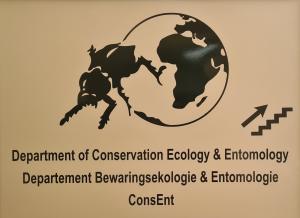
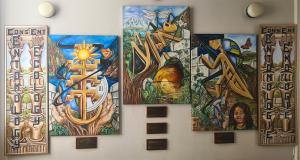
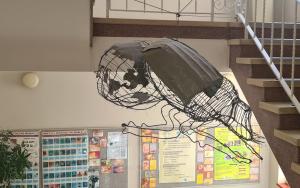
Conservation Ecology and Entomology, in its current format, was established in 2006 during an era of amalgamation and consolidation at Stellenbosch University and driven though the leadership of the then Vice Chancellor, Professor Chris Brink. The “ConsEntual” relationship between these two disciplines was evident at the start, and the Department is now known affectionately as “ConsEnt”. This name symbolizes the merger, the ethos of harmonizing the related disciplines of Conservation and Entomology, and the collaboration that exists between the two disciplines. In our short history, the ethos of the Department has been visualised in two ways. Paintings at the entrance to the Department express the desire for harmony between nature and people, while the well-loved (previous) Departmental logo, the ball (earth) and scarab, illustrated visually the idea that small actions and creatures can change the earth. This logo has now become part of our Departmental history as Stellenbosch University (SU) migrates to a unified brand architecture. However, the nickname ConsEnt has remained a collective for the staff, students and associates who have contributed under its name over the years
“The Conservation Ecology programme forms the core of the undergraduate training in the Department of Conservation Ecology and Entomology and is specifically designed to train the future generation of conservation practitioners.”
Motto
“Conservation in utilized areas” is therefore also the motto of the Department of Conservation Ecology and Entomology here at Stellenbosch University.
Vision, mission and strategic objectives
The Department of Conservation Ecology and Entomology brings together a considerable body of teaching and research in the rapidly growing and important field of conservation of utilized landscapes and their surrounds. In principle, the aim is to have agricultural and forestry production without compromising the natural viability of the agricultural land mosaic. Under this umbrella of conservation in the agricultural and forestry contexts, the range of expertise ranges from integrated pest management, conservation of natural communities, management of living resources, conservation policy formulation to technology transfer. We are a forward-thinking, dynamic department with a distinct agricultural and forestry address. This is reflected in the Vision, Mission and Strategic Objectives of the Department.
Our vision is to be a world centre of excellence for teaching, research and technology transfer in the field of conservation of natural resources. This includes bringing about the sustainable use and conservation of African biodiversity and ecosystem services, outside of formally protected areas, for the benefit of humanity. It also includes achieving a greater understanding of the rich tapestry of insect and other invertebrate life, with reference to the greater agricultural landscape and enhancing food security and agricultural sustainability. This includes managing economically important insects, while at the same time, conserving all aspects of indigenous biodiversity; exploring ways of conserving biodiversity, while engaging in novel methods of pest management.
Our mission includes teaching, research and technology transfer in ecology, conservation and management of utilized landscapes and their surrounds.
This involves seven thrusts:
- Conservation Planning and Management in Agricultural Landscapes
- Restoration Ecology and Landscape Ecology
- Conservation of Symbioses
- Vertebrate Conservation
- Invertebrate Conservation
- Area-wide Pest Management on Tree Crops
- Applied Physiological Ecology
We further aim to undertake and share broadly with diverse stakeholders and the public, innovative research and technology transfer in ecology, conservation and management of utilized landscapes and their surrounds, as well as basic and applied entomology, landscape ecology and biodiversity conservation, and special topics that explore new ideas or synthesis among sub-disciplines. This includes maintaining strong entomological and nematological ties with the agricultural crop production sector, especially tree crops, as our key knowledge partners; developing methods of environmentally sound, integrated pest management that take cognizance of the whole landscape; developing novel approaches for biodiversity conservation, with special reference to agricultural biodiversity.
Our strategic objectives are:
To develop a centre of excellence in teaching and research in the field of ecologically-sensitive agriculture.
To develop a spectrum of research from ‘management for scarcity’(conservation) to ‘management for abundance’ (integrated pest management).
To link strongly with the agricultural production sector across a distinct range of arenas, from ecotourism and sustainability to fruit and timber production.
To place special emphasis on PhD students as a core of productivity which draws more junior students yet leads to top professionals and good research outputs.
To engage, where appropriate and strategic, with the policy and management sectors, with special emphasis on information and technology transfer.
To develop strategic international liaisons, with other universities, European Union, leading international conservation organizations; and participate on Editorial Boards of lead journals.
To focus research on certain scarce resources, particularly water.
To engage in research which has distinct management objectives, from biodiversity conservation to integrated pest management.