
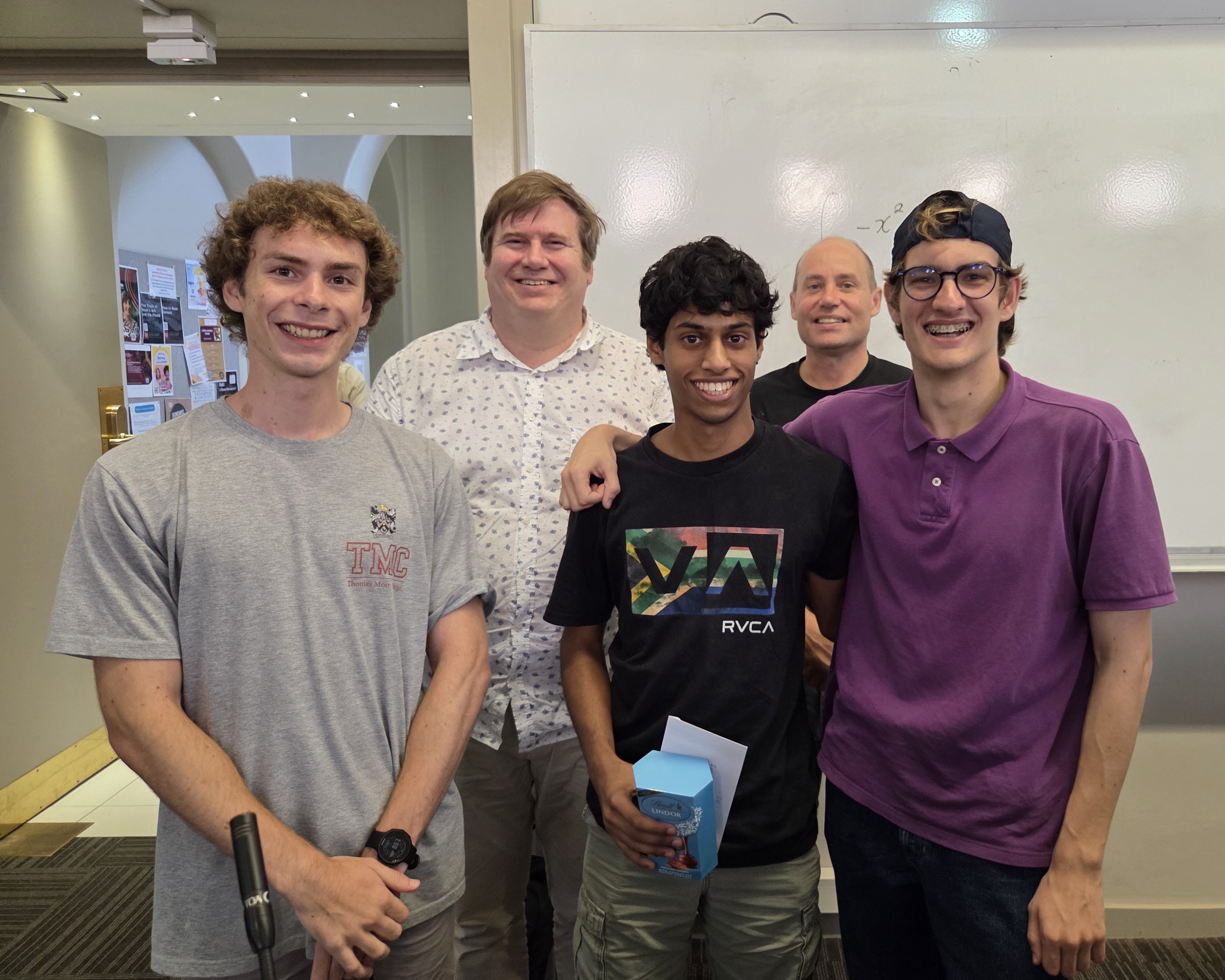
The winner of the first Integration Bee on 13 March 2026 was Raaid Fajander (middle) and runner-up was Brock van der Westhuizen. On the left is Xander Erasmus, organiser of the event.
Engineering students take laurels in first ‘Integration Bee’
- An Integration Bee is a competitive mathematics event modelled after a spelling bee, in which participants rapidly evaluate indefinite and definite integrals from calculus, typically without calculators or reference materials.
- Raaid Fajander, a second-year student in Mechatronics Engineering, and Brock van der Westhuizen, a third-year student in Electric and Electronic Engineering, were the winner and runner-up after a week of nail-biting face-offs between the top 8 contenders.
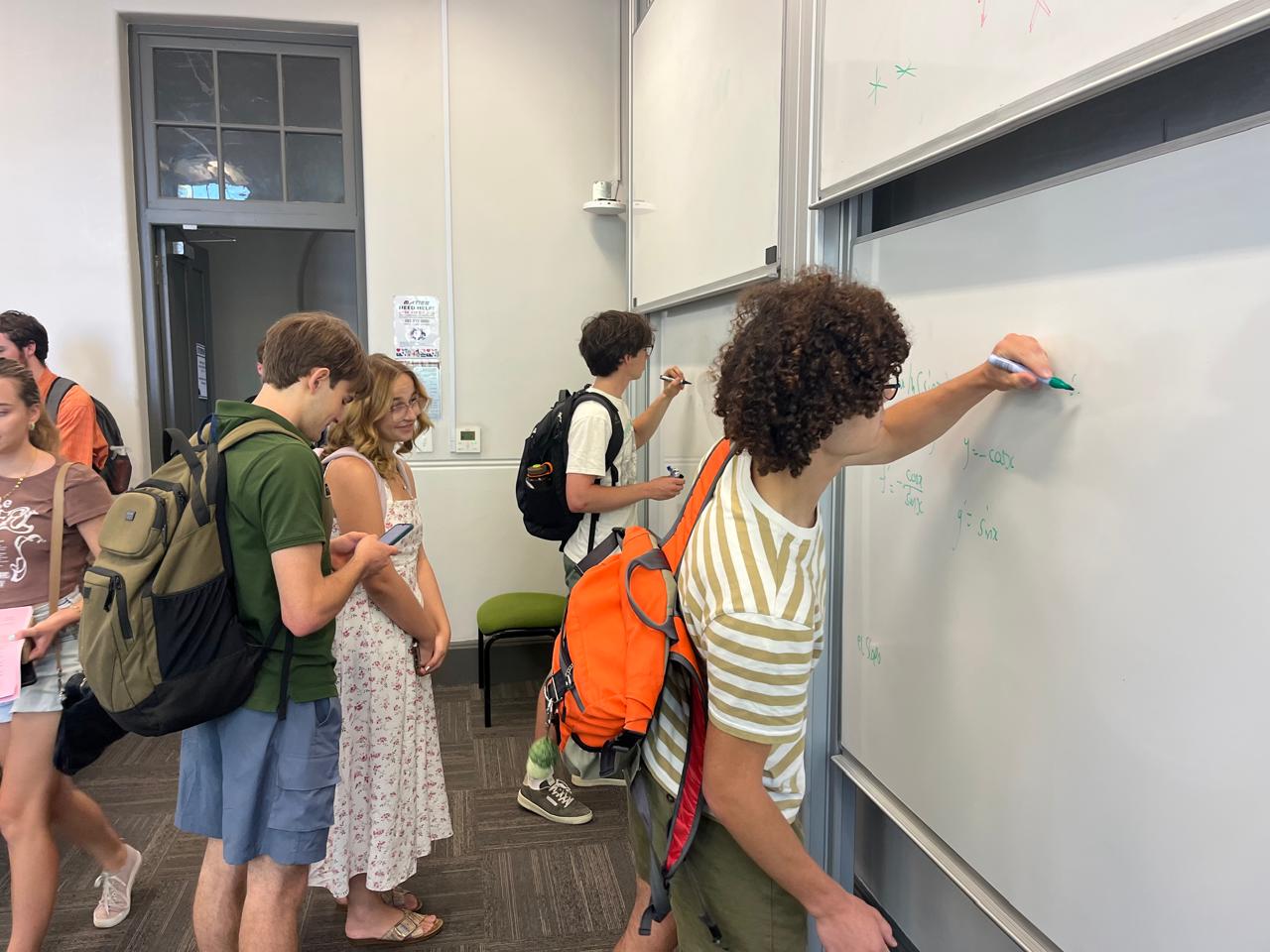
Room 1005 in the Mathematical Sciences Building was packed Friday 13 March to witness the final “face-off” in an Integration Bee organised by third year Applied Maths student Xander Branders and hosted by the Mathematics Division.
An Integration Bee is a competitive mathematics event modelled after a spelling bee, in which participants rapidly evaluate indefinite and definite integrals from calculus, typically without calculators or reference materials. Founded by an applied mathematics student at the Massachusetts Institute of Technology in 1981, the event has since spread to universities all over the world.
Raaid Fajander, a second-year student in Mechatronics Engineering, and Brock van der Westhuizen, a third-year student in Electric and Electronic Engineering, were the winner and runner-up after a week of nail-biting face-offs between the top 8 contenders.
Dr Graham Manuell, one of the judges and a lecturer in the Mathematics Division, says the two finalists gave an impressive performance: “Sometimes it is said that ‘differentiation is mechanics, but integration is an art’ because to differentiate something you just need to mindlessly apply a simple set of rules, but to compute an integral often takes a degree of ingenuity. There are many possible techniques you could attempt, and you need to get a feeling for when one will work as opposed to another one. If you decide to make a substitution, you also need to realise exactly which substitution to make out of many different options.”
In this year’s competition, the judges had to take extra time to evaluate one of Brock’s answers, making for great drama: “The one problem took much longer to judge because Brock solved it in a strange and unexpected way and so obtained a solution in a very different form to the expected solution. Since the answer looked very different to the answer we had, it took some time to convince ourselves that they were equal.”
From the competitors
Raaid says he enjoys maths and competed because he wanted to touch up on his integration skills: “I also wanted to participate because my friends and I used to try the MIT Integration Bee questions in high school for fun.”
Having grown up in Strand since 2010, he is an alumnus of Somerset College, where he did the Cambridge Assessment International Education (CAIE) A levels, as well as Further Mathematics: “Most of the maths that I did in first year, I already learnt in this subject. In fact, even the current maths we are doing in second year, I did in Further Mathematics.”
It was a different matter, however, dealing with the audience behind him: “It was hard to focus knowing that so many people were watching. But once I started thinking about solving the questions, the crowd became a background thought and I was able to overcome my nervousness. I really enjoyed the competition and challenging myself. I also enjoy constantly learning and improving my skills,” he adds.
Brock, who hails from Malmsbury, says he certainly felt the pressure, but tried his best to focus on the competition itself: “Once I began working through each integral, it became easier to forget about the audience. That said, the stress did lead to a few avoidable mistakes. Frankly, managing the pressure was more challenging than the integrals themselves.”
He ascribes his mathematical skills to the fact that he was homeschooled from high school onwards, obtaining his matric exemption through the Cambridge International Examinations board: “Being homeschooled forced me to learn independently and made me develop strong self-discipline. As a result, I consider myself largely self-taught in my academic development, especially in mathematics.”
Back in primary school, his teachers also encouraged him to participate in Olympiads and competitions. According to Brock, these experiences strengthened his mathematical knowledge and significantly developed his problem-solving skills. He continued competing throughout high school and varsity and, later this month, will attend a national training camp for the top 20 maths students from whom a team will be selected to represent South Africa at the 2026 International Mathematics Competition for University Students in Bulgaria.
From the organisers
According to Xander he came upon the idea of an Integration Bee after watching a YouTube video in which a guy named “blackpenredpen” filmed himself solving 100 integrals in one take, which was about six hours long. Digging a bit deeper, he discovered that MIT has been doing this kind of competition since the 1980s.
After approaching Prof Gareth Boxall, head of the Mathematics Division, with this idea, it took some work to figure out how to run such a competition and which integrals to use: “Thankfully I had gathered some random integrals over the years, so I just had to look and carefully consider what to use. Of course, making sure the integrals were doable for students, I had to integrate most of them myself from scratch, which did take a lot of effort. But because I really do love integration, it wasn’t such a burden.”
Going forward, Prof Boxall confirmed that the Mathematics Division would certainly like to do it again next year, making it a regular annual event.
According to Prof Bruce Bartlett, judge for the semi- and quarter finals this year, students do not necessarily need abstract mathematical skills to compete: “You do need to practice a lot, and be skilled at recognising patterns, which is at the heart of maths anyway."
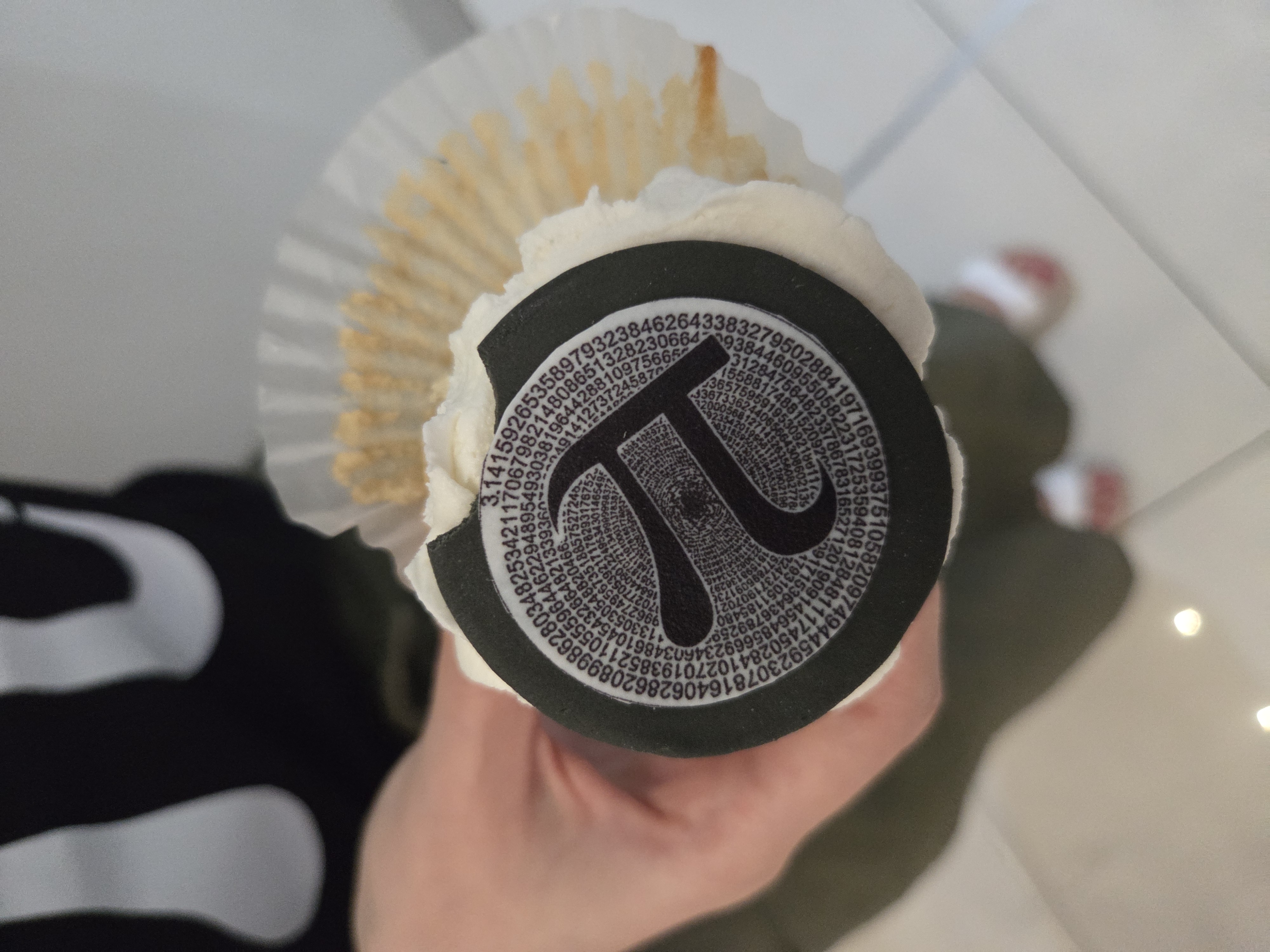
He added an additional challenge to the competition in celebration of International Pi Day: “The Pi Day hackathon was a challenge to write a program to compute a very large digit of pi on a in a few minutes (somewhere around the billionth digit). Specifically, they were tasked with finding the hexadecimal digit of pi, since that is the one for which we have a known algorithm, the Bailey-Borwein-Ploufe algorithm,” he explains.
The winner, and only entry, was Ethan Roome, a fourth-year Data Engineering student, who demonstrated his programme at the end of the competition.
In summary
The Integration Bee started on Monday 9 March with a qualification round. A group of 20 students wrote a 50-minute-long multiple-choice test which consisted of 11 integrals. The top eight were selected to participate in the quarterfinals on Tuesday 10 March, culminating in four faceoffs:
- Benjamin Kleyn vs Tinomudaishe Chidaushe
- Brock van der Westhuizen vs Nicholas de Jong
- Meiring van Zyl vs Jayden van Zuydam
- Raaid Fajandar vs Siyabonga Shoba
The contenders for the semifinals on Thursday 12 March were:
- Benjamin Kleyn vs Brock van der Westhuizen
- Meiring van Zyl vs Raaid Fajandar
On Friday 13 March, during a tense final faceoff, Raaid Fajander emerged as the overall winner with a score of two to one against Brock van der Westhuizen.
Related stories
Awards and milestones
SU mathematician headed for 75th Lindau Nobel Laureate Meeting
Dr Chevarra Hansraj is one of six South African scientists chosen by the Academy of Science of South Africa, with the support from the Department of Science...

Awards and milestones
First-year student selected to attend youth science forum in London
First year BSc student Sibella Murray has been selected by the National Science and Technology Forum (NSTF) to attend the 2026 LIYSF (London International...

Media release
New study led by South African scientists reveals how sea-ice microbes survive the Southern Ocean’s harsh winter, with implications for climate change
A study led by scientists from Stellenbosch University reveal that during winter the sea-ice around Antarctica harbors a reservoir of microbes of which most...