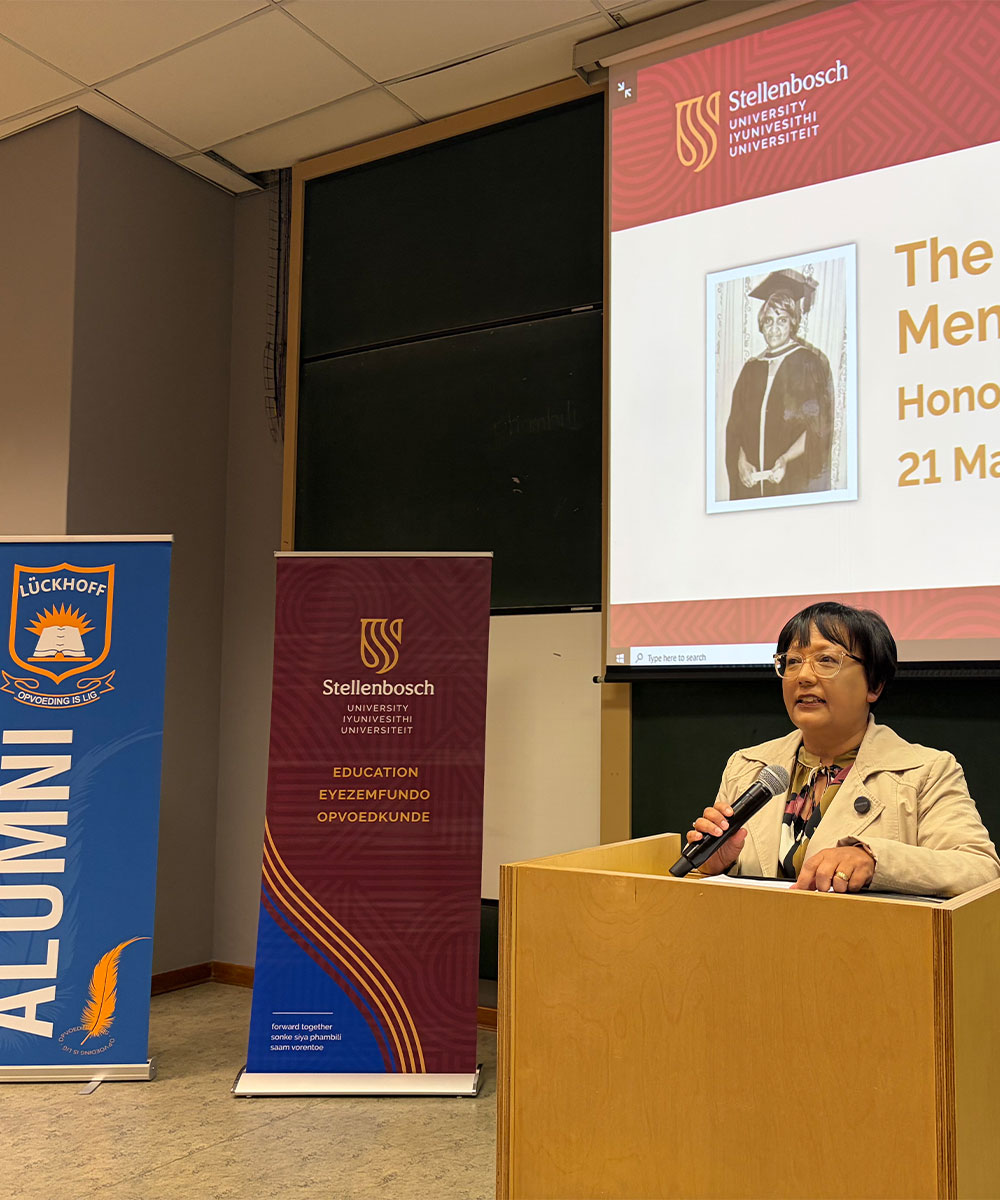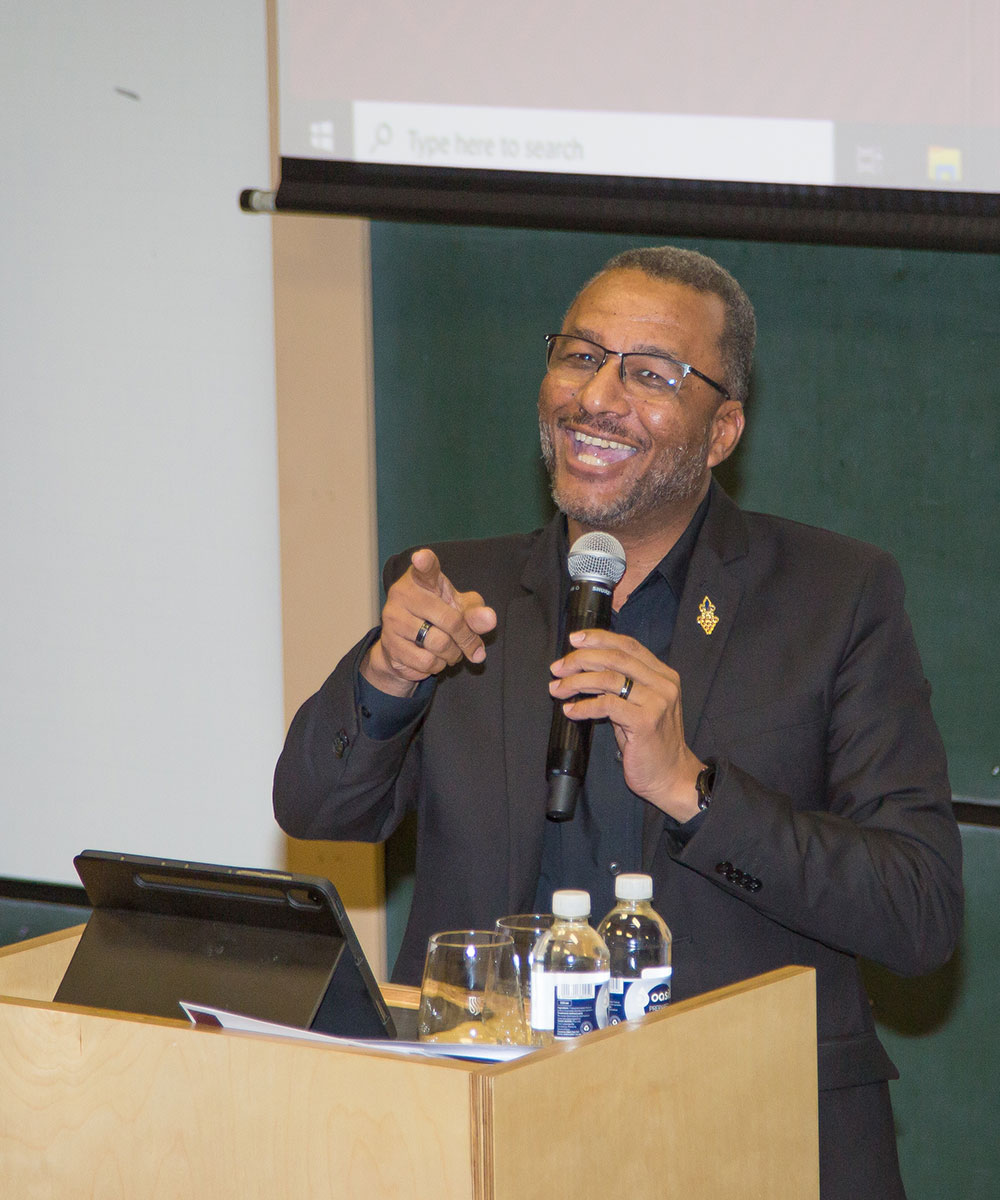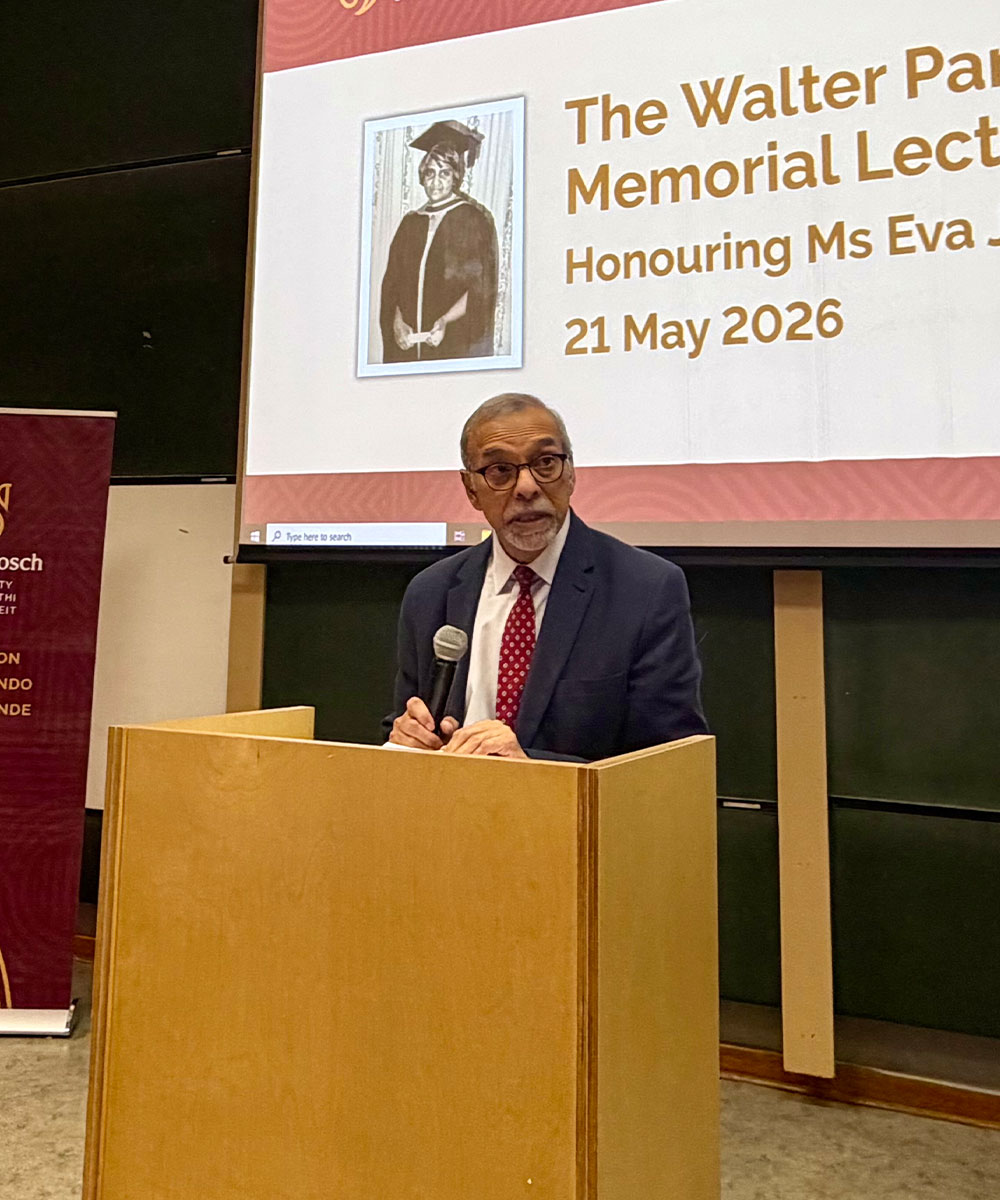

From left are Stanley Amos, Mohamed Shaikh, Jeremy Fasser, Prof Benita Nel, Renée Hector-Kannemeyer, Annette and Ian Johnson, and Prof Mbulungeni Madiba at the 2026 Walter Parry Memorial Lecture honouring the life and educational legacy of Eva Johnson.
The Eva Johnson story: how a Stellenbosch teacher made history
- The third annual Walter Parry Memorial Lecture honoured educator and pioneer Eva Johnson.
- Johnson became the first Lückhoff High School alumna to earn a master’s degree in 1986.
- Speakers reflected on overlooked educational histories and the legacy of Walter Parry.
The third annual Walter Parry Memorial Lecture at Stellenbosch University (SU) turned its focus this year to another educational pioneer whose story, speakers argued, forms part of a broader history too often overlooked in South Africa.
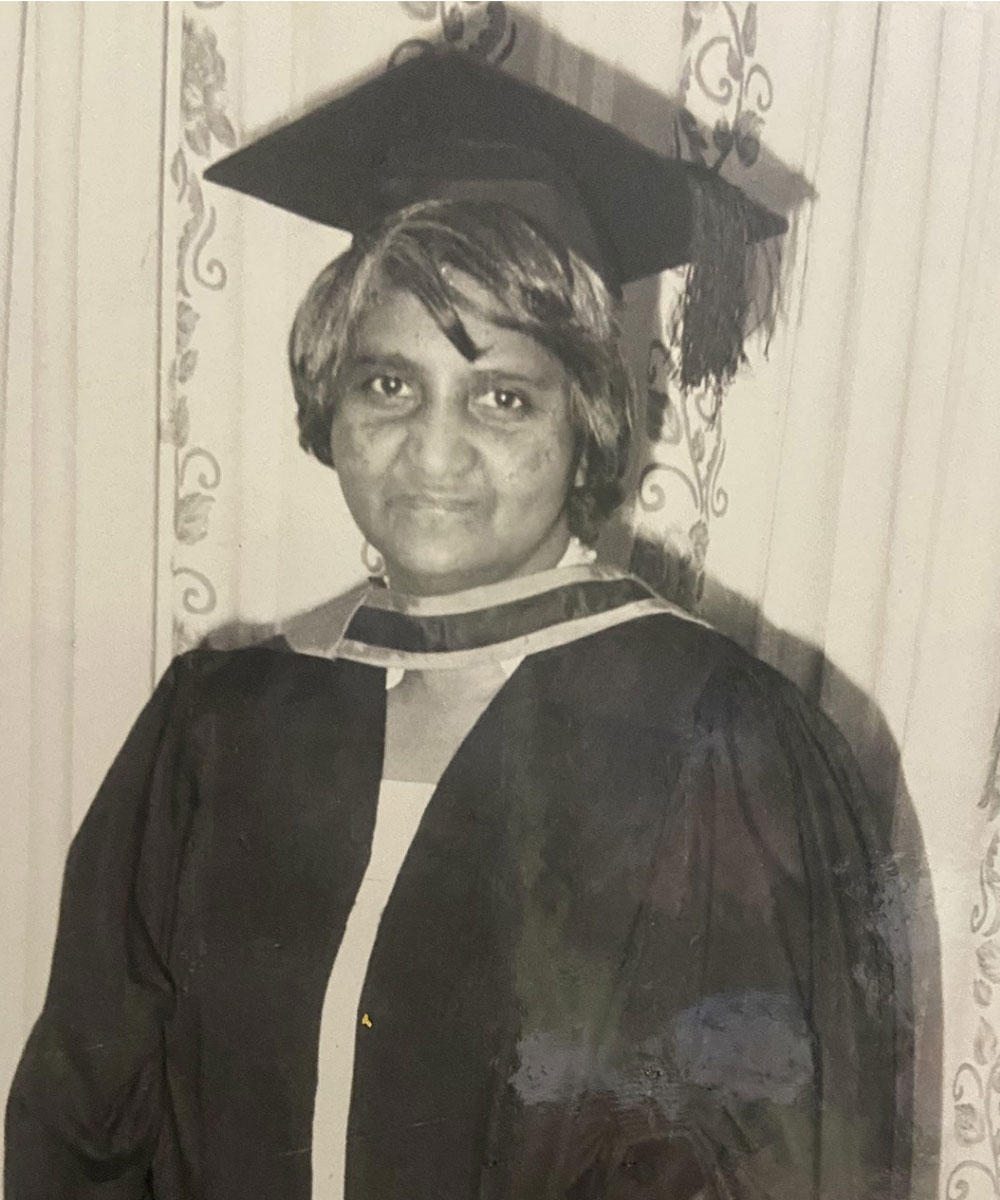
Held at SU’s Faculty of Education on 21 May, the lecture honoured the life and legacy of Eva Johnson (1931–2012), a teacher who in 1986 became the first Lückhoff High School alumna to obtain a master’s degree.
Recalling the past
The lecture series is named after Walter Parry (1913–1966), a gifted physicist and mathematics teacher who obtained an MSc in Physics cum laude from the University of Cape Town in 1934 but was denied the opportunity to pursue a scientific career under apartheid. He later became a revered teacher in Stellenbosch.
The evening formed part of a growing restitution and memorialisation initiative linked to the history of Die Vlakte, the once-vibrant community near the centre of Stellenbosch that was destroyed through apartheid forced removals in the 1960s.
'Welcome back’
The event took place in the Education building on the corner of Ryneveld and Crozier streets. Welcoming guests, the Dean, Prof Mbulungeni Madiba, acknowledged the historical significance of the venue.
“This Faculty stands on ground from which people were forcibly removed. So tonight, I want to say to the community: Welcome back! This is where you belong. This is where your children should come. This is your Faculty too,” he said.
The evening was attended by former learners, community members, academics, descendants of the Johnson and Parry families, and current Lückhoff learners. Local poet Gameeda Henry read her poem Die Vlakte, reflecting on memory, loss and community life before the removals.
Stellenbosch Executive Mayor Jeremy Fasser reflected on the town’s layered and contested past: “During apartheid, Stellenbosch carried a complicated history. It was a place associated with power, influence, and the intellectual foundations of the apartheid state. Yet it also became home to voices of resistance,” he said.
‘A story to be told’
The memorial lecture, titled Education as Repair: Reclaiming Our Stories, Rebuilding Our Future, was delivered by Prof Benita Nel, Director of the Science Learning Centre for Africa at the University of the Western Cape (UWC), who herself attended Lückhoff and was taught by Johnson in the early 1980s.
Johnson, born Eva Boonzaaier in Stellenbosch, grew up at a time when coloured learners in the town had limited access to secondary education. Lückhoff High was established in 1935, four years after she was born, and only introduced matric in 1950.
There were “four young men and one young woman in that class – that was Eva,” Nel recalled, adding that she would later call her Juffrou – the term of respect used for teachers in the community.
Johnson had qualified as a teacher at Hewat College in Athlone, and first taught in Malmesbury before returning to teach in her hometown. While working and raising a family, she went on to complete a BA through UWC, an honours degree through UNISA, and an MA in Education.
Her master’s thesis examined the history of coloured education in Stellenbosch from 1830 to 1963.
The study began with the arrival of Rhenish missionary Rev PD Lückhoff, who started his work in Stellenbosch in 1830 and would go on to establish the town’s first mission school, and ended with the transfer of coloured education to the newly established Department of Coloured Affairs in 1963.
That was also the year Johnson returned to Lückhoff, this time as a teacher of History and General Science.
With her study, Johnson “burst through the ceiling” in the “dark ages of apartheid,” Nel said. “She was not merely teaching us History. She was writing and making history.”
Throughout the lecture, Nel stressed the importance of recovering and documenting stories that had often been excluded from official histories.
“Reclaiming our stories is not nostalgia. It is not about welfare and charity. It is an act of justice. And it is an act of education,” she said.
Johnson’s narrative is truly “a story to be told,” she added, because “nothing can keep a coloured woman with purpose and determination down!”
Education as repair
Central to Nel’s lecture was the idea of “education as repair”.
“When we think of repair, we often think of something broken being returned to its original condition. But there is another kind of repair,” Nel said.
“A repair that takes the broken pieces – the denied opportunities, the inferior facilities, the limited expectations, the silenced and stolen stories – and reclaims them as part of who we are, while building something more whole, more just, and more genuinely excellent and beautiful than what existed before.”
She warned that educational inequality continues to shape communities in South Africa today. “This is why genuine repair cannot be accomplished by simply opening the doors. What is needed is a sustained, deliberate, and honest investment in the communities that were most systematically excluded.”
Moral obligation
This was echoed by Mohamed Shaikh, Acting Senior Director for Social Impact and Transformation, who said: “It is a moral obligation of the University to address unjust actions and legacies of the past as a means of attaining social justice.”
Programme director Renée Hector-Kannemeyer, the Deputy Director for Social Impact and Transformation at SU currently seconded to the Centre for the Afterlife of Violence and the Reparative Quest, highlighted the newly funded Walter Parry Mathematics and Science Programme linked to Lückhoff and SU’s Faculty of Science. She said the programme reflects a commitment to investing in futures historically denied under apartheid while carrying forward Parry’s intellectual legacy.
‘I remember’
Stanley Amos, Chairperson of the Lückhoff Alumni, recalled the collective joy of Johnson’s achievement and its enduring meaning for the school community.
“I clearly remember when the announcement was made that she had obtained her MA,” he said. “It was a big moment. Lückhoff celebrated that day.”
He added: “The school motto is ‘Education is light’. It is not just a symbolic phrase, because education gives us the ability not only to receive knowledge but also to create meaning and restore hope.”
One of the respondents to the lecture was Johnson’s daughter, Annette Petersen, who reflected on the importance of recovering forgotten histories.
She is continuing her mother’s legacy through her own doctoral research at SU. Her PhD explores the aftermath of the Group Areas Act and the emergence of Cloetesville, focusing on how physical education and sport helped shape identity and community among learners after forced removals.
The evening concluded with a vote of thanks by Ian Johnson, son of the woman he said he simply called Mammie. Looking up at a photograph projected behind him – showing Eva in academic wear, proudly holding her degree in both hands – Ian recalled taking the picture himself.
“It took me about 10 minutes because she would not keep still,” he said jokingly.
The inaugural Walter Parry Memorial Lecture (click here for a video) was hosted by SU’s Faculty of Science in 2024, while the second lecture was hosted by the Faculty of Theology in 2025.
* Desmond Thompson is a freelance journalist.
Click below to view more images