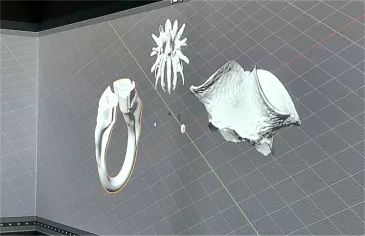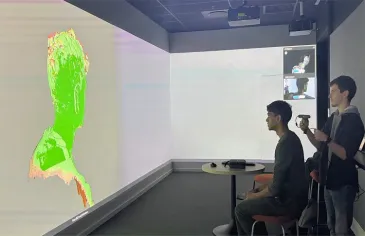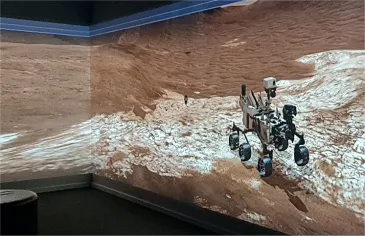
A new immersive facility at the SU Library allows students and researchers to step inside complex data. The lab positions SU at the forefront of immersive academic infrastructure.
Designed as a shared, cross-disciplinary space, it supports teaching, research and innovation across faculties.
It is a virtual and augmented reality visualisation space that provides an in-room panoramic visualisation across a 270° display area. The Immersive Technology Lab was designed as a “true immersive” projection-based experience.
Who may use this
The facility is reserved for staff and students of Stellenbosch University. You will need a valid Stellenbosch University student/staff card to gain access.
Where to find us
Stellenbosch University Library, upper level.
Opening Hours
Monday - Friday: 08:00 - 16:30.
Saturday: Closed
Contact us
The Immersive Technology Lab has launched!
Students and Staff — 2026 is the year to experience, design, and innovate like never before.
What you will explore:
- Interactive 3D environments for learning and research
- Expert guidance to bring your immersive ideas to life
- No prior experience needed — curiosity is your ticket in!

The Immersive Technology Lab was implemented as an extension to the existing Makerspace, the Lab adds enhanced visualisation services to the library’s existing data visualisation support service offering. It expands on the Makerspace’s existing suite of 3D content creation and editing services. In doing so, the Immersive Technology Lab integrates existing data visualisation literacy training services, virtual reality (VR) head-mounted display experience services and new research data visualsation services into one consolidated immersive visualisation environment. This uniquely positions the Lab as an interdisciplinary research support service at SU, accessible to students and faculty members across the whole spectrum of academic disciplines.
Staff and students using the Immersive Technology Lab will experience being visually immersed in a project – applying technologies such as virtual and augmented reality to create deeply engaging, simulated experiences for education, research, training, and industry. Examples of practical use could be nursing students practicing hospital procedures; engineers, being ‘in’ virtual 3D models of construction sites; and creating climate science models, such as translating invisible greenhouse gas data into visible, understandable experiences.
Accordingly, the Immersive Technology Lab was implemented as a direct consequence of the data-intensive environment in which Higher Education institutions with a strong research focus have to operate.