
Student Success
Student success is everyone’s business
At Stellenbosch University, support is available all around you – inside your faculty and across the co-curricular spaces of residences and Commuter Student Communities. Your academic journey is yours to own, and reaching out for help is part of owning it. But you are never on your own. A multi-layered support structure is here to guide you, with academic advising at its heart. Advising provides the stepping stones – scaffolded support – to help you bridge the gaps that many students meet while finding their feet in higher education.
How we advise: Six guiding principles
- We build on your strengths – We focus on what you are good at and help you grow your confidence, rather than dwelling on what is missing.
- We see the whole you – Your life outside the lecture hall matters, so we take your full circumstances into account when supporting you.
- We step in early – We look out for challenges before they grow, so you get help sooner rather than later.
- We work as one team – Faculties and support staff talk to each other and to you, so the help you get actually fits your needs.
- We keep things fair – We work to remove the barriers that hold students back, so everyone gets a fair shot at success.
- You belong here – We create a space where you feel part of a community, not just a student number.
What is academic advising?
Academic advising connects academic, psychosocial, and career support through a coordinated, student-centred approach. Advisors work across faculties and divisions to empower students to navigate their journeys, make informed decisions, and access timely support.
Grounded in collaboration and striving towards data-driven practice, advising contributes to early identification of risk and proactive intervention. As part of a broader ecosystem, it strengthens institutional alignment and fosters a culture where every student is supported to succeed and thrive.
Each faculty has a dedicated academic counsellor to support students’ mental health, academic well-being and personal development by helping them to navigate both the challenges and the opportunities that come with university life. These counsellors resort under the Centre for Student Counselling and Development (CSCD). Placing the counsellors at faculties, we aim to create a dedicated safe and confidential space where students can pause, reflect and engage with aspects of their academic and personal journey. Depending on the nature of the concern and on availability, counsellors may also connect students with other qualified colleagues at the CSCD.
The academic counsellors work side by side with the academic and support staff within the faculties.
Information for students
The following support is available to students:
- Developing study strategies, time management and academic skills
- Maintaining motivation and building study habits
- Managing academic anxiety and exam stress
- Adjusting to university life and workload
- Navigating personal or emotional challenges
- Reflecting on academic direction and goals
To book a session, please email [email protected]
Information for staff – supporting our students together
Often, academic staff are the first to notice when a student may need support. Tutors and mentors should remember that they are not alone and can tap into a broader support network, whether they need support themselves or whether they have noticed a student who might need support.
When to refer a student:
- Struggling with workload or time management
- Declining performance or motivation
- Uncertainty about academic direction
- Ongoing stress or anxiety
- Personal or emotional challenges
- Withdrawal or disengagement
How to refer a student: Encourage the student to email [email protected].
Encourage students to seek support as early as possible.
Remember that counselling is confidential.
Support for students

Academic skills support
Practical guidance to help you study smarter – including effective study strategies, time management, preparing for assessments, and knowing when to seek support.

Workshops
There are workshops that help you strengthen the skills that make studying easier: managing your study time, preparing effectively for assessments, sharpening your learning strategies, and improving focus and concentration.
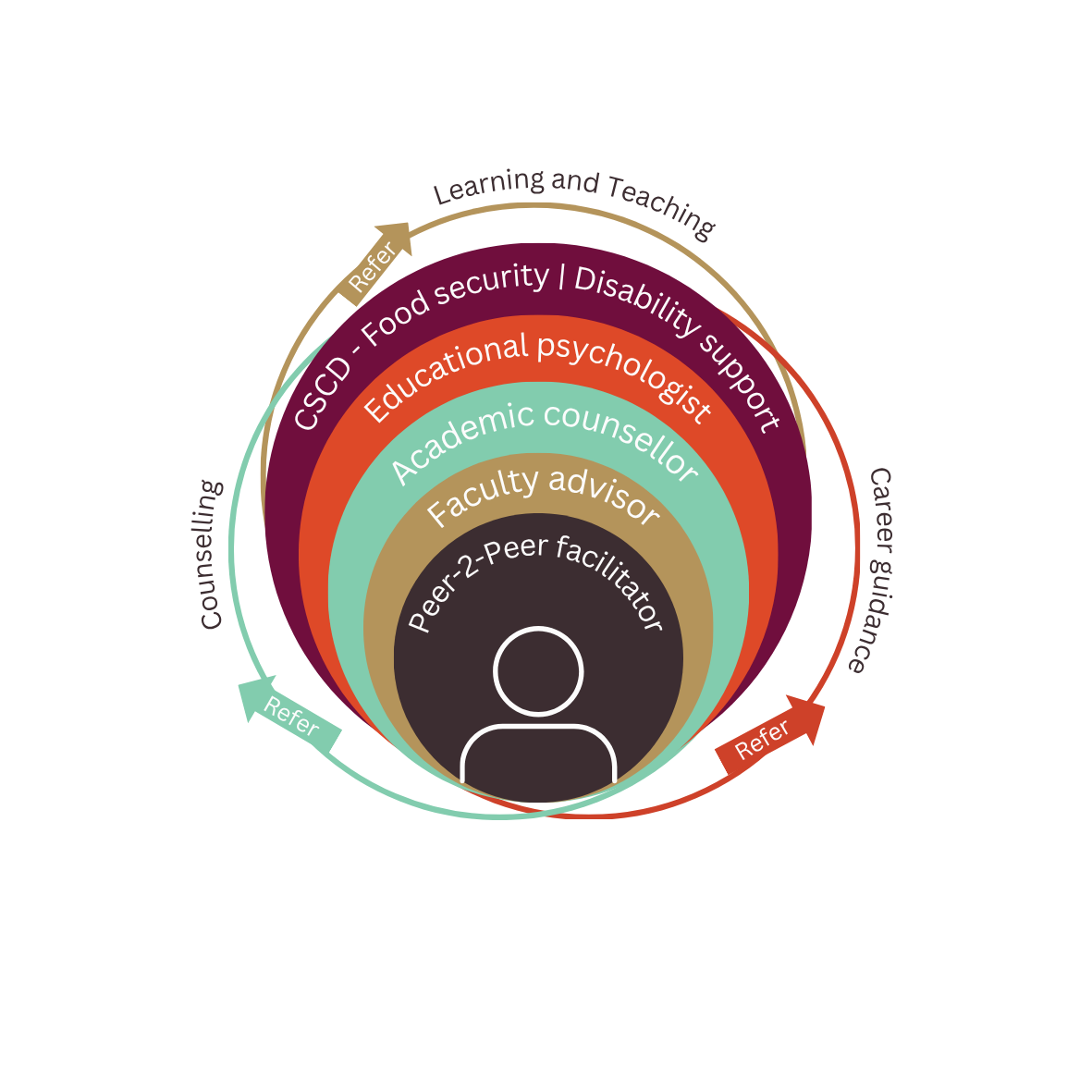
A referral to the CSCD
Sometimes your recent academic progress suggests that a little extra support could help. Academic challenges are often linked to study skills, stress, wellbeing, motivation, or personal circumstances.
SUNSuccess: The right support at the right moment
To help faculties to support students, we have created SUNSuccess – a module within SUNStudent. It uses data analytics to show you which services are available to you at any given moment. That might mean extra support to pass a module, or guidance to help you aim for a distinction. This feature will be piloted in the second semester of 2026, with a university wide roll-out in 2027.
New: Personalised support alerts on the SUNSuccess student portal
From 15 July 2026 – together with the upgrade of the new student portal interface – a new feature goes live on the SUNStudent portal. The new interface will provide a better user experience to students.
Information for students:
- When necessary, you will receive a notification about your academic performance, along with tailored support options. These include the option to book an appointment with a counsellor, tutor, or mentor; or the option to sign up for a workshop. You will receive reminders to help you to schedule these appointments and stay on track.
- Look out for a flag notification in your notification bell, under the “My Profile” menu item, and under the Appointments menu on the new student portal.
- Do you need help? As with all other SUNSuccess queries, students may contact the SU Client Services Centre at [email protected]
Communication to students:
Success stories of fellow students – you are not alone
These are the stories of Stellenbosch University students who navigated university life in all its complexity. Through their experiences, you will discover the support services, communities, and choices that shaped their paths – and could shape yours too. Whether you are looking for direction, reassurance, or just a reminder that others have been where you are, this is a good place to start.


Elbun Lambrechts, BEd 4th year
My story isn’t neat, but it’s real. And if it makes even one person feel seen, makes one leader feel less alone, or inspires the next student from a small town to step up and own their place, then it was worth it.


Student Success Summit 2026
On 20 February 2026, Stellenbosch University hosted its inaugural Student Success Summit at STIAS. Approximately 160 staff members and students came together to strengthen a shared vision for student success. Prof Deresh Ramjugernath, Rector and Vice-Chancellor, reaffirmed the Student Success Initiative as a top priority for the University.
Dr André Vermeulen highlighted neuro-agility and the need for adaptive teaching and engagement, while Ms Gugu Khanye emphasised intentional, data-driven institutional design.
Contributions from across the University enriched discussions, but student stories stood out. These stories and experiences provided powerful insight into lived realities and resilience. Prof Richard Stevens, Acting Deputy Vice-Chancellor: Learning and Teaching, concluded that collective effort will ensure the continued growth of student success at Stellenbosch University.