
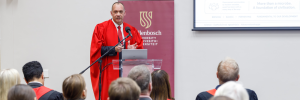
Prof Riaan den Haan develops yeast strains capable of converting waste into useful products
- Prof Riaan den Haan of the Department of Microbiology delivered his inaugural lecture on 26 May 2026.
- His research focuses on developing yeast strains for sustainable biotechnology applications.
- His work aims to convert biomass and industrial waste into useful products.
Prof Riaan den Haan of the Department of Microbiology in the Faculty of Science delivered his inaugural lecture on Tuesday 26 May 2026. The title of his lecture was Beyond fermentation: engineering yeast for a sustainable future.
Den Haan explained to the Corporate Communication and Marketing Division how he develops yeast strains that can convert biomass (organic material from plants or animals that can be used as a resource) and industrial side streams (by-products, or waste generated during manufacturing) into useful products rather than treating them only as waste.
Tell us more about your research and why you became interested in this specific field.
My research focuses on engineering yeast, particularly Saccharomyces cerevisiae, for sustainable biotechnology applications. Yeast is best known for its traditional roles in baking, brewing and wine fermentation, but it can also be developed into a microbial cell factory capable of producing fuels, enzymes and chemicals.
I became interested in this field during my postgraduate studies at Stellenbosch University, where I was introduced to heterologous protein production (the use of organisms such as bacteria or yeast to produce proteins from another organism) and the idea that yeast could be engineered to perform new biological functions. The concept of consolidated bioprocessing, where one organism breaks down plant biomass (organic material from plants that can be used as a resource) and converts the released sugars into useful products, became the central theme of my research career.
How would you describe the relevance of your work?
We currently rely heavily on fossil resources not only for energy, but also for many chemicals and materials used in everyday life. My work contributes to the broader effort to develop renewable alternatives by using plant biomass and waste streams as feedstocks for fuels and chemicals.
The relevance lies in helping to move from a linear fossil-based economy towards a more circular bioeconomy, where renewable carbon sources are converted into useful products more sustainably. The work has further relevance in waste management and waste valorisation (reusing, recycling, composting, or converting waste into useful products).
How can engineered strains of yeast be developed to convert plant-based waste into fuels and high-value chemicals?
Plant-based waste contains sugars, but these sugars are locked inside a highly resistant structure called lignocellulose. Yeast does not naturally break this material down, so we must engineer strains to produce the relevant enzymes that release the sugars, to use a wider range of sugars such as glucose and xylose, and to tolerate the harsh conditions created during biomass pretreatment. Once these capabilities are combined, yeast can be directed to convert biomass-derived sugars into products such as ethanol, lactic acid and potentially other bio-based platform chemicals.
What are some of the key challenges associated with consolidated bioprocessing?
The main challenge is that no natural organism has all the characteristics needed for an ideal consolidated bioprocessing organism. The yeast must produce effective biomass-degrading enzymes, use multiple sugars, tolerate inhibitors, perform under industrial conditions, and still produce the desired product efficiently. Another challenge is that this is not a single-gene problem. It requires the coordinated engineering of multiple traits, which is why synthetic biology tools and CRISPR-Cas genome editing (that enables scientists to cut and edit DNA at very specific points) have become important enabling technologies.
How does your research contribute to sustainable solutions for waste utilisation and renewable biomanufacturing?
Our research aims to convert lignocellulosic biomass and industrial side streams (by-products, or waste generated during manufacturing) into useful products rather than treating them only as waste. This includes agricultural residues, forestry residues and other plant-derived materials. By developing yeast strains that can function in biorefinery environments, we hope to support processes that produce renewable fuels and chemicals, reduce dependence on fossil carbon, and create additional value from underutilised biomass resources. This can contribute to biomanufacturing and the circular bioeconomy.
Higher education can be challenging. What keeps you motivated when things get tough?
The students and the science keep me motivated. Research can be slow, frustrating and unpredictable, but there is always the possibility that the next experiment will reveal something interesting … and when it does, new possibilities open up. I am also motivated by seeing students develop confidence, independence and scientific maturity. Many of the most rewarding moments in my career have come from seeing students take ownership of difficult projects and succeed.
What aspects of your work do you enjoy the most?
I enjoy the process of building something, scientifically and as a team. In research, we often start with a challenging idea that seems almost too ambitious, and then gradually develop the tools, strains, collaborations and people needed to make progress. Sometimes this takes you in surprising and unexpected directions, opening up new possibilities.
I also enjoy collaboration. Much of my work has been shaped by partnerships with colleagues and students in South Africa and internationally. I firmly believe that science advances further through collaboration than through competition.
Tell us something exciting about yourself that people would not expect.
One thing people may not expect is how close my academic journey came to ending before it really began. In my first week as a student at Stellenbosch, I was informed that my study loan had not been approved. Without the intervention and determination of my mother, who found someone willing to stand surety for me, I may never have started this journey.
That experience has stayed with me and reminds me that academic careers are shaped not only by ability, but also by opportunity, support and timing. This is why I will always try and create opportunities for students, researchers and colleagues around me.
How do you spend your free time?
I enjoy spending time with my family, and I try to keep life outside work as grounded as possible. Like many academics, I probably don’t always manage the balance perfectly, but my family has always been the most important part of my life. I am also an avid reader, enjoy following sport, and like spending time in nature when I get the chance. I swim for exercise and enjoy doing open water swimming events with my sons who were both competitive swimmers.
Related stories

Institutional news
Celebrating a partnership that invests in Africa's future
As the Gerda Henkel Foundation celebrates its 50th anniversary this year, Stellenbosch University (SU) reflects on the impact of its own decade-long partnership...
Institutional news
Connecting the dots: Prof Liezl van Dyk’s vision as new DVC: Academic
Stellenbosch University’s (SU) new Deputy Vice-Chancellor: Academic, Prof Liezl van Dyk, sees patterns everywhere: in 14-year chapters, prime numbers and the...

Media release
Cape Winelands Airport and SU forge strategic partnership for smart and sustainable development
Cape Winelands Airport and Stellenbosch University (SU) have entered into a cooperation agreement aimed at advancing innovation under the shared themes of...