

Stellenbosch University has introduced a range of flexible support measures to assist students experiencing financial difficulty.
SU strengthens support for students facing registration and funding challenges
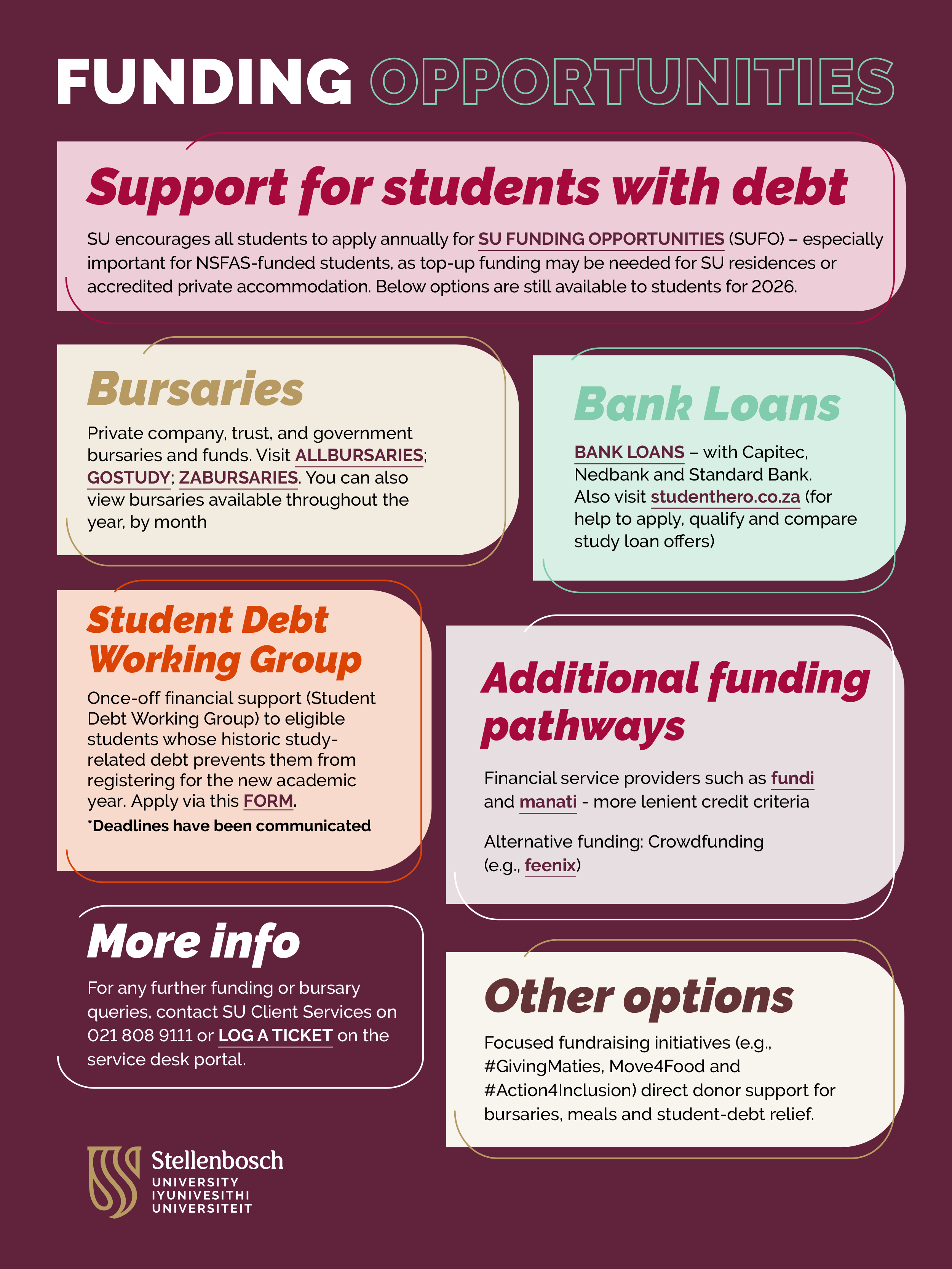
- SU activated the Student Debt Working Group (SDWG) to support students with historic debt, who without financial support would be unable to register for 2026.
- The University has lifted more than 95% of NSFAS-related blocks.
- The University works with students, leaders and partners to remove barriers and support academic, financial and wellbeing needs.
Stellenbosch University (SU) has introduced a range of flexible support measures to assist students experiencing financial difficulty. These include arrangements for those with outstanding balances, temporary online access for students awaiting funding, and collaboration with partners on innovative financial solutions for final-year students.
Together, these steps reflect SU’s commitment to removing barriers to student success, while continuing to prioritise quality accommodation and wellbeing services.
Funding and registration initiatives
- Student Debt Working Group: SU activated the Student Debt Working Group (SDWG) to support students with historic debt, who without financial support would be unable to register for 2026, and extended the application deadline. Returning students who meet all academic and administrative requirements to continue with their studies are eligible for once-off SDWG funding. The University has made more than R15 million available to support qualifying students, particularly those in the “missing middle” and high-risk NSFAS categories.
- Special debt arrangement for 2026: Students with outstanding debt of R10 000 or less may register upon signing an Acknowledgement of Debt and agreeing to a structured payment plan.
- Lifting of financial blocks: In a concerted effort to support students through financial and academic challenges, the University has lifted more than 8 000 financial blocks for academically deserving students this year and reopened further funding avenues to ensure returning students can register for 2026.
- NSFAS-related support: The University has lifted more than 95% of NSFAS-related blocks and continues to resolve outstanding matters in consultation with NSFAS.
Learning and accommodation initiatives
- Temporary access to learning platforms: Students awaiting the resolution of financial matters have temporary access to SUNLearn to ensure they are not academically disadvantaged.
- Emergency and interim accommodation measures: SU activated an emergency accommodation protocol during the Welcoming period and could support more than 150 newcomers (undergraduate and postgraduate). Further to this, SU continues to provide case-by-case interim accommodation support for returning students where required.
- Affordable meal options: Bookings have again been opened for affordable meal options in SU residences, where students can enjoy two meals per day for just R60.
Engagement with stakeholders
The University recognises that financial uncertainty can create stress and anxiety. SU continuous to engage with our student leaders and students in general to resolve registration and funding related matters as far as it is possible. This open approach helps us to better understand general and individual challenges and to jointly address issues.
In addition, SU is working towards finalising an arrangement with a commercial bank to assist final-year students through secured loan mechanisms.
Through its Development and Alumni Relations Division, SU continues to mobilise donor funding and alternative financial pathways to assist students.
SU also continues to engage with NSFAS amongst others on issues linked to outstanding payments (NSFAS close-out project and 2025 payments), course code challenges, classification of Stellenbosch as metro for purpose of accommodation allowances, etc.
Wrap-around support
SU is strengthening its focus on wrap-around support initiatives that address academic performance alongside the psychosocial, financial and developmental factors that shape student success. This is particularly important for underprivileged students, who often face multiple barriers when pursuing higher education.
This focus contributes to the University’s throughput rate (the proportion of a cohort of students who successfully graduate within the expected timeframe) of above 70% (2024: 74,9%) for undergraduate bachelor students.
The University’s 2025 results demonstrate that widening access and maintaining academic excellence are not mutually exclusive. By removing administrative and financial barriers, expanding accommodation solutions and strengthening student support systems, the University enabled almost 10 000 students to complete their qualifications – with growth across undergraduate, postgraduate and doctoral levels.
While supporting students through these measures, SU remains committed to sound financial stewardship and the long-term sustainability of its academic programme.
Related stories

Media release
Fifth-generation Matie carries the Cillié name with pride
When Simoné Cillié walked across the stage to receive her degree in actuarial science cum laude earlier this year, her grandparents and family members beamed...
Institutional news
SU champions integrated student success through SASSE survey participation
Starting on 18 August 2025, Stellenbosch University (SU), through the Office of the Deputy Vice-Chancellor: Learning and Teaching, will conduct two key surveys...