
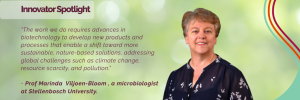
Biotechnology driving a greener future
- The development of genetically modified yeast strains that produce special enzymes for commercial applications.
Professor Marinda Viljoen-Bloom, a microbiologist at Stellenbosch University (SU), has spent over thirty years transforming micro-organisms into impactful innovations. Her work advances South Africa’s bioeconomy – an economic system focused on sustainable, nature-based solutions by creating renewable fuels from crops and developing enzymes that break down persistent bioplastic waste.
Prof Viljoen-Bloom completed all her degrees at SU, from a BSc in Microbiology and Chemistry to a PhD in Microbiology. As part of her doctoral studies, she spent 18 months as a visiting graduate student at the Whitehead Institute for Biomedical Research at the Massachusetts Institute of Technology (MIT) in Boston, USA – an experience that opened her eyes to the global potential of yeast biology. She became a lecturer in 1997 and served as an Associate Professor in the Department of Microbiology since 2010. In 2005, she reduced her work hours to a 5/8 appointment, which she says afforded her the freedom to work and raise a family. Her career shows that you can be a dedicated scientist, a wife, a mother and an active community member. “It is a matter of balance,” she says.
What does a microbiologist actually do? Viljoen-Bloom and her team develop genetically modified yeast strains that produce special enzymes for commercial applications. This includes renewable resources (biofuels), bioprocessing (fermentation and enzymatic reactions that convert raw materials into valuable products, such as biofuels and bioplastics), and the development of a circular economy (recycling, reusing, and repurposing biological materials).
“All these activities require advances in biotechnology to develop new products and processes that enable a shift toward more sustainable, nature-based solutions, addressing global challenges such as climate change, resource scarcity, and pollution,” she says. Her work directly supports two United Nations Sustainable Development Goals (SDGs): affordable and clean energy (SDG7), and responsible consumption and production (SDG12).
From 2007 to 2022, she managed the South African Research Chairs Initiative (SARChI) Biofuels Research Chair held by Prof. Emile van Zyl. The programme produced 286 international peer-reviewed papers, 16 patent applications, and trained 190 postgraduate students, including 92 Master’s, 38 Doctoral and 27 Postdoctoral researchers/fellows. “As a product of mentorship and great supervision, these projects developed advanced skills in microbiology, biotechnology, and process engineering that are critical to building a sustainable biofuels industry in South Africa,” she says.
She maintained is a long-standing collaboration with Prof. Lorenzo Favaro and his Waste-to-Bioproducts Laboratory at the University of Padova, Italy, with several students who have spent time in both groups. As part of the collaboration, Viljoen-Bloom is also deeply committed to developing the next generation of scientists. Together, Favaro and Viljoen-Bloom demonstrated how academics can lead in developing of pathways to impactful research, culminated in two university spin-out companies.
She currently serves as Director and Co-founder of Urobo Biotech, a Stellenbosch spin-out company led by postdoctoral fellow Dr Wessel Myburgh and PhD student Ms Dominique Rocher. Registered in 2023, Urobo Biotech, is developing microbial enzymes to break down and recycle bioplastics. Although bioplastics are marketed as eco-friendly, they are not always biodegradable and still contribute to the growing plastic waste crisis.
The Urobo team developed microbial enzymes that can significantly speed up the degradation of bioplastics. The resulting products, such as lactic acid, can then be recycled to manufacture new bioplastics. The company has already made history as the first South African team to reach the finals of the 2025 Hult Prize Global Accelerator, finishing in the top eight out of more than 188 000 teams from 130 countries.
Another technology developed by the Viljoen-Bloom-Favaro collaboration is yeast strains that can break down raw starch from crops such as corn, rice, and sweet sorghum to produce bioethanol – a renewable, cleaner fuel. This technology has been licensed to a spin-out company, Agri-E, registered at the University of Padova.
When asked, “What advice would she give to her 18-year-old self?” Viljoen-Bloom says emphatically, “Follow your heart, trust your gut and keep working hard.” Looking ahead, Prof Viljoen-Bloom plans to continue supporting the spin-out companies while investigating new collaborations and applications for microbial strain development.
Related stories
Events
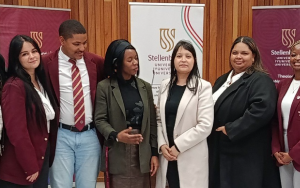
Annual Youth Day Lecture confronts the widening gap between degrees and jobs
As South Africa prepares to commemorate the 50th anniversary of the 1976 Soweto uprising next month, Stellenbosch University’s (SU) Annual Youth Day Lecture...
Impact
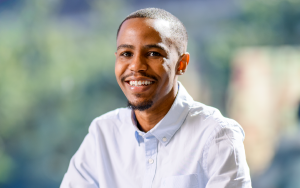
Thabo Tyholweni brings precision and compassion to student finance
As a Student Fees Administrator at SU, Thabo Tyholweni works behind the scenes to ensure that one of the most important aspects of student life runs smoothly –...
Impact
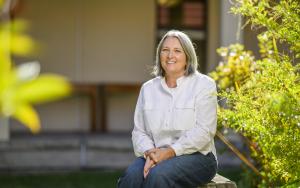
Marguerite van der Waal connects people through language
As Head of Language Services at the Stellenbosch University Language Centre, Marguerite van der Waal plays a vital role in advancing multilingualism...