
South Africa’s Tiny Duo with Big Agricultural Promise
- New African Discovery: Scientists found a new symbiotic nematode-bacterium duo (S. innovationi and X. innovationi) in South African soils.
- Fast Pest Control: The microscopic partnership eliminates destructive false codling moth larvae within 24 to 48 hours.
- Eco-Friendly Alternative: This naturally occurring duo offers a sustainable, chemical-free breakthrough for global citrus and grapevine crop protection.
Hidden beneath the soils of South Africa’s grain fields, scientists from the Agricultural Research Council uncovered a remarkable insect-parasitic nematode that they later named Steinernema innovationi. Yet the discovery did not end there. This microscopic insect parasitic roundworm was found to be associated with a previously unknown bacterial partner, which was only recently identified in collaboration with the Stellenbosch University Department of Conservation Ecology and Entomology and the Department of Microbiology, using molecular next-generation sequencing, as Xenorhabdus innovationi.
Together, this extraordinary symbiotic partnership represents an exciting breakthrough in the search for sustainable agricultural solutions. Isolated from the rich soils of Bethlehem in the Free State, this tiny but powerful duo has already demonstrated its ability to kill destructive false codling moth larvae, a major pest threatening citrus and grapevine industries worldwide, within just one to two days.
More than simply a scientific discovery, the S. innovationi and X. innovationi alliance showcases the immense untapped potential hidden within Africa’s biodiversity. At a time when agriculture urgently requires environmentally friendly alternatives to chemical pesticides, this naturally occurring biological partnership offers new hope for safer and innovative crop protection strategies for the future.
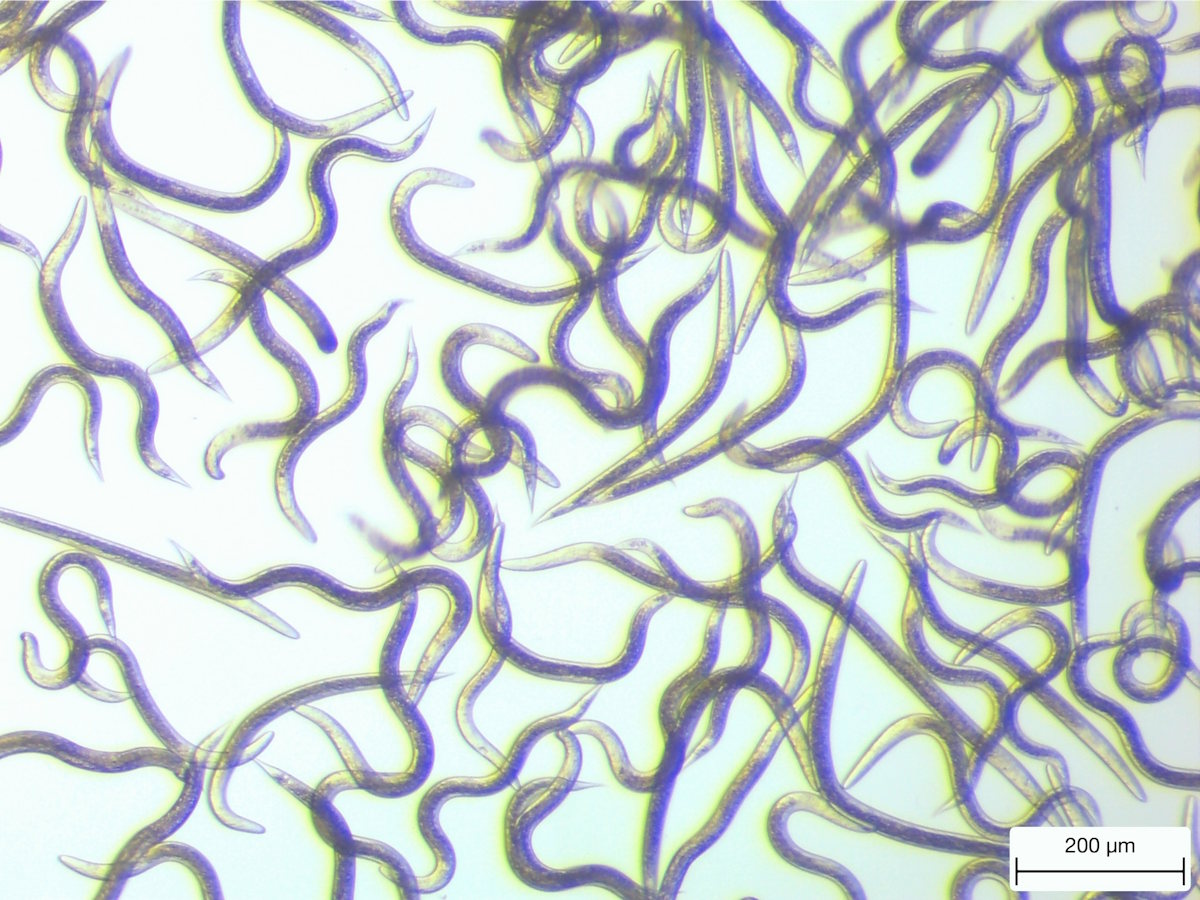
Fig. Free-moving nematodes in the soil are the active ingredient of the nematode-based biological control agent duo. The bacterium is harboured in the anterior part of the intestine and is released once the nematode enters the pest insect where it assists in the killing of the insect within one to two days.
For further information refer to the following scientific paper: Ritter, C.L., Wessels, H.L., Ramakuwela, T., Hatting, J., Malan, A.P. & Dicks, L.M.T. Xenorhabdus innovationi sp. nov., associated with the entomopathogenic nematode Steinernema innovationi from South Africa. Nematology 28(2), 193-208. Brill Academic Publishers http://hdl.handle.net/2263/108839
Related stories

Media release
People with Down syndrome must be included in conversations about their healthcare
People with Down syndrome and their families consistently value healthcare that is relational, respectful, and person-centred, rather than focused solely on...

Media release
SU scientist receives R14 million grant to tackle West Nile virus
As climate and environmental change continue to reshape ecosystems across the world, scientists are warning that mosquito-borne diseases may spread into new...

Media release
Many factors drive changes in human-wildlife relationships
Human populations are expanding and encroaching further into wildlife habitats, leading to dynamic and evolving relationships between humans and wildlife. As...