
Learning from !Khwa ttu: Reimagining the wildlife economy through indigenous knowledge
- Relational Value: The San worldview challenges commercial conservation by framing wildlife as an interconnected web of human and spiritual relationships rather than just economic units.
- Broader Expertise: True conservation requires integrating indigenous oral histories and deep botanical knowledge, expanding the wildlife economy to include plants and cultural practices.
- Ethical Partnership: Future wildlife models must shift from extractive commercialization to genuine partnerships with indigenous communities, prioritizing ethical responsibility and equitable benefit-sharing.
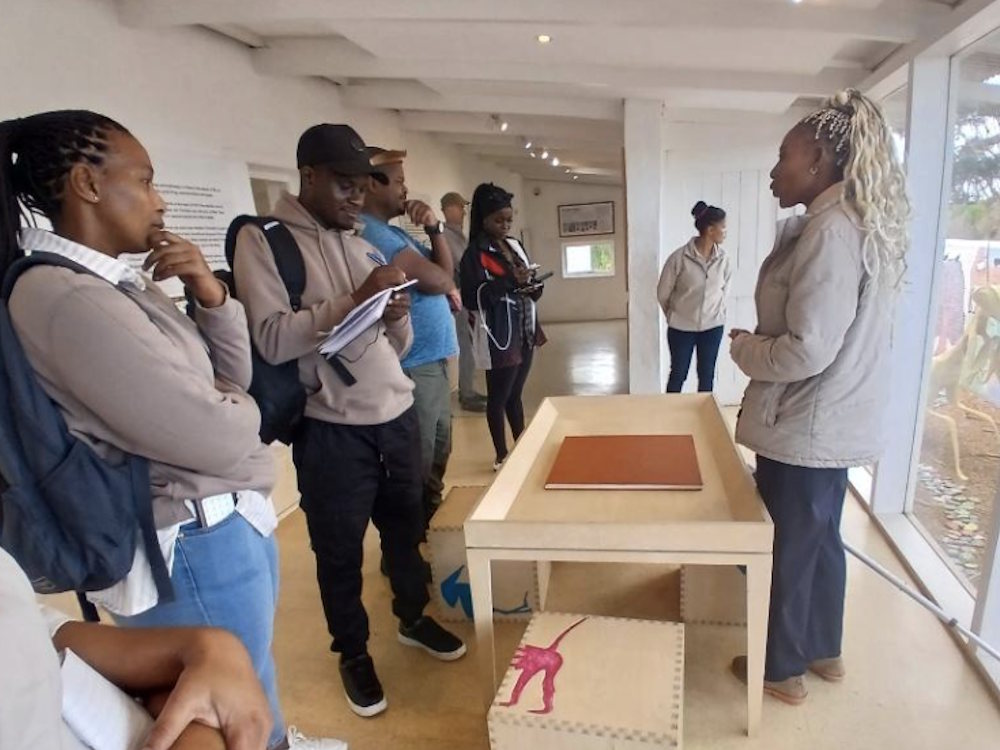
On Saturday 11 April 2026, a group of African Wildlife Economy Institute (AWEI) team members visited !Khwa ttu, often described as the ‘embassy’ of the San of Southern Africa, for the organisation’s inaugural team-building day. The visit offered an opportunity not only to step away from our usual work but also to examine some of the core assumptions underlying our approach to the wildlife economy. The special visit was co-ordinated by AWEI/Cornell’s PhD candidates and research associates, Lydia Bhebe and Francine Barchett.
Bringing the day to life was a San guide, who introduced us to stories about the praying mantis, the constellations, and the use of plants for healing, sustenance and hunting. These stories illustrate how the San understands the intricate relationships between humans, nature and spiritual life. The day also included more informal moments: grilling freshly hunted springbok over a traditional fire and sharing a meal featuring local, seasonal ingredients, including a foraged drink.
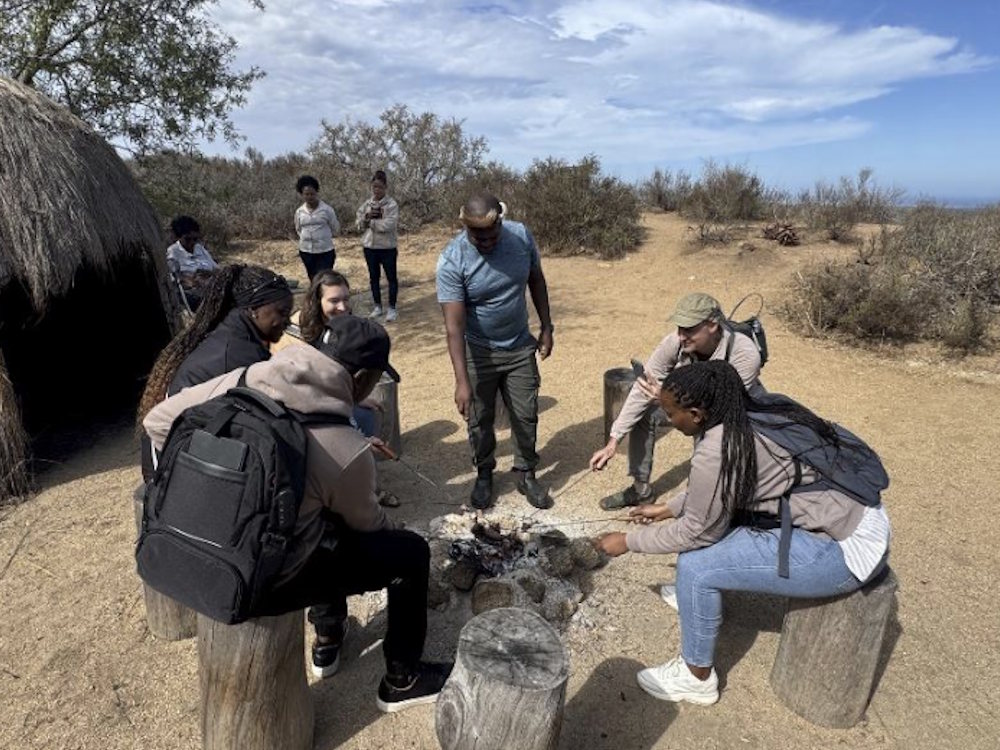
What resonated most deeply was the San worldview: humans, animals and plants exist within a living, interconnected system – a dynamic network shaped by memory, survival, spirituality and responsibility.
Wildlife as a relationship, not just a resource
In contemporary policy and market discussions, wildlife is often framed through the lens of value chains, revenue generation and productivity. The African wildlife economy is typically divided into sectors such as photographic tourism, non-timber forest products, hunting, game ranching and carbon markets. While these frameworks are useful, they risk reducing wildlife to economic units.
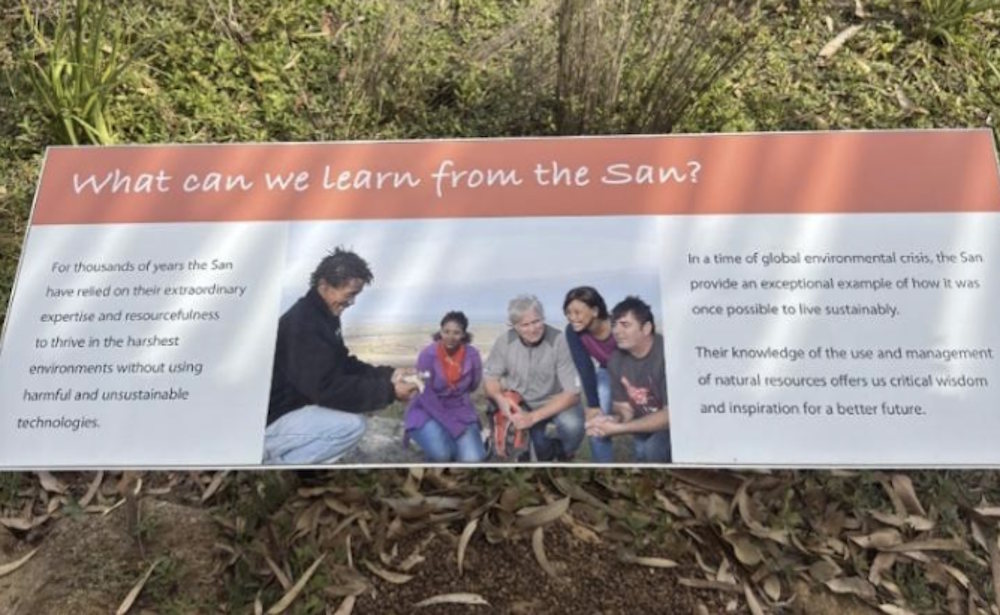
At !Khwa ttu a different perspective emerged, one in which use without relationship easily becomes extraction. The San story of the praying mantis, a trickster-creator figure, captures this powerfully. The mantis can transform and intervene in the hunt, thwarting a hunter who approaches arrogantly or with impure intent. In this worldview, hunting is not merely a technical skill; it is a relational act shaped by the hunter’s state of mind and mediated by the spiritual realm.
This challenges a central assumption of the modern wildlife economy: that value can be separated from relationship. For the San, how wildlife is used is inseparable from how it is understood.
Rethinking expertise in conservation
The visit also disrupted narrow definitions of expertise. In many formal conservation spaces, expertise is equated with academic credentials, policy fluency and technical data. At !Khwa ttu expertise lives in oral histories, tracking skills, deep plant knowledge and storytelling passed down through generations.
One memorable story is that of the Moon and the Hare. The Moon sends the hare to tell humans that, just as the Moon dies and is reborn, so too will they. The hare distorts the message, telling humans they will die and never return. Enraged, the Moon strikes the hare – explaining the split lip we see today. The story underscores a worldview in which responsibility and consequence are central, and animals are used to actively shape human understanding and morality.
This does not mean rejecting scientific knowledge. Rather, it raises an important question: How can different knowledge systems be brought into meaningful dialogue?
Beyond animals: Expanding the wildlife economy lens
The experience also highlighted how plants, often underrepresented in discussions of the wildlife economy, are central to the San’s ways of life. During the tour, we learned about tsammas or wild melons, which were gathered, eaten and sometimes buried under trees to be retrieved during drought, especially when water sources were scarce and shared with animals. Plants, therefore, served not only as food but also as infrastructure for water security and survival.
We also learned about plants used in medicine, hunting and everyday life. Blue lilies, for example, were described as used in childbirth and infant care, while cancer bush was explained not as a cure for cancer, but as an immune-supporting medicine. This distinction matters because it shows that indigenous knowledge is not simply a collection of ‘natural remedies’ but a precise, contextual system of use, caution and interpretation. Confetti bush was described as both a perfume and a hunting aid, used to mask human scent when approaching animals on windy days. The milky sap of certain poisonous plants was also applied to arrows, a practice that required careful handling and deep expertise, illustrating how botanical knowledge is used in hunting practices.
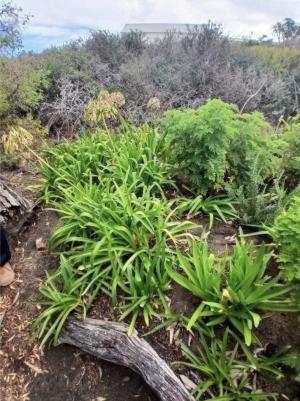
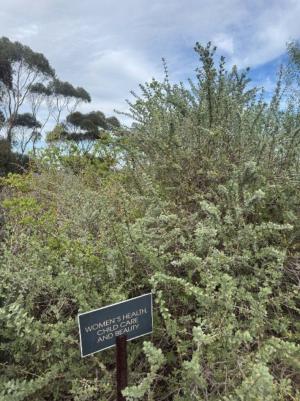
These examples reveal how indigenous ecological knowledge is highly specific, place-based and vital to survival. They also raise broader questions about bioprospecting, benefit sharing and the ethical use of indigenous knowledge. Many of the same systems now seeking to integrate indigenous perspectives are the ones that have historically excluded them. For example, the commercialisation of the Hoodia plant, traditionally used by the San as an appetite and thirst suppressant, has been widely cited as a case of biopiracy, where indigenous expertise was used without adequate permission or compensation.
From reflection to responsibility
As we left !Khwa ttu that afternoon, the visit held up a mirror to AWEI. In a field often driven by metrics and markets, the San reminded us that wildlife is a living web of relationships to be honoured.
A just wildlife economy cannot rewind the past, nor should it ignore it. While pure subsistence is no longer feasible, the principles of reciprocity, responsibility and relationality embedded in San knowledge remain vital. For AWEI, this calls for a deeper shift: moving beyond inclusion to genuine partnership, recognising indigenous communities as knowledge holders and leaders in shaping the future.
Toward 2035: Reframing the wildlife economy
The visit made one thing clear: the future of the wildlife economy cannot be defined by efficiency and scale alone. It must also be relational. Too often, however, relational values are theoretically acknowledged while economic logic continues to dominate in practice.
For AWEI, this means broadening our definition of the wildlife economy to include plants, knowledge systems and cultural practices as foundational elements. It requires embedding ethical dimensions into economic models so that use is never separated from responsibility, or value from relationship.
Practically, this involves supporting locally rooted enterprises, whether plant-based products, full-use wildlife models, or storytelling-driven value chains, that align livelihoods with ecological knowledge and cultural meaning. Yet such initiatives carry risks: without rigorous attention to context, ownership and equitable benefit sharing, they can replicate extractive patterns.
As both a think tank and convener, AWEI is well-positioned to navigate this tension by bringing indigenous knowledge holders, scientists, policy makers and entrepreneurs into productive dialogue.
Ultimately, the challenge is not to return to the past, but to carry forward what still holds value. The question is whether we are willing to build systems that reflect not only what we can measure but also what we and others truly value.
Related stories

Media release
People with Down syndrome must be included in conversations about their healthcare
People with Down syndrome and their families consistently value healthcare that is relational, respectful, and person-centred, rather than focused solely on...

Media release
SU scientist receives R14 million grant to tackle West Nile virus
As climate and environmental change continue to reshape ecosystems across the world, scientists are warning that mosquito-borne diseases may spread into new...
Media release
Many factors drive changes in human-wildlife relationships
Human populations are expanding and encroaching further into wildlife habitats, leading to dynamic and evolving relationships between humans and wildlife. As...