
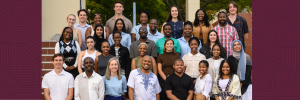
Prof. Thulani Makhalanyane (middle front) leads a large research group in African microbiome research in the Department of Microbiology at Stellenbosch University, consisting of eight postdoctoral fellows, six BScHons, dertien MSc and nine PhD students. The group is also strategically aligned with SU’s School for Data Science and Computational Thinking, thereby strengthening computational and systems biology skills within microbiome science in Africa. Credit: Peartree Photography
African microbiomes – from humans to ecosystems – will be focus of new research chair at SU
- African microbiomes are conspicuously absent from global datasets, with less than 3% of microbial diversity characterised to date.
- New research chair will reduce the knowledge gap regarding African microbiota.
- Prof. Thulani Makhalanyane is well-known for advocating the significance of and the vital role of microbiomes in health, agriculture, and environmental sustainability, particularly within the African context.
Africa’s unparalleled biodiversity and environmental variations present an extraordinary opportunity to explore novel microbial species and their functions. Yet African microbiomes are conspicuously absent from global datasets, with less than 3% of microbial diversity characterized to date.
This knowledge gap will now be addressed by a new research chair at Stellenbosch University, led by Prof. Thulani Makhalanyane, a leading international microbiologist and advocate for why African microbiomes matter. He also leads the African Microbiome Project – a pan-African effort to reduce the knowledge deficit regarding African microbiota by sequencing 10 million samples.
The South African Research Chair (SARChi) in African Microbiome Innovation is part of an initiative by the Department of Science, Innovation and Technology (DSTI) and the National Research Foundation (NRF) to attract and retain top researchers at South African public universities.
Prof. Makhalanyane is well-known for advocating the significance of and the vital role of microbiomes in health, agriculture, and environmental sustainability, particularly within the African context. Yet African microbiomes remain critically understudied: “This knowledge deficit is particularly concerning given Africa’s immense genetic diversity, environmental variability, and susceptibility of global challenges such as climate change, infectious diseases, and food insecurity,” he says.
“Current microbiome research is disproportionally concentrated in the global North, limiting the applicability of findings and impeding the development of context-specific solutions tailored to African systems. This disparity underscores the urgent need for dedicated research initiatives that prioritise African microbiomes, generating foundational datasets to inform science, policy and innovation,” he continues.
Furthermore, there is a critical need to strengthen research capacity and infrastructure in this field across the continent, ensuring that African scientists lead efforts that are relevant to African priorities. One of the main objectives of the new research chair will be to equip postgraduate students with the necessary skills in computational and systems biology within microbiome science. This will include the promotion of bioinformatics and machine learning in microbiome analysis, the creation of open-source computational toolkits tailored to African datasets, and the development of short courses in microbiome data science and microbial informatics.
According to Makhalanyane, his vision is to expand institutional research capacity and to foster a new cohort of computationally skilled microbiologists across Africa.
Prof. Sibusiso Moyo, Vice-Chancellor: Research, Innovation and Postgraduate Studies at SU, says the establishment of an NRF-SU chair on African microbiomes at SU comes at the right time when the University has just had its Research and Innovation Blueprint 2030 and Strategy Plan 2026-2030 approved. “By leveraging existing investments in genome sequencing and computational infrastructure at Stellenbosch University, this initiative will position Africa as a leader in microbiome science rather than merely a data source for global research efforts There is also an expectation of the Chair to continue internal and external collaborations.”
Prof. Bertie Fielding, Dean of the Faculty of Science at SU, says the chair will close a critical gap in global microbiome research by ensuring that African microbial diversity is studied, understood and led from Africa: “Prof. Makhalanyane’s work will be important for advancing science, building capacity and supporting solutions in health, agriculture and environmental sustainability,” he added.
Why microbial community research?
The community of bacteria, archaea, fungi, and viruses found in a particular environment is called its “microbiome”. Combined, they may have profound roles as regulators of human health and ecosystem functions. Initiatives such as the Human Microbiome Project and the African Biogenome Project have provided us with insights regarding the diversity and functions of these communities. For instance, several studies have demonstrated that microbes have the capacity to control food cravings, behaviour, and susceptibility to disease in animals. In soils, microbial communities control carbon sequestration, nutrient recycling and organic matter decomposition.
It is important to note, however, that there are large gaps in our understanding of the microbiome. There are several reasons contributing to this knowledge deficit. For example, most microorganisms are not easy to isolate in the laboratory. Current estimates suggest that less than 3% of microbial communities have been validly characterized. Some estimates suggest that several billion microorganisms remain uncharacterized, across a variety of ecosystems and hosts. In addition, current studies suggest that microbiota may vary considerably over local, regional, and global scales.
To reduce this knowledge deficit, we urgently need to investigate the diversity and functional attributes of microbial communities across diverse ecosystems, and particularly in Africa.
Related stories
Media release
People with Down syndrome must be included in conversations about their healthcare
People with Down syndrome and their families consistently value healthcare that is relational, respectful, and person-centred, rather than focused solely on...
Media release
SU scientist receives R14 million grant to tackle West Nile virus
As climate and environmental change continue to reshape ecosystems across the world, scientists are warning that mosquito-borne diseases may spread into new...
Media release
Many factors drive changes in human-wildlife relationships
Human populations are expanding and encroaching further into wildlife habitats, leading to dynamic and evolving relationships between humans and wildlife. As...