
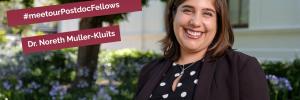
Dr. Noreth Muller-Kluits
#meetourPostdocFellows: Dr. Noreth Muller-Kluits
- In March 2025, the Public Squares Initiative launched its Postdoctoral Fellowship
- The fellowship is designed to embed early-career researchers within collaborative and engaged research spaces such as the Public Squares
- In this two-part series, we introduce our postdoctoral fellows
In March 2025, the Public Squares Initiative launched its Postdoctoral Fellowship with support from the Office of the Deputy Vice-Chancellor for Research, Innovation, and Internationalisation. The fellowship is designed to embed early-career researchers within collaborative and engaged research spaces such as the Public Squares where they can both contribute to and shape emerging research agendas.
“The idea for establishing a fellowship emerged from seeing how quickly our teams were generating new ideas, collaborations, and proposals, and recognising the need for dedicated capacity to sustain that momentum” explains Dr. Astrid Treffry-Goatley, Project Manager for the Public Squares.
The aim of the fellowship is not only strong academic outputs, but also the skills to work across disciplines and with societal partners. It also seeks to strengthen the initiative’s ability to translate research into sustainable and impactful change.
In this two-part series, we introduce our postdoctoral fellows as they share more about their projects, research journey and what brings them enjoyment and relaxation.
Dr. Noreth Muller-Kluits is a disability researcher, academic and social worker by profession. She is a Postdoctoral Research Fellow within the Public Square on Early Intervention and Child Mental Health, led by Dr. Anusha Lachman (Department of Psychiatry) and Dr. Berna Gerber (Department of Health and Rehabilitation Sciences).
What motivated you to apply for the Public Squares Postdoc Fellowship, and how does it align with your research interests?
Working within the dynamic, transdisciplinary space where we all bring our expertise to a broader theme – early intervention and child mental health – seemed like an amazing collaborative environment to learn from each other whilst also working towards common goals.
Could you describe your current research project and explain why this research is important right now? What key questions/problems does your project address?
My current research project is aimed at exploring the experiences of primary caregivers during early intervention, specifically in how disability is communicated during this process.
What has your academic journey been like leading up to this fellowship and are there key moments or influences that have shaped your work?
My academic journey thus far has been shaped and supported by extraordinary mentors at very key times. Since my first postgraduate qualification, I was fortunate to receive invaluable guidance and support from supervisors, research hosts, and professional experts. Many of the skills and opportunities I have today would not have been possible without them.
The ethos of the Public Squares Initiative is to advance collaborative and engaged research, involving key stakeholders such as community members, policymakers, etc. in the research process. How does your research reflect this?
My research aims to highlight the voice of the service user, in this case, primary caregivers, and then use advocacy to reach these different stakeholders.
What has been the most rewarding and challenging part of your fellowship so far?
I have enjoyed exploring different platforms to disseminate research and/or create advocacy for key topics within early intervention and child mental health, and I look forward to exploring this even further in the future.
In terms of challenges, I won’t necessarily call this a challenge, but the ethical application is always a key part of the process which often comes with its own technicalities for consideration to ensure the best outcome for the research study and the participants involved.
How do you hope your research will contribute to public discourse/policy, and what impact do you see for it beyond academia?
I hope that this research study will contribute to the way we look to support primary caregivers more, in how we communicate with them, what resources we provide for them, and how we make sure the information and resources are accessible.
How has being part of the Public Squares community shaped your thinking around research and its impact?
The transdisciplinary space has broadened my perspective on topics, especially as it relates to early intervention and child mental health, with a disability lens. Listening to and sharing experiences and thoughts with colleagues from different disciplines brings forward a very holistic perspective on these topics.
What do you enjoy doing outside of your research?
I enjoy new experiences, whether this is a new place or a new activity or even a culinary experience. I enjoy learning from these experiences I have never had before and always try to take something from it.
Is there a fun fact about you that not many people know?
I do enjoy having a plant-filled environment at home, so I am continuously working to develop this more and more.
Related stories

Opinion and features
Ending hunger in Africa needs Africa-led science — and the governance to match
World Hunger Day was observed on 28 May. In an opinion piece for the Mail & Guardian, Prof Scott Drimie of the Division of Human Nutrition explained why it is...

Opinion and features
Key continental issues highlighted on Africa Day
Building Africa’s future, Ubuntu and liberal democracy, the lives of migrant African women in South Africa, and the internationalisation of African higher...

Opinion and features
International Biodiversity Day: Wild harvesting across Africa for the global cosmetics industry
International Biodiversity Day was celebrated on 22 May. In an opinion piece for the Cape Argus, Dr Francis Vorhies of the African Wildlife Economy Institute...