
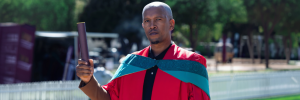
Dr Luphiwo Mduzana at the graduation ceremony.
SU celebrates SA’s first black orthotist-prosthetist to obtain a PhD
- Dr Luphiwo Mduzana obtained a doctorate in health sciences rehabilitation.
- Role model for emerging medical orthotists and prosthetists.
- He hopes his achievement boosts orthotics and prosthetics in South Africa.
“Coming from a rural background should never limit one’s aspirations. What matters most is not where you come from, but where you want to go and what you are determined to achieve.”
These are the words of Dr Luphiwo Mduzana, who on Thursday (26 March 2026) became the first black medical orthotist and prosthetist (a specialist who design and fit supportive devices like braces and artificial limbs) in South Africa to obtain a PhD. Mduzana received his doctorate in health sciences rehabilitation at Stellenbosch University (SU)’s March graduation. He heads the Department of Rehabilitation Medicine at Walter Sisulu University (WSU) in the Eastern Cape.
Mduzana, who grew up in the small town of Cala in the Eastern Cape, says his achievement is a collective accomplishment rather than an individual one.
“Many people have contributed to my journey. It has taken me nearly six years to complete my PhD, and throughout this time I have been supported by many individuals particularly my children, my siblings, my mother, colleagues at WSU, supervisor and mentors at the SU’s Division of Disability and Rehabilitation Studies and my close friends who encouraged me along the way.
“Because of this support, I believe this milestone does not belong to me alone; it belongs to the many people who walked this journey with me and to the broader orthotics and prosthetics profession.”
Mduzana’s supervisor, Prof Lieketseng Ned from SU’s Division of Disability and Rehabilitation Studies, says his achievement represents a significant milestone for the profession and positions him as a role model for emerging medical orthotists and prosthetists. “Through his leadership and scholarship, he is poised to contribute meaningfully to the advancement, transformation, and academic strengthening of the profession in South Africa.”
Encouragement
Although Mduzana aspired to become an engineer, his mother suggested a career in medicine. She was right. “When I discovered the field of medical orthotics and prosthetics, it felt like the perfect balance between the two.
“Through this profession, I can design and manufacture assistive devices for people who need them, while also working within the healthcare environment that my mother envisioned for me. In many ways, it became the best of both worlds.”
Mduzana says another inspiring moment occurred during his third year of study in Tanzania when one of his lecturers explained that the beauty of prosthetics and orthotics lies in the ability to restore mobility — for example, a patient may arrive in a wheelchair, but after receiving a prosthetic device, they leave walking again. “Witnessing someone regain their independence whether returning to school, work, or sport is incredibly fulfilling. That moment is priceless and remains one of the greatest rewards of this profession.”
As is often the case with a PhD journey, Mduzana faced his fair share of challenges. One of the biggest obstacles he had to overcome was the Covid-19 pandemic, which started in 2020 when he began his research. He lost valuable time and had to change aspects of his methodology and research design to adapt to the new circumstances.
Balancing academic work with family life was another challenge because it required careful management, Mduzana says. “As a father of four, there were certainly moments when the demands of research and family responsibilities felt overwhelming. However, I was fortunate to receive strong support from my family and friends. Their encouragement made it possible for me to remain present as a father while continuing to pursue my academic goals.”
PhD research
For his PhD, Mduzana focused on developing clinical guidelines for lower-limb prosthetic prescription. He points out that South Africa does not have a standardised national guideline that practitioners can rely on when prescribing lower limb prostheses. As a result, clinicians often depend on guidelines developed in other countries, which may not always reflect the realities of our healthcare systems or patient populations.
“My research seeks to develop practitioner informed guidelines that are grounded in the experiences and expertise of clinicians working within our context.
“By developing locally relevant guidelines, clinicians will be better equipped to determine whether a person with an amputation is an appropriate candidate for prosthetic rehabilitation and what type of prosthetic intervention would best suit their needs.
“My hope is that this research will strengthen evidence-based practice in prosthetic prescription within South Africa. Clinical guidelines are essential in healthcare because they provide structured, research-informed approaches to decision-making.”
Mduzana says his research also considers the broader realities of developing countries, which makes it relevant not only to South Africa but also to the Southern African Development Community (SADC region).
“Hopefully, these guidelines can be adopted or adapted by neighbouring countries, and that some of them may participate in piloting and refining the framework. This would allow us to collaborate regionally in strengthening prosthetic care.”
Message
Mduzana would like his latest achievement to inspire young professionals entering the field and help grow the profession. “I would like to see the science of orthotics and prosthetics continue to develop in South Africa, with the emergence of specialised areas of expertise and stronger research contributions.
“I also hope it contributes to transformation within the profession and encourages young professionals to pursue advanced training and leadership roles. The next generation has the potential to shape the future of orthotics and prosthetics in our country.”
For students from small towns or disadvantaged backgrounds who aspire to pursue postgraduate studies, Mduzana has this message:
“Believe in yourself and in your dreams. If one person can achieve something, it means others can achieve it as well. Your background or circumstances should never define the limits of your potential.
“What matters most is determination, belief, and commitment to your goals. If you set your mind to something and remain focused on it, it becomes possible to achieve even the most ambitious aspirations.
“Pursue your dreams boldly. Whether you aspire to become a doctor, a professor, or a researcher, those goals are entirely within reach. With dedication and perseverance, anyone can achieve what they set out to become.”
Related stories
Awards and milestones
Retha Smit’s lifetime of determination leads to PhD at 67
At 67, Dr Retha Smit is living proof that you’re never too old to learn. A lifelong learner, Smit received her PhD in psychiatry from Stellenbosch University...
Awards and milestones
SU bestows honorary doctorate on pioneer of digital banking in Africa
Dr Tjaart Johannes van der Walt, regarded as a pioneer of digital banking on the African continent, was awarded an honorary doctorate by his alma mater...
Awards and milestones
SU awards honorary doctorate to champion of health equity
Stellenbosch University (SU) awarded an honorary doctorate to pioneering South African social scientist and epidemiologist Dr Olive Shisana on Thursday (26...