
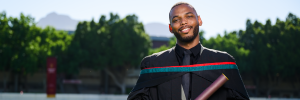
A quiet childhood dream propelled Dr Kevin Naude to success
- A first-generation graduate reflects on a near-decade academic path from SciMathUS to medicine.
- Loss, faith, and family shaped Naude’s resilience during the most demanding year of his degree.
- Mentorship, community and leadership helped him earn top recognition, including a Rector’s Award.
For as long as he can remember, Dr Kevin Naude fostered an unspoken dream: the idea that he might one day become a doctor. Now, nearly a decade after first stepping onto Stellenbosch University’s (SU) campus, he has become the first medical doctor in his family. But what should have been a celebratory final year brought unexpected tragedy as two close family members passed away earlier this year.
Growing up in Ida’s Valley, Naude was shaped by the histories of two Karoo towns – Oudtshoorn on his mother’s side and Carnarvon on his father’s. His grandparents, forced by circumstance to leave school early, had something more enduring than qualifications to pass down. “They taught us respect, discipline and humility,” he says. Those values became the backbone of a journey that required endurance and unwavering faith. “My family wanted better for me and my siblings, and their hope became my motivation,” Naude adds.
The long road to medicine
His path was never straightforward. Weak matric results initially closed the door to medicine, but not to determination. Naude enrolled in SciMathUS (a one-year bridging course at SU), a move that would reshape his confidence and his future. “SciMathUS showed me that my circumstances did not define my potential,” he says. “It gave me the tools and confidence I needed to enter higher education.”
After completing this programme, he pursued a BSc degree – and excelled. Graduating cum laude in 2019 was proof that he belonged in the academic world he once thought was beyond reach. The achievement opened the door to the MBChB programme at SU.
As a first-generation student, he was acutely aware of the sacrifices behind his education. “After my father was retrenched in 2019, he and my grandmother paid my tuition and residence fees from her pension, while my mother took care of textbooks and daily necessities,” he says. A bursary from the Department of Labour Compensation Fund in 2021 eased some of the pressure, but the responsibility of success remained on his shoulders.
A year marked by loss
Nothing, however, prepared him for the emotional challenges of 2025. His maternal uncle passed away in March. In July, on his birthday, Naude lost his maternal grandmother, whose guidance had shaped his life. “When such moments arrive, life feels divided into a before and an after. The grief was overwhelming,” he says.
Balancing this loss with rotations, exams and clinical responsibilities would challenge even the most seasoned professional. Yet Naude persisted, leaning on prayer, the support of family and friends and the grounding routines he had built during medical school. “This period taught me that perseverance is not only about achieving goals, but also about showing compassion and remaining committed even when life becomes heavy.”
Throughout his studies, moments in the wards and clinics provided clarity about the kind of doctor he hoped to become. His elective at the Helderberg Hospice in 2023 had a profound impact. “I came to understand that healing is not always about curing; sometimes it’s about presence and preserving a patient’s dignity,” he says. It was around this time that his own grandmother fell seriously ill, a convergence of events that deepened his understanding of vulnerability and care.
Leadership, purpose and recognition
Over the past few years, leadership opportunities gave him broader purpose. He invested deeply in mentorship and student governance, guided by his belief in uplifting others. “Helping peers reminded me that when we lift others, we strengthen ourselves,” he says.
His influence on campus did not go unnoticed. In 2024 he received one of SU’s highest honours – the Rector’s Award for Excellent Achievement, alongside Tygerberg Student Representative Council (TSRC) Honorary Colours for leadership. For Naude, the recognition affirmed that contribution extends far beyond academics. “Success is measured not only by achievements, but also by the impact we have on others,” he says.
Looking back, Naude realises that medicine revealed itself slowly, shaped by encounters with patients at Tygerberg Hospital and surrounding clinics. “These experiences taught me not only about disease but about resilience, humanity and vulnerability.”
The routine of medical school – early mornings, clinical rotations, late-night studying – taught him structure and discipline. Senior doctors invested in his growth, modelling the kind of clinician he hopes to become. Support networks carried him through moments when grief and pressure collided. “I learned to celebrate small victories and remain humble, curious and dedicated. I’m grateful to the Almighty that I’m fortunate enough to become a doctor.”
A message to the next generation
For younger students, especially those from under-resourced communities, Naude offers a message shaped by experience. “Your beginnings do not determine your future,” he emphasises. “Many journeys are longer or less direct, but that doesn’t diminish their value. Dreams may be delayed, but they are rarely denied.” His advice is both practical and hopeful: Seek help, ask questions, trust that your path holds meaning even when it feels slow.
As he prepares for the profession he once only dreamt of, Naude is clear about the doctor he wants to become. A life of service and compassion guides his ambition to specialise as a physician. “I run my own race and strive to be better than I was yesterday,” he comments.
His years at SU have anchored him and he’ll always be grateful for the opportunities he received. “These experiences shaped my resilience, humility and appreciation for the cards I have been dealt. I developed not only my academic abilities, but also my character and sense of purpose.”
Related stories
Awards and milestones
Matie alumnus appointed CEO of United States Tennis Association
From the Maties tennis courts in Stellenbosch to leading one of the biggest organisations in world tennis, Stellenbosch University (SU) alumnus Craig Tiley...
Awards and milestones
Top first-year achievers shine at Vice-Chancellor’s Excellence Awards
Stellenbosch University (SU) honoured 37 of the country’s most outstanding matric achievers on Tuesday evening at the Vice-Chancellor’s Excellence Awards for...
Awards and milestones
SU biotech spin-out bags SWEAT Africa 2026 pitch prize
A Stellenbosch University biotech spin-out competed against some of the best startups in Africa to clinch the top prize at the 2026 SWEAT Africa pitch...