Electronics and Electromagnetics
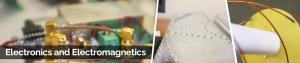
Research activities cover the areas of antennas and propagation, numerical methods for solving complex electromagnetic field problems, microwave systems and devices, RADAR, electromagnetic compatibility and superconducting circuits.
This division’s research activities receive financial support from the NRF and several companies in the private sector. A specific, significant source of funding is the SKA SARCHI research chair.
More details on the main research focus areas within this division are listed below.
Computational Electromagnetics
Electromagnetic structures can become exceeding complex to analyse or design analytically and measurement of structures in the microwave regime and beyond can be exceedingly expensive. Computational electromagnetics (CEM) is concerned with the numerical solution of Maxwell’s equations, in order to simulate electromagnetic field behaviour and consequently the performance of electromagnetic structures. CEM is a crucial enabling technology for radio frequency, microwave and wireless engineering, as well as being a technology in its own right. All widely-used CEM methods are of interest to us, including the finite element method (FEM), method of moments (MoM), finite difference time domain method (FDTD), as well as asymptotic methods and hybrid methods. We closely interact with EM Software & Systems – S.A., developers of the EM simulation software suite FEKO.
- Contact Prof. Matthys Botha for more information on this research activity.
HF Metrology and Electromagnetic Compatibility
High frequency (HF) metrology is concerned with reliable measurements at high frequencies using the following:
- Instruments such as vector network analyzers, spectrum analyzers, power meters and sampling oscilloscopes
- Facilities such as anechoic and reverberation chambers, and open area test sites
- Sensors such as E-field and B-field sensors, common-mode current probes, Rogowski coils, Bersier probes, etc.
A key feature of metrology is that of calibration. In this regard, we have active relationships with standards bodies in South Africa and also with the National Institute of Standards and Technology (NIST) in Boulder, Colorado.
- Contact Dr. Gideon Wiid for more information on this research activity.
High Frequency Antennas
Areas of interest include microstrip antennas for satellite communications, spiral antennas for ground penetration and borehole radar, wave propagation in complex electromagnetic environments, free-space and near-field measurement techniques, the Karoo Array Telescope (KAT) and the Square Kilometre Array (SKA).
Facilities include a microwave anechoic chamber for antenna measurements, a Gaussian microwave optics test bench for the measurement of material properties and across-the-board measuring facilities up to 50GHz.
- Contact Prof. Dirk de Villiers for more information on this research activity.
Microwave Active Components and Systems
This research activity focuses on the design of active components such as low-phase noise oscillators and phase-locked loops typically used in radars, low noise and high power amplifiers and microwave sensors. High-speed, multi-channel QPSK data transmitters and receivers are developed for satellite applications. A strong modelling and measurement expertise is available, involving close interaction with local radar and avionics industries.
- Contact Prof. Johann de Swardt for more information on this research activity.
Microwave Passive Systems
This activity concerns the design, electromagnetic analysis and optimisation of passive microwave circuits such as filters, couplers, high power combiners, etc. In terms of component design, current research focuses on high-power devices at X-band, including power combiners and PIN diode switches, with specific attention to new structures and topologies. Antenna feed design for the Karoo Array Telescope (KAT) is also included in this research. On a systems level, millimetre-wave imaging at 35 and 94GHz has emerged as a strong international focus due to its applications to security. This research is undertaken at a systems level as well as a device level, with the aim of finding cost-effective solutions to industry problems. In terms of modelling, the focus is on adaptively sampled interpolation-based mathematical models of microwave structures. This type of model can be constructed by using very few electromagnetic analysis points, and can be used to great effect in the optimisation of circuits containing these structures.
- Contact: Prof. Petrie Meyer for more information on this research activity.
SKA SARCHI Research Chair
As part of the Square Kilometre Array (SKA) project and the South African Research Chair Initiative (SARCHI), Prof. Dirk de Villiers has been appointed as the SKA SARCHI research chair. This chair funds a wide range of research activities within the Electronics and Electromagnetics division, all related to the SKA project. The SKA is an ambitious project to construct the world’s largest ever radio telescope, right here in South Africa. The aim of the chair is to support the SKA-related electromagnetic engineering work here in South Africa as closely as possible, and to simultaneously use this as a vehicle for world-class research in the field.
- Contact Prof. Dirk de Villiers for more information on this research activity.
Superconductor Quantum Electronics and Sensors
This research activity, under the Quantum Electronic Design Automation (QEDA) laboratory, focuses on the development and application of superconductor quantum circuits in advanced electronic systems. The research encompasses the design and optimization of superconducting quantum interference devices (SQUIDs), cryogenic sensors, and high-speed digital circuits. A significant aspect of this research concerns integrated circuit parameter extraction. This work is crucial for accurately modelling and predicting the behaviour of superconductor circuits, enabling the design of highly efficient and reliable superconductor electronic components. The team’s efforts are pivotal in advancing quantum computing technology, and in partnership with international collaborators this research aims to create qubits and quantum gates with superior coherence times and operational speeds compared to traditional semiconductor-based systems. The research not only pushes the boundaries of quantum electronics but also holds promise for transformative applications in medical imaging, scientific instrumentation, and quantum computing.
- Contact Prof. Coenrad Fourie for more information on this research activity.
High Frequency and Antenna laboratories – This is the university’s RF and antenna measurement laboratory. For more information about the services that are available, please contact Ms Anneke Bester at [email protected].
Superconductivity and Nano-Devices (SAND) – Our research group is called SAND (Superconductivity, Advanced materials and NanoDevices), and we research Superconductive digital circuits (including software-defined radio front-ends), superconductive IC parameter extraction (inductance), superconductive analogue sensors, SQUID magnetometry, cryocooled electronic interfaces, EDA software development, and geomagnetism.