
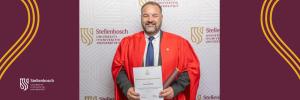
Inaugural Lecture: Prof Arnold Rix’s Vision for Engineering a Stable, Low-Carbon Future
- South Africa holds a distinct advantage in the global shift toward sustainable power: exceptional solar and wind resources. Yet, the availability of these natural resources does not automatically translate into a stable power supply. The variability of renewable sources places significant pressure on our national grid, which was historically designed for steady, centralised generation.
South Africa holds a distinct advantage in the global shift toward sustainable power: exceptional solar and wind resources. Yet, the availability of these natural resources does not automatically translate into a stable power supply. The variability of renewable sources places significant pressure on our national grid, which was historically designed for steady, centralised generation.
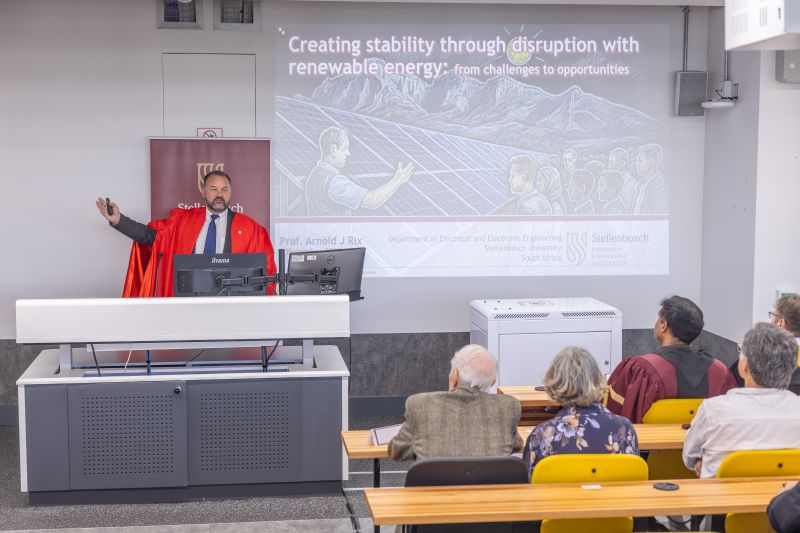
On Thursday, 6 November 2025, Professor Arnold Rix addressed these issues in his inaugural lecture titled Creating Stability Through Disruption with Renewable Energy: from Challenges to Opportunities.
Professor Rix holds the Scatec Chair in Renewable Systems within the Department of Electrical and Electronic Engineering. His work concentrates not merely on generating cleaner energy, but on the engineering required to make that energy reliable. He aims to close the distance between theoretical modeling and the physical reality of the grid.
The Challenge of Low-Inertia Grids
The central technical hurdle facing South Africa is grid stability. Traditional power stations provide inertia (a physical property that helps stabilise grid frequency when demand fluctuates). But solar and wind systems, connected via inverters, do not inherently provide this support. This means the country is effectively moving toward “low-inertia grids,” or electricity systems with little built-in stability.
Professor Rix’s research group at the Department of Electrical and Electronic Engineering at Stellenbosch University confronts this by combining modeling, field experimentation, and system-level integration. They work to improve photovoltaic (PV) performance and degradation analysis, refine forecasting methods, and optimise hybrid storage. The objective is to design systems that do not just participate in the grid but actively support it.
Industry Alignment as a Driver for Innovation
That said, academic research must eventually function outside the laboratory. Through the Scatec Chair, Professor Rix’s work maintains a direct link to industrial application. This partnership allows the team to test models against real-world data, improving the design and operation of large-scale projects.
Professor Rix notes that the work supports the optimisation of PV plant designs to guarantee long-term operation. The team developed forecasting tools that help utilities plan for higher renewable penetration without risking blackouts. Beyond the main grid, they examine the electrification of paratransit. By introducing solar-powered charging infrastructure to the informal transport sector, the research extends the benefits of renewable technology to broader segments of the economy.
A Coordinated Approach to Energy Security
As mentioned, South Africa has a distinct geographical advantage, but it also faces specific hurdles: grid instability, limited storage capacity, and slow infrastructure expansion. While regulatory uncertainty often slows large-scale integration, the engineering solutions are becoming clearer. The sector requires a coordinated approach combining improved forecasting, superior grid management, and investment in flexible generation.
Professor Rix’s team develops advanced PV and wind performance models to conduct grid-stability analyses. They design hybrid energy systems capable of higher renewable penetration. By strengthening ties among academia, industry, and policymakers, the Faculty can accelerate the transition from research outcomes to scalable solutions.
Future Outlook: Intelligence and Decentralisation
Looking ahead, the energy sector will become increasingly integrated and intelligent. Rix anticipates a shift where digital technologies, such as AI-driven forecasting and real-time system optimisation, make renewable systems more resilient.
Hybrid solutions combining solar, wind, and storage will likely dominate, supported by improvements in battery chemistry and grid-interactive inverters. In the South African context, distributed generation and local microgrids offer a practical path to improve energy access. Furthermore, coupling renewables with green hydrogen and electric mobility offers an opportunity to decarbonise across multiple sectors.
Precision in Research
Professor Rix’s approach to these technical challenges mirrors his personal interest in long-range target shooting. That discipline demands patience, an understanding of environmental factors, and absolute precision, qualities that are equally necessary in engineering research. It requires a clear focus to solve complex problems.
He continues to guide students to become confident engineers. Their work, and the continued cooperation between the Faculty and industry partners, will form the backbone of a sustainable energy system. The transition to a low-carbon future is not just about installing solar panels; it is about the intelligent engineering that keeps the lights on.
Read the full editorial: https://www.su.ac.za/en/news/prof-arnold-rix-advances-renewable-energy-technologies-low-carbon-future
Watch Professor Rix’s lecture: https://www.youtube.com/live/h_P3L1btxyQ?si=wAHOASMLP2goMP9J
Related stories

Engineering and technology
A Smarter Way To Manage Home Energy During Load-Shedding
For many South African households with solar panels and batteries, the hard part isn’t installing the hardware. The harder part is deciding when to charge the...
Engineering and technology
When Mobile Networks Fail, A Phone Can Still Reach Your Group
At a concert, sports event, or outdoor gathering, people often assume their phones will work when they need them. In practice, that can fall apart fast. If too...
Engineering and technology
Engineering Open Day returns to a reimagined space
Grey skies and a passing thunderstorm did little to deter prospective students and their families from attending the Faculty of Engineering’s 2026 Open Day on...