Prospective Undergraduates
Industrial engineering provides the tools for modern businesses to thrive in today's competitive world. By analysing and improving processes and systems, industrial engineers ensure businesses are constantly improving and achieving optimal results. This field is essential for organisations seeking to solve complex problems, optimise resources, enhance productivity, and drive innovation to stay ahead of the curve.
Industrial Engineering is about making complex systems work better. You’ll learn to analyse and improve processes, optimise resources, and design solutions that create real‐world impact in settings as varied as manufacturing plants, logistics networks, hospitals, and service organisations.
Our programme combines a strong technical foundation with the human side of organisations. You’ll build depth in engineering design, analytics and operations while gaining grounding across mechanical, electrical, civil and chemical engineering, together with manufacturing and management science. At the same time, you’ll develop the communication, leadership and group‐dynamics skills needed to guide teams, manage change, and present clear, evidence‐based recommendations to decision‐makers.
Industrial engineers tackle the analysis, design, planning, implementation, operation, management and maintenance of integrated systems of people, money, materials, equipment, information and energy. You’ll turn data into decisions using statistics, optimisation and simulation - often under uncertainty - so that improvements are not only effective but sustainable. Along the way, you’ll engage with core domains such as manufacturing and production systems, analytics and operations research, logistics and supply chains, quality and reliability, information systems, and engineering economics and management.
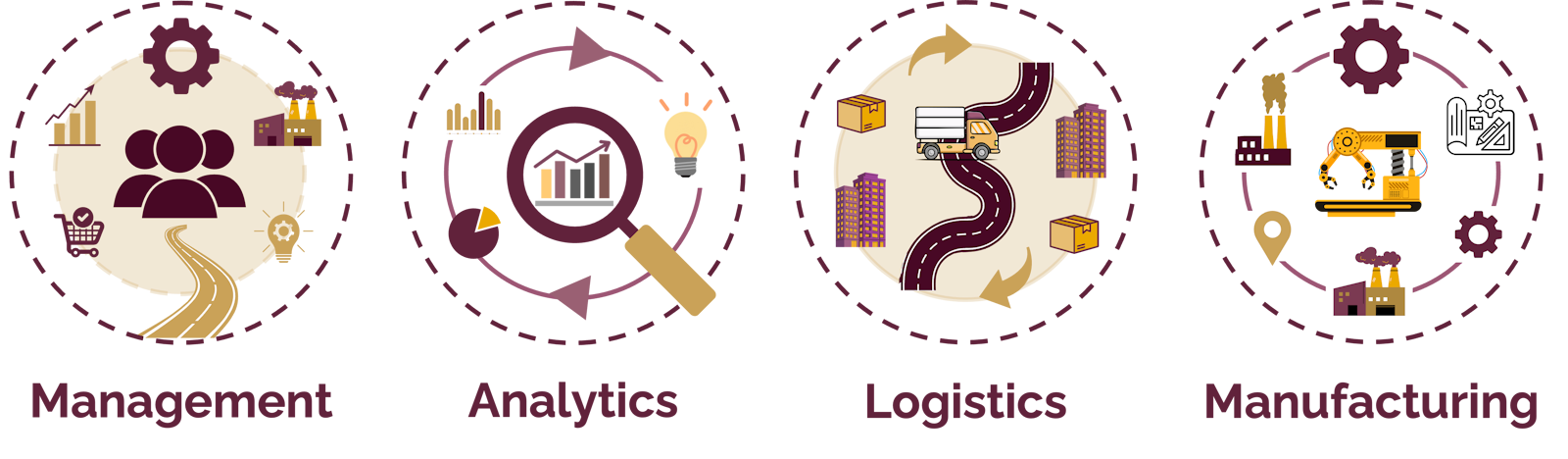
Graduates pursue diverse careers in process optimisation, quality management, project management, data analytics, operations and supply chains, and systems design—across industries and sectors. The result is a versatile skill set that lets you see the big picture, simplify complexity, and deliver measurable improvements wherever people, processes and technology intersect.
What is the Bachelor of Engineering (BEng) in Industrial Engineering?
The Bachelor of Engineering (BEng) in Industrial Engineering at Stellenbosch University is a four-year professional engineering degree accredited by the Engineering Council of South Africa (ECSA). This accreditation confirms that the programme meets the standards required for engineering practice in South Africa and that it is a fully recognised engineering qualification.
Through ECSA accreditation and South Africa’s participation in the Washington Accord, the degree is also internationally recognised in many countries, including the United Kingdom, Ireland, Canada, the United States, Australia, and Hong Kong. Graduates of the programme may, after completing the required practical experience, apply for registration as a Professional Engineer (PrEng), providing a clear pathway to professional engineering practice both locally and internationally.
For the complete curriculum of the four-year BEng (Industrial Engineering) programme, refer to the Engineering Yearbook 2026 (Section 2.11.3 and 2.11.7).
First Year
Your first year lays the groundwork shared by all engineering students. You’ll develop core mathematical and scientific skills and learn how engineers think and solve problems. Typical modules include Engineering and Applied Mathematics, Chemistry, Electrotechnics, and Engineering Drawing, along with a dedicated introduction to Industrial Engineering.
Second Year
From second year, you move from mostly pure mathematics to engineering modules that apply mathematics to practical problems. Degree pathways begin to diverge as you focus more on Industrial Engineering topics. You’ll start working with tools used to plan and improve production and operations, with Production Management introduced alongside applied mathematics and engineering sciences.
Third Year
Third year deepens your Industrial Engineering expertise. You study Quality Assurance and Management to ensure products and services meet high standards, Operations Research to make data‑driven decisions, Engineering Economics and Manufacturing to weigh costs and benefits in real settings, Data Analytics to interpret and use data effectively, and Engineering Statistics to model uncertainty. You also explore Philosophy and Ethics to understand the responsibilities of engineers in society.
Fourth Year
Your final year brings the pieces together in advanced, practice‑ready modules. You’ll work with Information Systems to support decision‑making, Simulation to test and optimise complex systems, Industrial Practice to gain real‑world experience, Enterprise Design to design end‑to‑end operations, and Industrial Ergonomics to make workplaces safer and more efficient. You also strengthen your professional toolkit with complementary modules such as Project Management and Environmental Engineering. In addition, you complete a supervised Final‑Year Project (capstone) where you apply the skills developed across the degree to solve a complex, real‑world industrial engineering problem. This project typically involves defining the problem, collecting and analysing data, building models and simulations, designing and optimising solutions, and presenting your results in a professional report and oral presentation, often in collaboration with an industry or community partner.
Thinking about applying? If you enjoy problem‑solving, teamwork, and improving how things work—whether in manufacturing, healthcare, logistics, or services—Industrial Engineering offers a versatile pathway with strong career prospects.
The detailed admission requirements for the BEng Industrial Engineering programme at Stellenbosch University can be found here.
Application deadlines
The annual application deadline for the upcoming academic year is 31 July. Late applications, closing on 30 September, will be considered only if space is available in the Industrial Engineering programme.
How to apply
To be considered for admission to the BEng Industrial Engineering programme, applicants must submit an online application via the SUN Student Applicant Portal before the application deadline.
Applicants who are in Grade 12 at the time of application will be considered for conditional admission based on their final Grade 11 results. Please note that Grade 12 term or preliminary results are not used for conditional or provisional admission decisions.
Applicants who have already completed Grade 12 will be assessed using their final Grade 12 results. If successful, they will receive a final offer of admission, which must be accepted before the indicated expiry date.
For step-by-step guidance on applying online to Stellenbosch University, click here.
Need help with your application?
If you experience any issues uploading your application documents, please email the Stellenbosch University Client Services Centre at [email protected]. Include your full name and application number in all correspondence with SU.
Application fee
An application fee is payable when applying to study at Stellenbosch University. Read more about application fees here.
Tuition fees
For detailed information on tuition and study fees at Stellenbosch University, click here.
Provisional and personalised fee quote
Prospective students may request a provisional fee statement for any year of the BEng Industrial Engineering programme.
To generate a quote, click here and select the modules you plan to register for in the upcoming academic year under Module selection. Once you have generated and downloaded your quote, please save the file and open the PDF from your device. The document may not open correctly directly in your web browser.
Can I transfer into Industrial Engineering from another programme?
Most four-year BEng programmes, including Industrial Engineering, share the same core modules in the first year (with the exception of Data Engineering in BEng (Electrical & Electronic Engineering)).
Students who successfully complete all first-year core modules may apply to transfer into Industrial Engineering at the end of their first year. If any first-year modules are not passed, a transfer to another BEng programme is subject to a selection process and availability.
For undergraduate enquiries or prospective student support, email us at [email protected] or contact: