
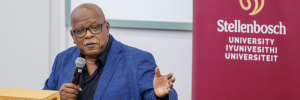
Scholars reflect on the transformative legacy of Prof Lis Lange
- Leading academics, colleagues and students gathered at SU to reflect on Prof Lis Lange’s wide-ranging impact.
- The symposium critically appraised Lange’s legacy in curriculum reform, governance and intellectual activism.
- A commemorative volume based on the papers delivered at the symposium will be published next year.
Colleagues, friends, and students of the late Prof Lis Lange recently assembled in the Library Auditorium at Stellenbosch University (SU) for a memorial symposium that examined her enduring mark on higher education in South Africa. The event, “The contribution of Prof Lis Lange to higher education in South Africa: A critical appraisal,” served as both a tribute and a rigorous evaluation of an academic who shaped the sector across multiple institutions.
Jointly sponsored by Stellenbosch University and Nelson Mandela University (NMU), the initiative for hosting the event came from Prof Jonathan Jansen, Distinguished Professor in the Faculty of Education at SU and Prof André Keet, Deputy Vice-Chancellor: Engagement & Transformation at NMU.
In his opening remarks, SU Rector and Vice-Chancellor Prof Deresh Ramjugernath said the purpose of the symposium was to not only celebrate Lange’s life, but to capture and examine her ideas, leadership and contribution to the higher education sector in South Africa.
Lange’s career spanned senior roles at science councils, multiple universities including SU, the University of the Free State (UFS), the University of Cape Town (UCT), and NMU, and the Council on Higher Education. She influenced both policy and practice, her work resonating well beyond individual institutions. “Lis believed that universities must think critically about themselves,” Ramjugernath said. “She believed inquiry, reflection and, importantly, constructive critique to be essential for institutional growth. She had a deep and unwavering belief that universities exist to serve society – not symbolically but substantively.”
Prof Sibongile Muthwa, Vice-Chancellor of NMU, contributed via recorded message to highlight Lange’s legacy as an influential figure in the sector with her “transgressive and courageous” insights on matters ranging from the politics and practice of the curriculum to asymmetries in policy and governance. “Given the global and national challenges faced by our institutions, Lis’ critical thinking and analysis, her forthright critique and her insights are going to be profoundly missed,” Muthwa noted.
The symposium convened diverse voices to appraise Lange’s leadership in areas such as curriculum transformation, teaching and learning innovation, and the evolving role of quality assurance in South African higher education.
Personal reflection
In a poignant contribution the focus shifted from intellectual appraisal to a personal reflection on the lives that Lange touched. The testimony of Mx Lihlumelo Toyana, a writer and cultural worker, drew the gathering into an intimate orbit around Lange’s enduring influence.
Toyana, once a student assistant at the UFS, painted a portrait of mentorship that was deeply empathetic. “Lis saw me not as an errand runner or as a peripheral figure, but as a young scholar with ideas worth taking seriously; a young thinker with a mind and a voice worth engaging,” she reflected. Toyana described a leadership that dissolved hierarchies: “She asked about my inspirations, she listened, she affirmed, and in doing so, dismantled the power differentiations that so often stifle genuine connections.”
Toyana invoked Lange’s “affirmative, genuine, transformative” approach, recalling how she championed academic freedom, intellectual honesty and the protection of vulnerable voices.
Honouring the legacy of a ‘scholar-administrator’
Other speakers, including Prof Nomalanga Mkhize, Prof Kirti Menon, Prof Saleem Badat, Dr Reno Morar and Prof Danwood Chirwa reinforced the breadth of Lange’s legacy. They spoke of her fearlessness as a scholar-administrator, her critical imagination and her insistence that transformation in higher education must mean more than compliance or ritual.
Badat charted Lange’s work in theorising national quality assurance systems and her visionary engagement with questions of justice and democracy. Morar reflected on her leadership at UCT, where she compelled the institution to wrestle with the tension between effective administration and moral purpose. Chirwa described a manager who was both rigorous and compassionate, while Keet returned the focus to the intersection of personal conviction and institutional reform.
In his closing remarks, Jansen pierced the solemnity with a call for vigilance and solidarity in South African higher education. He warned of a “creeping xenophobia on our campuses”, cautioning that universities must remain spaces open to “the best ideas, the best people … regardless of the accident of geography”. Jansen’s tribute ended with a reminder that Lange belonged to “that rare tradition of scholar-administrators” who sacrificed personal ambition to build institutions, mentor new generations and keep alive the spirit of social justice.
The symposium closed with an eye toward continued engagement. The collection of papers presented at the event will be published in a commemorative volume next year. The book, Jansen said, will be a scholarly contribution “that ensures our ideas continue to move through the sector Lis helped to shape over her lifetime”.
- Watch the video of the symposium here.