
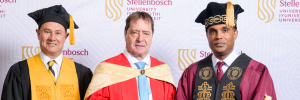
Colin Deiner (middle) received an honorary doctorate from Stellenbosch University.
SU honours internationally recognised disaster-management and response expert
- Colin Deiner received an honorary doctorate.
- He was honoured for his unwavering commitment to saving lives.
- He advances disaster management and response services.
The Western Cape provincial government’s Chief Director: Disaster Management and Fire and Rescue Services, Colin Deiner, received an honorary doctorate from Stellenbosch University (SU) at its December graduation. Deiner was awarded the degree Doctor of Engineering (Deng), honoris causa, on Monday (8 December 2025) at a graduation ceremony for the Faculty of Engineering.
He was honoured for his unwavering commitment to saving lives; his contributions to advancing disaster management and response services; and his generosity in sharing his expertise and knowledge across diverse platforms.
In his acceptance speech, Deiner expressed his deep gratitude for receiving an honorary doctorate from SU, highlighting the institution's reputation for producing engineers who contribute significantly to the country.
“It's difficult to put into words what it means to stand here today to receive an honorary doctorate. It’s deeply humbling and a profound privilege on its own to receive it from Stellenbosch University, an institution renowned for producing engineers who shape our country, our future. And to be the first disaster manager to be honoured in this way, is something I accept, not only personally, but on behalf of everyone in the disaster and emergency management services.”
He emphasised that this recognition signals that disaster management is no longer being seen as solely reactive but as an engineering challenge requiring scientific rigor and innovative thinking and a willingness to design solutions for threats that are growing more complex every day.
Deiner added that natural and technological disasters, building collapses, industrial accidents and failures of systems that were once considered robust are not isolated incidents, but symptoms of a world under immense environmental, climatic and societal pressure.
“They remind us that disasters do not occur in a vacuum. They happen at the intersection of people, infrastructure and environment. That intersection is the domain of engineering.
“Engineering is the quiet backbone of resilience. It is the unseen mass behind the flood wall, the structural integrity of a bridge in a swollen river, the reliability of a pump station that keeps the city alive, the redundancy built into a power grid, the design of buildings meant to survive both time and catastrophe.
“Good engineering saves more lives before a disaster than any emergency team can do during a disaster.”
Deiner told the Engineering graduates that the work they do will directly influence whether communities thrive or collapse in the face of adversity.
More about Colin Deiner
Colin Deiner is internationally recognised for his extensive expertise in disaster management and response. He has led South African search and rescue teams to disaster-affected areas across the country and abroad. This includes earthquakes in Turkey (1999), India (2001), Algeria (2003), Iran (2003-2004), Pakistan (2005), Haiti (2010) and Japan (2011), floods in Malawi (2015) and KwaZulu-Natal (2022), the 2017 Knysna fire disaster, and the George building collapse in 2024. Deiner also coordinated the drought disaster campaign (Day Zero) in the Western Cape and the non-medical component of the Covid-19 provincial response.
In 2017, he was recognised by the Disaster Management Institute of Southern Africa for extraordinary service to the disaster management profession and in promoting disaster risk reduction in South Africa.
Deiner has shared his extensive expertise widely, contributing regularly to industry publications on disaster management, search and rescue, wildfires, and related topics. He has also collaborated with several Stellenbosch University departments — including Fire Engineering in the Faculty of Engineering, the Research Alliance for Disaster and Risk Reduction (RADAR) in the Faculty of Arts and Social Sciences, and the Division of Emergency Medicine in the Faculty of Medicine and Health Sciences — to share his knowledge and support research and training initiatives.