
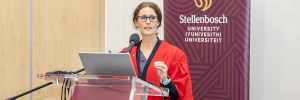
Prof Tammy Robinson-Smythe helps to keep invasive marine species in check
- Prof Tammy Robinson-Smythe of the Centre for Invasion Biology delivered her inaugural lecture on Thursday 14 May 2026.
- She focuses on how marine alien species spread along South Africa’s coast and how to manage them.
- Her work aims to support government and conservation agencies to manage marine invasions.
Prof Tammy Robinson-Smythe of the Centre for Invasion Biology in the Faculty of Science delivered her inaugural lecture on Thursday 14 May 2026. The title of her lecture was Research in support of conservation: the story of marine alien species in South Africa.
Speaking to the Corporate Communication and Marketing Division, Robinson-Smythe emphasised the importance of developing cost-effective approaches to manage the invasion of alien marine species.
Tell us more about your research and why you became interested in this specific field.
My work focuses on marine alien species i.e. species that don’t belong along the South African coast but have arrived in our waters because of human activities (e.g. shipping). I work on many aspects of marine invasions, including how they spread along our coast and how we can manage them to reduce the negative effects that they can have on our native biodiversity and people.
I started working in this field as a PhD student. I was interested in rocky shores and most of the mussels you find on the rocky shores on our west coast are an alien species from the Mediterranean Sea. The more I learnt about marine alien species, the clearer it became that there was a need to address this topic in South Africa. That was more than 20 years ago now, and I haven’t looked back.
How would you describe the relevance of your work?
I have purposefully chosen to work at the interface of pure and applied science. My work draws on theory but also focuses on on-the-ground application. As a developing nation, South Africa has limited resources to deal with invasions so there is a need to develop cost-effective approaches that support evidence-based decision making. My work aims to support government and conservation agencies in effectively managing marine invasions.
What are some of the major impacts of marine alien species on biodiversity in South Africa?
We have been very lucky that we haven’t yet had devastating impacts like those in many other regions. In South Africa the most severe impact has been from the invasion of the Mediterranean mussel that has changed rocky shore communities along more than 1 000 km of coastline.
How has our understanding of marine invasions in South Africa advanced in recent years?
Our understanding is constantly growing. In the last four years we have identified more than ten new alien species. We have also recognised the value of citizen science in monitoring for new invasions, and we have developed pre-emptive management approaches to support SANParks and other conservation agencies in protecting key biodiversity hot spots from invasions.
What practical steps or initiatives are currently underway to address marine invasions across Africa?
Unfortunately, very limited African work happens in the field of marine invasions. However, most countries are signatories to the Convention on Biological Diversity, so I’m hopeful that the situation will start to improve as they move towards meeting their legal obligations under this agreement.
The key to driving action is going to be active collaboration. To this end we are busy planning a workshop that will bring together government officials, academics and students from South Africa, Namibia and Angola. Participants will be taught how to identify alien species that might invade the Benguela system that all three countries share. We hope that this will be the start of a regional network that will address marine invasions.
Higher education can be challenging. What keeps you motivated when things get tough?
I really enjoy working with my postgraduate students! There is nothing more inspiring than working with young scientists who are excited and keen to contribute. I love that students see things differently and ask questions that haven’t been asked before. They keep me on my toes in the best possible way.
What aspects of your work do you enjoy the most?
The best part of my work is doing fieldwork with my postgraduate students. Getting out of the office and spending time in nature is good for all of us, but it’s even better when we find exciting things that no one has documented before.
Tell us something exciting about yourself that people would not expect.
I’ve been for a 10 km run on every continent except Antarctica – 6 down and 1 to go.
How do you spend your free time?
I’ll be honest, I don’t have much free time these days, but when I do, I spend it with my family. Our home runs on coffee, laughs and dog walks. It’s a little chaotic but there is nowhere else that I would rather be.
Related stories

Institutional news
Celebrating a partnership that invests in Africa's future
As the Gerda Henkel Foundation celebrates its 50th anniversary this year, Stellenbosch University (SU) reflects on the impact of its own decade-long partnership...
Institutional news
Connecting the dots: Prof Liezl van Dyk’s vision as new DVC: Academic
Stellenbosch University’s (SU) new Deputy Vice-Chancellor: Academic, Prof Liezl van Dyk, sees patterns everywhere: in 14-year chapters, prime numbers and the...

Media release
Cape Winelands Airport and SU forge strategic partnership for smart and sustainable development
Cape Winelands Airport and Stellenbosch University (SU) have entered into a cooperation agreement aimed at advancing innovation under the shared themes of...