
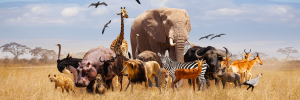
Many factors drive changes in human-wildlife relationships
- Changes in human-wildlife relationships shaped by much more than direct encounters.
- Influenced by people’s values, practices and institutions governing how wildlife is managed.
- Distant actors, media, and storytelling also play a role.
Human populations are expanding and encroaching further into wildlife habitats, leading to dynamic and evolving relationships between humans and wildlife. As they increasingly share space in new ways, it is important to understand what drives changes in human-wildlife relationships.
“Understanding how and why relationships between people and wildlife change can help us design more inclusive and effective approaches to their coexistence. This requires paying attention not only to ecological change, but also to people’s values, practices and the institutions that govern how wildlife is managed – especially in places where there is sudden ecological change, shifting public views and contested governance,” says Dr Dian Spear from the Centre for Sustainability Transitions at Stellenbosch University (SU).
In a study published in People and Nature on Tuesday (19 May 2026), Spear examined nine examples from the coastal waters of Cape Town and rural Southern Africa to better understand what drives change in human-wildlife relationships and how these drivers shape people’s interactions with wildlife. According to her, Southern Africa provides a diversity of wildlife and perspectives, fragmented landscapes and growing human-made pressures, mirroring global challenges in human-wildlife relationships and offering a useful context to explore them.
The examples she examined included a rabies outbreak in Cape fur seals in the coastal waters of Cape Town; the disappearance of great white sharks in these waters due to killer whale predation; the global reaction to the killing of Cecil the lion in Zimbabwe; the influence of the documentary My Octopus Teacher, which was filmed along the shores of False Bay, near Cape Town; the use of faux leopard fur in cultural ceremonies in Zambia and South Africa; and the impact of rhino poaching and militarised conservation in the Kruger National Park in South Africa.
Spear points out that, globally, changes in human-wildlife relationships are driven by shifts in what animals do, what people do, what people think, and the rules society puts in place. She adds that these drivers determine whether humans and wildlife species will encounter each other and how they will interact.
The cases highlighted in her study show that people’s relationships with wildlife in Southern Africa are dynamic and often contested, and vary widely across places, over time, and between different groups. “A single species might be seen as a cultural symbol, a threat, a source of income, a cherished neighbour or all of these at once.”
According to Spear, interactions between humans and baboons in the City of Cape Town and in rural South Africa offer a clear example of varied relationships, as people’s attitudes and responses to baboons differ across these areas. These differences influence how people and baboons interact.
“Some of the cases reveal the influence of distant actors and the role of the media and storytelling in changing what people think and how they feel about wildlife. This means that human-wildlife relationships are shaped by much more than direct encounters.”
If we want to succeed in managing increasingly dynamic and sometimes contested human-wildlife relationships, we must implement flexible, integrated approaches that consider both wildlife systems and human institutions, views and practices, Spear argues.
“In contested areas, these dynamics require transparent, context-sensitive decision-making, effective communication, stakeholder engagement, and conflict-resolution mechanisms that consider both local and global perspectives.
“My study offers a way to anticipate and navigate change in human-wildlife relationships, while highlighting the need for context-sensitive approaches that consider emotional, cultural and institutional factors.”
Spear emphasises the need for more research on changing human-wildlife relationships given the lack of studies regarding some of the cases she examined.
- Source: Spear, D 2026. “Drivers of change in human-wildlife relationships: Southern Africa as an example.” People and Nature. DOI: 10.1002/pan3.70340
Related stories

Media release
New internship programme at SU clinics opens doors for aspiring medical receptionists
For many young South Africans, earning a qualification is only the beginning of a difficult journey. The next hurdle is finding the work experience employers...
Media release
Stellenbosch University researchers and international partners develop global ‘Declaration on Multilingual Healthcare’
Patients who do not speak the same language as their healthcare providers are disadvantaged worldwide when it comes to accessing healthcare services and...

Media release
Seven days of gambling could wipe out a year of national student funding
At the current rate at which South Africans gamble, it would take just seven days to spend the equivalent of the country’s entire national student funding...