
Inaugural Lecture: Professor Reza C. Daniels
Contact information
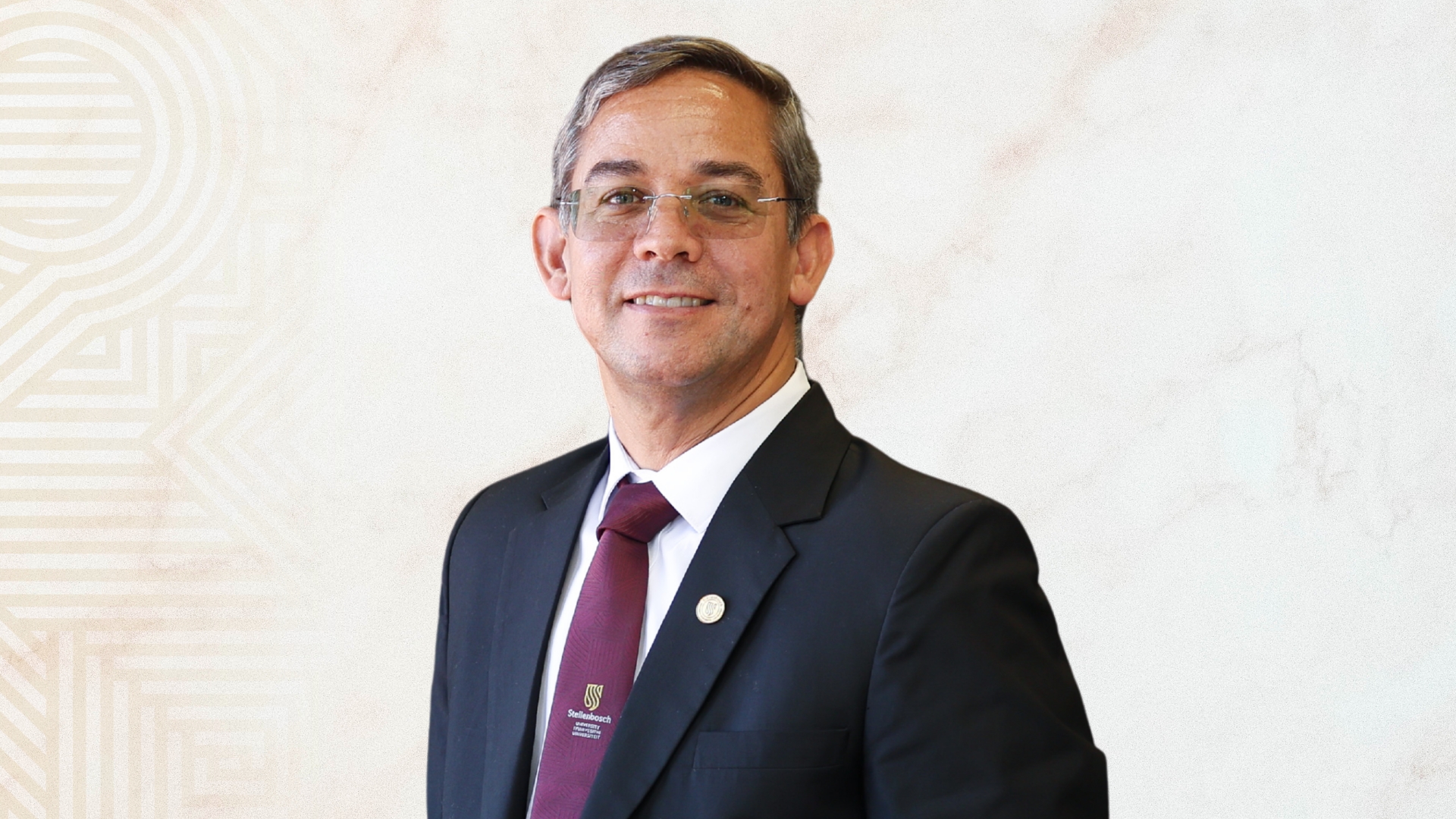
Join us for Prof Reza C. Daniels' professorial inaugural lecture – Data + theory = policy? The applied economist’s epistemological challenge, hosted by the Faculty of Economic and Management Sciences.
Professor Reza C. Daniels
Dean
Faculty of Economic and Management Sciences
Title: Data + theory = policy? The applied economist’s epistemological challenge
Event details
Date: Tuesday 28 July 2026
Time: 17:30 SAST
Venue: Room 1046, Van der Sterr Building, Victoria Street, Stellenbosch
Format: Hybrid event
RSVP here for in-person attendance.
RSVP here for online attendance.
Data + theory = policy? The applied economist’s epistemological challenge
Economists are often asked to help societies grow or to prevent economic decline. Yet economists’ ability to offer sound advice depends on whether the information that they use accurately reflects the conditions faced by people, firms, communities, public institutions and the natural environment. This inaugural lecture uses Reza Daniels’s academic portfolio to explain why data and theory do not always lead to sensible policy conclusions. Put differently, the epistemological challenge is essentially this: How do economists know what they think they know? When data poorly reflect the problems of interest, theory may no longer be as useful, and inferences based on the data can often lead to poor policy design. This can exacerbate, rather than reduce, the three systemic failures that economists are often asked to find policy solutions for: market failure, government failure and network failure. Market failure occurs when private exchange misallocates resources. Government failure occurs when public intervention is poorly targeted, weakly implemented, or unable to learn. Network failure occurs when the people and institutions that need to coordinate, exchange knowledge and build trust are not connected well enough. The lecture presents a theory of change based on Daniels’s work: Start with an economic problem, whether measurement-related, growth-related or linked to stagnation; identify the real condition behind the visible symptom, to the extent possible; understand how that condition is reflected in data; test the mechanism suggested by theory; design policy so that implementation can be observed; and learn from what happens. This approach is then demonstrated by means of Daniels’s work on earnings, wealth, firm innovation, informality, labour market shocks, environmental behaviour and just transitions. The main takeaway? Economists must be intentional about understanding how observed data may not reflect the economic conditions that they are meant to measure, and must then take appropriate action to address the problems encountered and develop suitable policy solutions.
Biography
Reza C. Daniels is a professor of Economics as well as Dean of the Faculty of Economic and Management Sciences at Stellenbosch University. He also serves as an honorary professor in the School of Economics at the University of Cape Town. Reza studied at the universities of Auckland, Michigan and Cape Town, obtaining his PhD in Economics at the latter. He has since published widely in peer-reviewed journals and regularly serves as editor for both local and international journals.
As a member of the Economic Society of South Africa, the American Economic Association, the Econometric Society and the International Statistical Institute, his expertise is valued both within and beyond academia. In 2024, the Academy of Science of South Africa appointed Reza to its Standing Committee on Science for Reduction of Poverty and Inequality. Earlier this year, he was also appointed to the Bioeconomy Audit Committee of South Africa’s National Advisory Council on Innovation (NACI), who advises government on the role of science, mathematics, innovation and technology in achieving our country’s objectives.
Additionally, Reza has served as a consultant to the public and private sectors as well as to international development banks. He is a member of the Institute of Directors South Africa and has held executive and non-executive board positions in the manufacturing, consulting, research and development, university, non-profit and philanthropy sectors. Committed to help drive positive change in society, he is also a fellow of the African Leadership Initiative and the Aspen Global Leadership Network.