

Noku Katom is a community developer, faith-driven entrepreneur, and scholar–practitioner.
Theology graduate is proof that education has no expiry date
- Teenage pregnancy and early parenting did not deter Noku Katom from her dream of higher education.
- She has graduated from SU cum laude with a master's degree in practical theology.
- She plans to partner with churches across South Africa to build faith-based entrepreneurship ecosystems, particularly aimed at empowering women.
When teenage pregnancy and early parenting felt like a double-edged sword, Noku Katom made a life-changing decision: She would “go and fetch herself”.
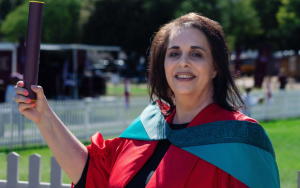
This week, she graduated cum laude with a master’s degree in practical theology (community development) from Stellenbosch University’s (SU) Faculty of Theology. “Though life’s challenges delayed my path to higher education, I knew that that chapter was part of my story, not its end,” she reflects.
Today, Katom is a community developer, faith-driven entrepreneur, and scholar–practitioner exploring how theology can inspire economic justice and transformation in South Africa’s deeply unequal society.
A journey rooted in resilience
Originally from the Qumanco village in Cofimvaba in the Eastern Cape, Katom is the third of eight children. She was raised in a community where resilience and faith were part of daily life, she says.
Although she had been living in Kayamandi since the early 2000s, SU once felt out of reach. “There were very few students who looked like me or spoke like me. Language was also a major barrier,” she comments. “I never imagined myself studying at SU.”
But over time, as she witnessed the University’s transformation, something shifted. “What once felt distant and inaccessible eventually became part of my own journey.”
Today, she shares that story widely, especially with young people who doubt whether they belong at SU. She explains how she witnessed the University’s transformation during her time living in the area. “That transformation made it possible for me to imagine myself studying here.”
One thing that stood out for her was that the University is located within walking distance of marginalised communities. “This proximity created a sense that higher education could be within reach,” she comments.
Starting later, but with purpose
Katom began her studies in her late thirties, navigating the complexities of being an older student among younger peers.
“I had to confront the inner shame of being an older full-time student among much younger students,” she admits. “But one thing people often don’t realise is that older students often perform very well academically – not in comparison with younger students, but because we study with life experience, discipline, and intention.”
This is something she shares when encouraging mature aspirant students who feel they may have missed their chance. “Education does not have an expiry date.”
Challenges – and moments of grace
Like many students, Katom faced financial difficulties throughout her studies. Yet she speaks with deep gratitude about the support she received along the way.
One moment stands out.
“In December 2022, I had an outstanding debt with the University, and it was unexpectedly paid in full by someone. I still don’t know who it was,” she says. “For me, that was a powerful reminder of God’s provision.”
She also values SU’s policy that allows students with outstanding debt to attend their graduation.
“Graduation is such a significant moment, especially for students from marginalised backgrounds. I will always be grateful that SU allowed me to experience this milestone.”
Despite financial constraints, her academic journey opened doors she never imagined. These included international travel to India, Finland and Poland. A 2024 exchange programme in Finland proved particularly transformative.
“It turned me into an author,” Katom says. “I wrote a book reflecting on my journey. It reminded me that entrepreneurs see opportunities behind challenges.”
Support central to success
Katom credits her support network as central to her success.
She speaks with deep appreciation of Dr Dawid Mouton from the Faculty of Theology, who provided pastoral care during the Covid-19 pandemic; even allowing her to cry when things got tough. “His support was not only academic; it was deeply human.”
Her supervisor, Prof Nadine Bowers du Toit, also played a pivotal role.
“I could write a whole book about her guidance; perhaps it would be titled “Thesis, Tears and Triumph: A Student’s Guide to Choosing the Right Supervisor”. Her support went far beyond academic supervision; she genuinely cared about my wellbeing as a person.”
That care was especially meaningful after the loss of Katom’s father in 2025. “She held space for me during a very painful time. That meant more than I can fully express.”
Finding purpose in theology
Although her decision to study theology was rooted in faith, Katom initially had a limited understanding of the field.
“I thought theology was mainly about becoming a pastor,” she says. “But I knew my calling was in working with people and communities.”
At SU, she discovered the wide scope of the discipline and found her place in practical theology, specialising in community development.
“What amazed me was discovering that the work I had been doing for years actually exists as a full academic discipline. In many ways, my studies helped me put academic language and theoretical grounding to work I had already been passionate about for a long time.”
Turning research into impact
Katom hopes to pursue a PhD in the future, when finances allow.
In the meantime, she is focused on putting her master’s research into practice. Her study, “Christian Entrepreneurship and Marketplace Ministry: Bridging the Sacred–Secular Divide for Women’s Economic Participation in the South African Context”, reflects her vision for change.
She plans to partner with churches across South Africa to build faith-based entrepreneurship ecosystems, particularly aimed at empowering women.
“The goal is to help churches become spaces where faith, economic justice and empowerment meet,” she explains.
Through mentorship, skills development and community support, she hopes to expand women’s participation in the economy – and demonstrate how theology can actively contribute to social transformation.
A story still unfolding
As Katom celebrates her third graduation, she remains grounded in what continues to motivate her.
“I am in competition with no one but my yesterday,” she says. Her journey from a young mother in a rural Eastern Cape community to a cum laude graduate and emerging thought leader is a powerful reminder that it is never too late to begin again.
“Education changed my life,” she reflects. “Now my calling is to ensure that faith becomes a force for economic justice and human dignity in our communities.”
Related stories

Media release
SU attracts government leaders committed to strengthening public service
Stellenbosch University (SU) has once again demonstrated its growing role as a partner in strengthening public leadership in South Africa, as several high...
Awards and milestones
A doctorate driven by purpose and perseverance
“Coming from a rural background should never limit one’s aspirations. What matters most is not where you come from, but where you want to go and what you are...
Awards and milestones
Retha Smit’s lifetime of determination leads to PhD at 67
At 67, Dr Retha Smit is living proof that you’re never too old to learn. A lifelong learner, Smit received her PhD in psychiatry from Stellenbosch University...