
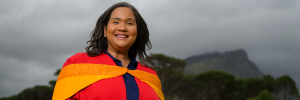
Dr Florence de Vries’ PhD shaped by loss, purpose and care
- Communications leader completed a PhD that interrogated how journalism shapes mental health narratives in South Africa.
- De Vries turned personal loss and lived experience into a study grounded in care, empathy and responsibility.
- Her research calls for newsroom cultures that treat mental health reporting as an act of public service, not spectacle.
Dr Florence de Vries has spent her career thinking carefully about the power of storytelling – who wields it, who benefits from it and who can be harmed by the way a story is told. As head of Marketing and Communications in Stellenbosch University’s (SU) Faculty of Medicine and Health Sciences, the former journalist works daily at the intersection of public health, science and narrative.
Graduating this week with a PhD in Journalism focused on how South African media frame mental illnesses through an ethics-of-care lens is a natural extension of both her professional instincts and her personal history.
De Vries turned to this topic long before she imagined herself writing a dissertation. “I’ve always been fascinated by mental illnesses, particularly how these are portrayed in the media and the impact those portrayals have on public understanding,” she explains. Conversations with her supervisor, Emeritus Professor Lizette Rabe, illuminated a theoretical path that clarified everything she had been circling for years. The ethics of care offered a framework rooted in empathy and relational responsibility; a way of asking whether journalism can respond more humanely to people’s lived realities.
The work challenged her in ways she did not anticipate. It would anchor her during a period of profound grief, when she lost both her parents within a short time. “They were the quiet architects of who I became,” she says. “Losing both of them was devastating, and I struggled to function and complete this research while processing my grief.” Her PhD is dedicated to their memory.
Reframing mental illness in the public eye
De Vries’ research centred on News24’s coverage of tennis player Naomi Osaka and gymnast Simone Biles, athletes who disrupted global expectations in 2021 when they chose mental health over competition. Osaka withdrew from the French Open, citing depression and anxiety. Biles stepped back from several Olympic events to protect her wellbeing. De Vries recognised their decisions as pivotal cultural moments. “Their cases provided a strong motivation to study how the media frames mental health, as the athletes acted as catalysts for broader conversations about mental wellbeing, pressure and expectations placed on elite athletes,” she notes.
What interested her was not celebrity, but the public reaction: outrage, empathy, disbelief, admiration. Media narratives, she argues, shape the moral climate in which those reactions form. And many narratives, even well-intentioned ones, still fall short of the sensitivity mental health reporting requires.
One of her most troubling findings was how seldom journalists engage with the ethical guidelines already available to them. “They’re aware of guidelines and codes, they are simply not encouraged to, or have the need or time, to familiarise themselves with it.” Visual shorthand also concerned her. The routine use of “headclutcher” images – a stock figure with their head in their hands – struck her as reductive and stigmatising.
Yet she found hope. South African health journalists, she argues, demonstrate a real attentiveness to the needs of others. “They appear more attuned to the needs of others when it comes to reporting on mental illnesses,” she says. That sensitivity is the essence of ethics of care: an approach that foregrounds relationships, empathy and real human needs over abstraction or sensationalism.
Grief, resilience and a philosophy of possibility
De Vries’ intellectual clarity did not shield her from the weight of personal loss. Her parents’ deaths brought her research into painful focus. Studying stigma while navigating grief-induced depression required a new vocabulary, one she was only beginning to form. “My research and advocacy gave me the beginnings of a language to manage and talk about loss,” she says. She is unapologetic about naming her own depression. Stigma, she notes, remains “a very real, very opaque barrier to living well”.
The story of her mother – a woman who raised her daughters to value knowledge over convention – is woven throughout De Vries’ identity as a communicator and scholar. “She refused to give in to traditional ways of raising girls,” De Vries says. Her mother deliberately did not teach her daughters to cook, having herself been burdened with that responsibility from childhood. Instead, she subscribed them to reading clubs and pen-pal networks, widening their worlds deliberately. “She chose what not to pass on, what to disrupt and what futures to make possible.” It is a philosophy that continues to guide De Vries’ leadership: protecting potential, she says, and seeing people for where they can go.
Her best mental health advice echoes that ethic of care. “You can’t take care of anyone if you don’t take care of yourself,” she says – a truth she once dismissed and now recognises as foundational.
Shaping conversations that matter
As head of communications in a complex academic and clinical environment, De Vries has worked steadily to show that strategic storytelling is not peripheral to the work of a health sciences faculty. She sees communication as an enabler of academic excellence, clinical impact and social-good initiatives. “I am a strong proponent of showcasing our breakthroughs, exceptional researchers and contributions to public health, also as a strategic tool for attracting the best students and staff.”
Her public scholarship extends beyond campus. She writes frequently for the Daily Maverick on mental health and serves on the board of the Ithemba Foundation, an organisation raising awareness about mental illnesses. The PhD sharpened her conviction that language matters profoundly. “Stigmatising language is so deeply entrenched that my own health care providers are not exempt from it,” she says. She is now revisiting her dissertation with the aim of developing publishable papers to spark conversations in newsrooms, universities and public audiences.
De Vries will celebrate her graduation quietly with friends, family, her husband and her daughter. The moment will be shaped by absence as much as achievement. Yet it marks the culmination of a study grounded in care, loss, resilience and the belief that journalism can be a force for dignity rather than distortion.
Related stories

Media release
Sport sustained hope for prisoners on Robben Island, PhD study shows
Robben Island is mostly associated with the suffering, brutality and isolation endured by political prisoners who fought against Apartheid. What is often...

Media release
Learning leadership from horses at SU
Leadership lessons at Stellenbosch University (SU) sometimes happen beyond lecture halls and meeting rooms.
Instead, they unfold in the university’s paddocks...
Education
New cohort of Future Professors receive a warm welcome at introductory conference
At a time when universities worldwide are grappling with rapid technological change, evolving knowledge economies and shifting public expectations, a group of...