
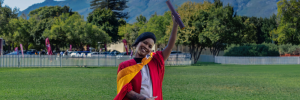
Dr Allison Matroos at the graduation.
Dr Allison Matroos is the pride of Atlantis
- Obtained doctorate in Afrikaans and Dutch.
- Had to overcome several challenges on her way to success.
- Wants to help give communities like Atlantis a voice.
The West Coast town of Atlantis is often associated with poverty, unemployment, gang violence and drug abuse. But it's also a place of achievers. Of people the town can be proud of. One such person is Dr Allison Matroos.
This native of Atlantis reached the pinnacle of academic success on Monday (23 March 2026) when she received her doctorate in Afrikaans and Dutch at Stellenbosch University's (SU) March graduation ceremony. What makes Matroos’ achievement even more remarkable is that she completed her doctoral studies in two years. She is currently a postdoctoral fellow and temporary lecturer at SU's Department of Afrikaans and Dutch.
As the first one in her family to go to university, it wasn't easy for Matroos. She had to overcome several challenges on her way to success. She grew up with her grandmother. Matroos says although her childhood was difficult, she was determined to rise above her penurious domestic circumstances and financial challenges.
“When you grow up in Atlantis you learn at an early age of survival, but also what the word 'perseverance' really means. My journey wasn’t easy. I walked a winding path of falling and getting up again in an environment where one's dreams are often overshadowed by violence and feel out of one's reach.”
Matroos says sometimes she was plagued by doubts on this winding road. Sometimes she thought about throwing in the towel.
“If I could have been paid R1 for all the times I thought about giving up, I would be a millionaire today. Knowing that my mother and grandmother were praying for me and that no one was going to come and save me, that I was responsible for my own future, kept me going.”
Matroos is very pleased with her PhD and says it is proof that hard work really does pay off. “It's not about being the smartest, but about putting in the time and showing up – even in the times you feel like running away.”
She dedicates her PhD to her partner, McKenzie. “She believed in me unwaveringly and her support made me complete it in two years, instead of three years.”
Matroos is also grateful for the support and inspiration of her late brother. “I want him to be proud of me from heaven.”
For her PhD, Matroos investigated the role of literature, specifically short stories and poems, in promoting the four macro skills (reading, speaking, listening and writing) of second language students. She designed lessons where students not only learn rules, but actively “play” with the language through stories and poems to build their skills and confidence.
“My fascination with Afrikaans language and literature lies in the affective power of language, in other words how a low affective filter, as the American linguist Stephen Krashen puts it, is essential for the successful learning of a language. Literature provides that ‘safe space’. It fascinates me how a single poem or short story can lower a student's anxiety and unlock a passion for a language that may have previously been experienced as 'difficult' or ‘strange’.”
Matroos isn't just a promising emerging researcher – she is also a short-story writer of stature. She started writing in Grade 9 and at the age of 21 published her first collection of poems and short stories, entitled Kaleidoskoop.
“The driving force behind the first poem I wrote is my little brother's death. Writing helps me understand my feelings. I explore themes such as love, humanity/being, social issues, among others.”
Matroos says storytelling is a way for her to reflect the experiences of communities like Atlantis.
“My research emphasises that the choice of culturally appropriate texts dramatically increases students' engagement and motivation. By telling stories that reflect the reality of our communities, we acknowledge our own existence. It repositions our experiences as something valuable enough to study and write about. It's important to capture the experiences of people of colour in particular, so that their voices can be heard.”
She hopes her journey will send the message to young people growing up in communities like Atlantis that they shouldn't let their circumstances steal the pen from their hand.
“Take control of your life and write your own story. Ask for help if you need help. Being shy or embarrassed won’t get you anything.”
When Matroos isn't researching or teaching, she enjoys sketching and painting, watching the popular American medical drama Grey's Anatomy, and going on hikes.
Now that she has obtained her doctorate, Matroos says she wants to further develop her model for the use of short stories and poems, possibly for teacher training or curriculum development to address the gap in Afrikaans education nationally.
She will also continue to write academically and creatively to ensure that the voices from Atlantis and similar places never fall silent in the classroom again. Matroos is currently writing articles about her research.
Related stories
Awards and milestones
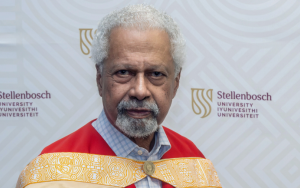
SU honorary doctorate for Nobel laureate Prof Abdulrazak Gurnah
Nobel laureate Prof Abdulrazak Gurnah received an honorary doctorate from Stellenbosch University (SU) on Monday (23 March 2026) at the institution’s March...
Awards and milestones
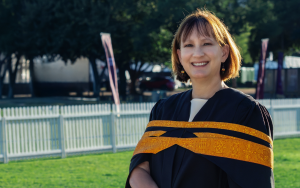
From typist to master’s graduate, Sunelle Hanekom’s journey comes full circle
For more than three decades, Sunelle Hanekom worked behind the scenes – organising, supporting and managing processes to ensure that others could succeed. Now...
Media release
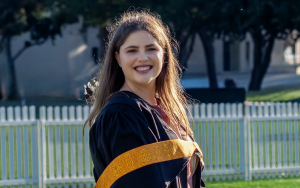
From pain a passion takes flight for SU history graduate
What began as a quiet hobby during moments of pain has taken flight into a powerful academic journey for Stellenbosch University (SU) graduate Annie de Villiers...